by admin | Jul 22, 2025 | Blog, Articles
Table of Contents
-
Introduction
-
Why Conveyor Systems Are Vital in Modern Manufacturing
-
Core Categories of Conveyor Systems
-
Automated Conveyor Systems: A Game Changer
-
Key Benefits of Advanced Conveyor Systems
-
Factors to Consider Before Choosing a Conveyor System
-
Industry-Specific Conveyor Use Cases
-
Conveyor Accessories That Boost Performance
-
Conveyor System Case Study: Lean Manufacturing Integration
-
Future Trends in Conveyor System Design
-
Conclusion
-
Frequently Asked Questions (FAQs)
1. Introduction
Manufacturing is evolving faster than ever in 2025. Companies are under constant pressure to improve productivity, reduce costs, and minimize downtime. One of the most powerful ways to achieve this is by integrating advanced conveyor systems into plant workflows.
In this guide, we’ll explore the top conveyor systems available in 2025, explain their industrial use cases, and show how they support streamlined operations across various sectors.

2. Why Conveyor Systems Are Vital in Modern Manufacturing
Conveyor systems are no longer just about moving items from point A to B—they’re the backbone of process automation in modern manufacturing.
Key Roles They Play:
-
Transporting raw materials and finished products
-
Automating repetitive tasks
-
Supporting just-in-time (JIT) production
-
Enhancing safety by minimizing manual handling
-
Providing real-time tracking via sensors and controls
Whether you’re in automotive, food processing, logistics, or heavy industry, optimized conveyor systems are now essential.
3. Core Categories of Conveyor Systems
Understanding the primary types of industrial conveyors is the first step toward selecting the right system for your plant:
🔹 Belt Conveyors
Keyword Target: Belt conveyors
Belt conveyors are the most common type due to their versatility. They use a continuous belt loop powered by pulleys to move products smoothly.
Best For:
Materials: PVC, PU, rubber, modular plastic
Ideal for moving items with a flat, rigid bottom (like boxes or totes).
Types:
-
Gravity roller
-
Powered roller
-
Accumulating roller
Applications: Warehousing, sorting, palletizing
Chain-driven systems are built for heavy-duty operations, moving parts or pallets that require high torque.
Used In: Automotive, steel, and bulk material handling industries
🔹 Pallet Handling Conveyors
Keyword Target: Pallet handling conveyors
Specialized systems designed for moving full pallets of goods. Often integrated with automated storage and retrieval systems (ASRS).
Features:
🔹 Overhead Conveyors
Used in clean production environments or for maximizing space.
Advantages:
Keyword Target: Automated conveyor systems
Automation is a top priority for operations managers in 2025. Automated conveyor systems include smart sensors, PLCs, and sometimes even robotic arms to optimize movement and monitor system health in real-time.
Features:
-
Automatic speed adjustment
-
AI-based routing
-
Integration with WMS & ERP
-
Preventive maintenance alerts
Benefits:
Implementing advanced conveyor systems provides:
| Benefit |
Description |
| ✅ Increased Productivity |
Faster product movement and reduced manual labor |
| ✅ Lower Operational Costs |
Reduced labor and fewer production stoppages |
| ✅ Enhanced Safety |
Less manual material handling |
| ✅ Data-Driven Control |
Integrated sensors track performance |
| ✅ Scalability |
Easily adapted for future growth |
With automation and modularity, today’s conveyor systems can scale with your business.
6. Factors to Consider Before Choosing a Conveyor System
Choosing the right system goes beyond price—here’s what procurement teams must evaluate:
-
Material type: Are you moving boxes, powder, or metal parts?
-
Load weight: Helps determine frame and motor specs.
-
Environment: Humid, food-grade, or explosive zones?
-
Layout complexity: Straight-line, incline, multi-level?
-
Speed requirements: Pieces per hour (PPH) targets.
-
Integration needs: ERP, barcode scanners, robotics?
Always consult a conveyor specialist to create a tailored solution.
7. Industry-Specific Conveyor Use Cases
Let’s look at how different industries leverage conveyor systems:
🏭 Manufacturing
🚚 Logistics & Warehousing
🍪 Food & Beverage
-
Hygienic belt conveyors
-
Clean-in-place systems
🚗 Automotive
Each use case demands specific features, such as temperature resistance, load capacity, and cleaning capabilities.
8. Conveyor Accessories That Boost Performance
Keyword Target: Conveyor accessories
Accessories transform a basic system into a high-performance one:
| Accessory |
Function |
| 📦 Diverters & Merges |
Route packages dynamically |
| 🔄 Turntables |
Redirect flow direction |
| 🧠 Sensors |
Enable smart automation |
| 🔧 Safety Rails |
Prevent products from falling |
| 🔌 Speed Controllers |
Adjust pace as needed |
Upgrading with accessories boosts flexibility, safety, and automation potential.
9. Conveyor System Case Study: Lean Manufacturing Integration
🏢 Company: Alnasr Chemicals – Giza, Egypt
Challenge: High downtime during material transfers
Solution: Integrated roller + belt conveyor system with automated PLC controls
Results:
This real-world example demonstrates the power of customized material handling solutions.
10. Future Trends in Conveyor System Design
As Industry 4.0 evolves, conveyor technology is advancing:
-
IoT Integration: Real-time data via smart sensors
-
AI-Driven Routing: Dynamic traffic optimization
-
Modular Design: Easy upgrades and retrofits
-
Eco-Friendly Belts: Recyclable materials and energy-efficient motors
-
Robotics Collaboration: Seamless robot-conveyor interaction
Smart factories are investing heavily in these technologies to remain competitive in 2025 and beyond.
11. Conclusion
If you’re aiming to improve production speed, reduce human error, and optimize operations, investing in the right conveyor system is a strategic decision.
From belt conveyors to automated conveyor systems, manufacturers have more choices than ever to meet unique workflow demands.
By understanding your material type, production needs, and long-term goals, you can build a conveyor system that scales with your business and delivers consistent ROI.
12. Frequently Asked Questions (FAQs)
Q1: What’s the most cost-effective type of conveyor system?
A: For basic material movement, gravity roller conveyors are the most budget-friendly. For versatility and automation, belt conveyors are a solid mid-range option.
Q2: Can I retrofit accessories into my old conveyor system?
A: Yes. Most conveyor accessories such as sensors and guides can be added later to enhance performance.
Q3: How long does a modern conveyor system last?
A: With proper maintenance, modern systems last 10–15 years, and automated models can provide real-time alerts for preventative servicing.
Q4: Are conveyor systems suitable for small factories?
A: Absolutely. Modular conveyor systems can be scaled to fit small spaces and grow as your operations expand.
check out our electrical components

by admin | Jul 21, 2025 | Blog
مقدمة: إزاي ENTRA بتقود سوق السيور الناقلة في مصر؟
السيور الناقلة مش مجرد معدات نقل… دي شريان حياة خطوط الإنتاج. واللي بيميز ENTRA مش بس إنها بتصنع السيور، لكن كمان بتقدملك حل متكامل يشمل كل حاجة من أول اختيار مكونات السيور (conveyor components Egypt)، لحد التشغيل بالموتور وأنظمة التحكم.
🛠️ 1. مكونات السيور الناقلة في مصر – نظرة من الداخل
✅ conveyor components Egypt – إزاي ENTRA بتختار كل جزء بعناية؟

rpt
كل سير ناقل بيبدأ باختيار دقيق للمكونات، وده لأن نجاح الخط بيعتمد عليهم:
| الجزء |
الماركات المستخدمة في ENTRA |
المميزات |
| المواتير (Motors) |
SEW, Bonfiglioli, WEG |
كفاءة طاقة، عمر طويل |
| الجيربوكس (Gearbox) |
Helical, Worm, Planetary |
حسب نوع الحمولة |
| الرولز والبكرات |
تصنيع محلي بمواصفات ألمانية |
استقامة ودقة حركة |
| الحساسات (Sensors) |
SICK, Omron, Panasonic |
سرعة استجابة، أمان عالي |
| الإنفرتر (VFD) |
Schneider, Delta, Siemens |
تحكم مرن وسهل |
| الهيكل المعدني |
Stainless 304 أو Steel معالج |
مقاوم للبيئات القاسية |
كل قطعة ليها وظيفة حيوية، وENTRA بتستخدم أعلى الخامات المعتمدة عشان تضمن موثوقية على المدى الطويل.
🧵 2. خامات السيور الناقلة – belt materials ENTRA

🧪 ليه الخامة مهمة؟
الخامة بتحدد:
📊 أنواع السيور المستخدمة في ENTRA:
| نوع السير |
مناسب لـ |
الخامة |
مميزات |
| PVC Belt |
منتجات خفيفة، غذائية |
PVC |
سهل التنظيف، اقتصادي |
| PU Belt |
تغليف الأدوية، غذاء |
Polyurethane |
مقاوم للزيوت والدهون |
| Modular Plastic Belt |
نقل صناديق، كرتون |
Polypropylene |
متين وسهل الفك |
| Rubber Belt |
مواد خام، أسمنت |
Rubber Blend |
مقاوم للقطع والثقل |

Robotic Parts Assembly for production lines
🔧 تخصيص حسب الطلب:

btr
🤖 ليه نختار سيور بالموتور؟
الأنظمة المؤتمتة بتقلل من:
-
تدخل الإنسان
-
زمن التشغيل
-
استهلاك الطاقة
✅ مكونات motorized conveyor systems من ENTRA:
-
محركات كهربائية موفرة للطاقة
-
Gearbox معد خصيصًا للحمل
-
لوحة تحكم PLC ببرمجة مرنة
-
أنظمة تحكم عن بعد أو SCADA
-
حساسات توقف تلقائي عند الخطر
🔌 أنواع السيور الموتورايزد:
| النوع |
المميزات |
التطبيقات |
| Roller Conveyor بالموتور |
حركة سلسة |
الصناديق والكراتين |
| Belt Conveyor Motorized |
نقل مستمر |
الأغذية، المستحضرات |
| Inclined Motorized Conveyor |
نقل مرتفع |
محاجر، مواد خام |
| Curved Motorized Conveyor |
زوايا ومنحنيات |
التعبئة والتغليف |
🔄 4. خطوة بخطوة: رحلة التصنيع داخل مصنع ENTRA

dav
🏭 المرحلة الأولى: تقطيع وتجهيز الشاسيه
🧰 المرحلة الثانية: التجميع الميكانيكي
🔌 المرحلة الثالثة: التوصيلات الكهربائية
🧪 المرحلة الرابعة: الاختبار والتجريب
🔗 5. التكامل مع الأنظمة الذكية – Automation Integration

💡 ENTRA بتقدم:
-
أنظمة HMI للتحكم عن طريق شاشة لمس
-
SCADA للمتابعة من الموبايل أو الكمبيوتر
-
ربط مع الطباعة، الوزن، التغليف والروبوتات
🚚 6. التركيب والتشغيل في موقع العميل
الخطوات:
-
التغليف الآمن والنقل للموقع
-
التركيب بمساعدة فريق ENTRA الفني
-
التشغيل التجريبي
-
تدريب العمالة
-
تسليم المستندات الفنية
🔧 7. الصيانة وقطع الغيار
-
عقود صيانة سنوية
-
صيانة وقائية لكل مكون
-
توفير قطع الغيار الأصلية
-
Hotline 24/7
📊 8. نتائج وأمثلة من الواقع – Case Studies
🧪 مصنع كيميائي بالسويس:
🥫 مصنع أغذية بالقاهرة:
ENTRA – صانع الفرق في سوق السيور في مصر
اللي بيميز ENTRA مش بس التصنيع، لكن الفهم العميق لمتطلبات السوق، واختيار أفضل conveyor components Egypt، وتقديم سيور بخامات ممتازة (belt materials ENTRA)، وكل ده بيتكامل في نظام واحد احترافي (motorized conveyor systems).

by admin | Jul 20, 2025 | Blog
يعني إيه نقل هوائي (Pneumatic Conveying)؟
النقل الهوائي أو Pneumatic Conveying هو نظام بيعتمد على ضخ الهوا أو الشفط علشان ينقل خامات بودر أو حبيبات من نقطة لنقطة جوه المصنع. وده بيتم من خلال مواسير مغلقة، باستخدام ضغط هوا أو فاكيوم، وبيوفر أمان ونظافة أعلى بكتير من الوسائل التقليدية.
✅ ليه تختار نظام نقل هوائي في المصنع بتاعك؟
-
نقل سريع وآمن للخامات
-
بيحافظ على جودة المواد بدون تلوث
-
مناسب للأماكن اللي محتاجة تعقيم ونظافة
-
موفر في التشغيل والصيانة
-
بيوفر مساحة لأن المواسير بتعدي في السقف
🔍 أنواع أنظمة النقل الهوائي
💨 1. نظام الدفع بالهوا (Positive Pressure Conveying)
🌀 2. نظام الشفط (Vacuum Conveying)
🛠️ مكونات نظام Pneumatic Conveying
| المكون |
الوظيفة |
| الهوبر (Hopper) |
تخزين المواد قبل النقل |
| البلور أو الكمبروسر |
توليد الهوا أو الشفط |
| المواسير |
نقل الماتريال |
| السيكلون |
فصل الهوا عن المواد |
| الكنترول يونت |
تحكم في ضغط وسرعة التشغيل |
🧪 أهم الاستخدامات:
نظام النقل الهوائي مناسب لـ:
⚖️ مقارنة بين السيور الميكانيكية والنقل الهوائي
| العنصر |
سيور تقليدية |
نقل هوائي |
| سرعة النقل |
متوسطة |
عالية |
| النظافة |
منخفضة |
عالية |
| الصيانة |
متكررة |
بسيطة |
| مرونة التوصيل |
ضعيفة |
ممتازة |
| التلوث |
عالي |
منعدم |
🌟 ENTRA Electromechanical – الريادة في مصر والشرق الأوسط
شركة ENTRA Electromechanical من أهم شركات تصميم وتصنيع أنظمة النقل الصناعي في مصر والشرق الأوسط، بخبرة أكتر من 15 سنة.
خدمات ENTRA:
-
تصميم نظام نقل هوائي حسب كل خامة ومصنع
-
تصنيع محلي بجودة عالمية
-
تركيب وتشغيل على أعلى مستوى
-
دعم فني وصيانة دورية
-
استشارات مجانية وخطط تطوير مخصصة
📈 دراسات حالة – Case Studies
مصنع كيماويات في الجيزة
ENTRA صممت ونفذت نظام نقل هوائي لمصنع كيماويات بيستخدم بودرة نشطة، وتم نقل الإنتاج بالكامل من سيور تقليدية لنظام مغلق، وده:
🧠 معلومات فنية
| الخاصية |
القيمة |
| أقصى ضغط تشغيل |
2 بار |
| المدى |
حتى 150 متر أفقي |
| الخامات المنقولة |
بودر – حبيبات – دقيق |
| المادة المصنوعة |
ستانلس ستيل أو بولي إيثيلين |
📞 ازاي تبدأ مع ENTRA؟
-
اتواصل معنا من خلال الموقع entra-eg.com
-
اطلب زيارة معاينة لمصنعك
-
استلم التصميم والعرض خلال 48 ساعة
-
ابدأ التنفيذ مع أفضل فريق هندسي
🔗 روابط مفيدة
🤔 أسئلة شائعة عن النقل الهوائي
هل النظام آمن للمواد الغذائية؟
أيوه، بيستخدم في مصانع السكر والقهوة والدقيق، ومطابق لمعايير الـ FDA.
ينفع أركب السيستم في مصنع قديم؟
أكيد، ENTRA بتعمل تعديل للخطوط الحالية وتدخل النظام بدون ما توقف الإنتاج.
✅ خلاصة الكلام
لو عندك مصنع وبتدور على طريقة نظيفة وفعالة وسريعة لنقل الخامات، يبقى نظام النقل الهوائي هو اختيارك الأمثل. وعلشان تضمن تصميم احترافي وتنفيذ سريع، اتواصل مع ENTRA Electromechanical – شركاء نجاحك في الصناعة.
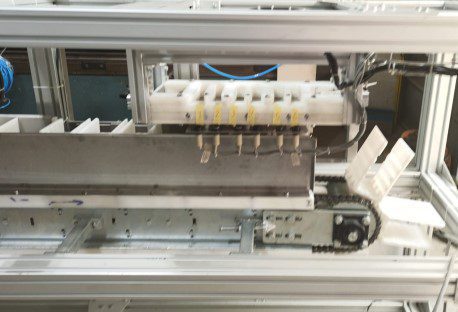
by admin | Jul 20, 2025 | Blog
Abstract
Automation has become a linchpin of industrial transformation across Egypt and the wider Middle East. This article delivers an in‑depth, journal‑style survey of automation solutions, with emphasis on conveyor systems, the types of conveyors used, the role of outsourcing in delivering these solutions, economic and technical insights, and a Q&A section to engage readers.
1. Introduction: Rise of Automation in Egypt & the Middle East
Over the past decade, Egypt, GCC countries, and other economies in the Middle East have accelerated the adoption of industrial automation to boost productivity, optimize costs, and comply with global standards. Leading firms such as ENTRA in Egypt are designing and delivering integrated conveyor‑based solutions tailored for industries ranging from logistics and food to pharmaceuticals and automotive
With outsourcing—from design to deployment—becoming increasingly common, regional manufacturers and integrators now offer end‑to‑end packages that include conveyors, control systems (PLC, SCADA, IoT monitoring), integration, and support. This outsourcing model allows industrial operators to benefit from advanced solutions without maintaining full in‑house engineering teams.
2. Conveyor Systems: Backbone of Material‑Handling Automation
2.1 What Are Conveyor Systems?
Conveyors are mechanical systems designed to transport materials or products from one point to another via belts, rollers, chains, screws, air ducts, or overhead tracks. In automated factories and warehouses, conveyors dramatically reduce human labor and load/unload times, enhancing throughput, safety, and accuracy
2.2 Common Types of Conveyor Systems
2.2.1 Belt Conveyors
The most prevalent type worldwide, consisting of a continuous loop belt powered by drive and tail pulleys. They are flexible, configurable for curves or inclines, and suited to light‑to‑medium loads. Belt material options include rubber, PVC, and modular plastic belts—often chosen for food‑grade or hygiene‑sensitive applications
2.2.2 Roller Conveyors
Consist of motorized or gravity rollers, ideal for boxes, cartons, or pallets. Roller conveyors excel in logistics, shipping zones, and buffering operations. Heavy‑duty roller lines can handle weights above 500 lbs
2.2.3 Chain Conveyors
Chain‑driven systems for heavy or awkward loads. They include apron, drag, flight, scraper, and en‑masse chain conveyors. Widely used in automotive lines, heavy goods, painting/coating processes, and bulk material movement
2.2.4 Screw Conveyors (Auger Conveyors)
A rotating helical screw moves bulk powdery or granular materials within a tube. Ideal for grains, flours, chemicals, and other bulk solids requiring enclosed, controlled handling
2.2.5 Pneumatic Conveyors
Use air pressure or vacuum pipelines to transport powdered or granular materials in a sealed duct system—ensuring hygiene and containment. Common in food, pharmaceutical, cement, and chemical sectors ويكيبيديا+15
2.2.6 Overhead Conveyors
Track-mounted systems where items hang from trolleys. Excellent for paint lines, garment handling, assembly operations—freeing floor space and enabling high throughput flow
2.2.7 Vibrating Conveyors
Use vibrating troughs or pans to transport dry bulk solids. They’re widely used where sanitation matters, or for extreme environments and incline conveying up to 45° ويكيبيديا.
2.2.8 Flexible & Modular Conveyors
Made of plastic or metal modules and multi‑flexing chains. Highly configurable—curves, inclines, and reconfigurable paths. Popular in food, beverage, pharma, and packaging lines ويكيبيديا.
2.2.9 Advanced / Smart Conveyors
New systems include cross‑belt sorters—with independent transverse belts that sort items at high speed using induction or linear motors—used in parcel/logistics hubs ويكيبيديا.
An experimental frontier: AI‑based Maglev conveyors, employing magnetic levitation and real‑time AI control to reduce friction, maintenance, and cycle time—while enabling ultra‑clean, high‑speed transport for precise parts assembly
2.3 Integration of Conveyors into Automation Solutions
Modern conveyor systems are no longer standalone mechanical devices—they are integrated into smart automation platforms:
-
Controlled via PLC and SCADA systems
-
Monitored by IoT sensors, RFID, barcode/RFID scanning
-
Integrated with robotic pick‑and‑place, sortation modules, and automated storage/retrieval systems (ASRS)
-
Scalable control and data visualization for maintenance, productivity tracking, and predictive diagnostics
Regional integrators like ENTRA (Egypt) offer conveyors along with IoT‑enabled control and support for full facility automation . manufactures modular conveyor lines for agriculture, food processing, packaging, and assembly industries—with outsourced design, installation, and post‑deployment service contracts
3. Automation Solutions & Outsourcing Models in Egypt / Middle East
3.1 Why Outsource Automation Projects?
Egypt-based operators and regional industrial groups often outsource conveyor automation projects because:
-
Access to expert engineering: local integrators bring mechanical, electrical, and software expertise.
-
Reduced CAPEX risk: modular solutions that can grow.
-
Faster deployment compared to building in-house systems.
-
Service & maintenance contracts ensure uptime, spare parts, and upgrades.
-
Localization: Egyptian integrators like ENTRA and provide support and know regional regulatory standards.
3.2 Key Outsourcing Providers / Partners
-
ENTRA Electromechanical Conveyors: offers end-to-end conveyor automation, control system integration, custom material handling tailored to logistics, manufacturing, mining, food, pharma sectors across Egypt and MENA region
-
Various other GCC‑based firms (UAE, Saudi)—such as ATCO Business Solutions and SMARTLOGITECX—also offer turnkey conveyor automation systems for regional clients, covering belt, modular, roller, sorting, and vertical conveyors
3.3 Example Implementation Flow (Outsourced Project)
-
Needs Assessment: site visit and requirement gathering (product types, throughput, hygiene, space constraints).
-
Design & Engineering: conveyor selection (belt/roller/chain/screw), layout design, integration points, control system design.
-
Sourcing & Manufacturing: local fabrication of steel frames, modular belts, chain conveyors; belts from partners like Habasit
-
Installation & Integration: mechanical assembly, wiring, PLC/SCADA setup, robot/sorter linking, HMI setup.
-
Testing & Commissioning: load tests, safety interlocks, throughput verification.
-
Training & Handover: operator training, documentation, maintenance schedules.
-
Support & Scaling: service contracts, upgrades, remote monitoring, spare parts.
4. In‑Depth Types of Conveyors Used in Middle East Automation
Let’s review each conveyor type, technical details, and typical applications in the region:
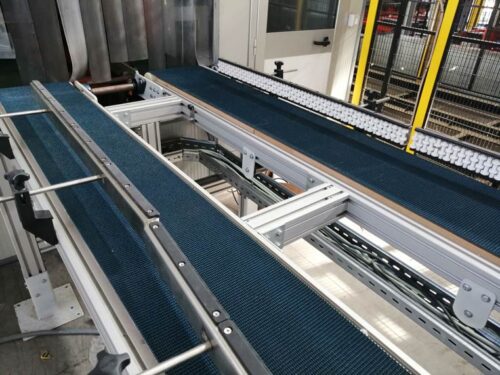
-
Materials: PVC, rubber, modular plastic belts for hygiene compliance, FDA certification available from local providers (e.g. UAE/Egypt)
-
Layouts: straight, incline, decline, curved, trough belts.
-
Applications: logistics, warehousing, packaging, mining, SME manufacturing.
-
Advantages: versatile, scalable, continuous flow, low noise, easy to clean.
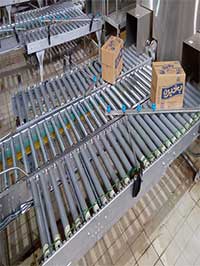
-
Types: gravity roller (sloped, no power) and powered motorized roller conveyors (including motorized drive roller—MDR with embedded BLDC motors) for zones handling up to ~35 kg loads
-
Special variants: curve roller conveyors, pop‑up diverters, zero-pressure accumulation zones, pallet roller conveyors for heavy‑duty pallets
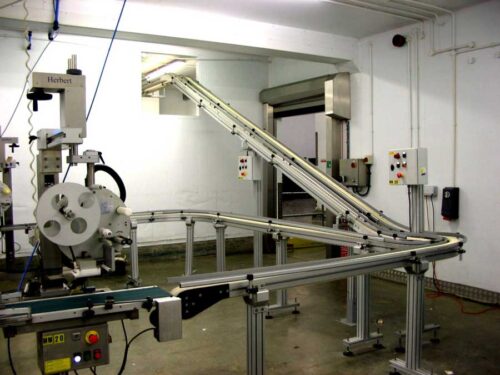
-
Types: apron conveyors, drag conveyors, flight conveyors, scraper conveyors, en‑masse conveyors. Designed for heavy/harsh environments: pallets, barrels, automotive parts, clinker, sawdust, etc ويكيبيديا.
-
Variants: table‑top chain, slat chain, heavy‑duty industrial chain.
-
Applications: automotive assembly, metal finishing, distribution centers, paint plants.
-
Functional Detail: screw rotates within a trough or tube, propelling bulk solids. Horizontal, inclined, vertical configurations available.
-
Applications: food processing (grains, sugar), chemical plants, cement, feed mills. Precise flow control and dust reduction are key benefits.
4.5 Pneumatic Conveyors
-
Design: enclosed line conveying using positive pressure or vacuum. Keeps materials hygienic and contained.
-
Applications: pharmaceutical powders, chemical powders, fine cement, food powder handling.
4.6 Overhead Conveyors
-
Design: hanging trolley track.
-
Applications: garment finishing lines, paint booths, automotive part transport. Ideal when floor space is restricted and items must stay off the ground.
4.7 Vibrating Conveyors
-
Design: vibratory trough or tube.
-
Applications: conveying hot or dry bulk solids, screening/sorting, environments with washdown needs (food, metal foundries)
4.8 Flexible / Modular Conveyors
-
Design: modular plastic links sliding on wear strips, flexible paths.
-
Applications: food, beverage, pharmaceutical, packaging. Good for layouts that need frequent reconfiguration
4.9 Cross‑belt Sorter Systems
-
Used in high-speed parcel sorters: independent short belts on carriers that discharge items sideways at sort points. Ideal for logistics, e‑commerce, airlines, and postal hubs. They often use linear motors or induction drives and integrate scanning systems (barcode, RFID) ويكيبيديا.
4.10 AI‑Maglev Conveyors (Research / Emerging)
-
Incorporate magnetic levitation and AI‑driven controls for frictionless, speedy, silent conveyors with minimal maintenance. Currently experimental but representing a future vision for Middle East smart factories
5. SEO Insights: Keywords and Phrases That Matter
To attract readers and search engines, here are key themes and target phrases to weave naturally:
-
automation solutions Egypt, conveyor systems Egypt, industrial automation Middle East
-
outsourced automation services Egypt, automation outsourcing Egypt, turnkey conveyor automation
-
types of conveyors Middle East, belt conveyor Egypt, modular conveyors Egypt, chain conveyors automotive Egypt
-
smart conveyors Middle East, IoT automation Egypt, cross belt sorter logistics Egypt, AI‑Maglev conveyor future.
6. Q&A Section
Q1: What types of conveyors are most suitable for food and pharmaceutical industries in Egypt?
A: Typically modular link conveyors with FDA‑approved plastic belts, belt conveyors with PVC or polyurethane belts for hygiene, and pneumatic conveyors when handling powders. Suppliers like ENTRA offer these specific conveyor types with cleanable surfaces and certifications
Q2: Can Egyptian manufacturers avoid in‑house automation by outsourcing?
A: Yes—companies commonly outsource automation design, fabrication, installation, and maintenance to integrators like ENTRA . This is efficient, cost-effective, and reduces technical burden while ensuring support and scalability.
Q3: What conveyor type fits heavy load applications like pallets or barrels?
A: Chain conveyors (flight, drag, apron types) and heavy‑duty roller conveyors handle loads well over 500 lbs. Motorized pallet rollers, chain conveyors with sprockets, and apron chain types are tailored for high weight and rugged conditions
Q4: Are sophisticated sorter conveyors (e.g. cross‑belt sorters) available in Egypt/Middle East?
A: Yes—logistics hubs, parcel shipping centers, and airports are implementing cross‑belt sorters, integrating scanning systems and linear induction motors via local systems providers or international suppliers in the region ويكيبيديا.
Q5: What is the future of conveyors in the region?
A: Emerging technologies such as AI‑Maglev conveyors, IoT‑connected smart systems, and modular, reconfigurable designs will shape modern smart factories. Ongoing R&D and pilot projects, like the Maglev system, are paving the way
7. Insights & Best Practices
✅ System Design & Layout Optimization
-
Analyze product dimensions, weight, throughput, incline, curve, hygiene, and environmental conditions.
-
Use modular conveyors for adaptability.
✅ Integration with Control Systems
-
Employ PLC, SCADA, and IoT sensors for central control and visibility.
-
RFID/barcode scanning allows real-time tracking and traceability.
-
Consider predictive maintenance modules to reduce downtime.
✅ Outsourcing as a Strategic Advantage
✅ Maintenance & Training
✅ Cost & ROI
-
Initial CAPEX vs long-term OPEX savings.
-
Conveyor systems lower labor cost, improve throughput, reduce error and downtime—delivering rapid ROI when integrated effectively.
8. Journal‑Style Case Study: Conveyor Automation in a Food Packaging Plant (Hypothetical Example)
Background: A multinational food company in Egypt operates a processing line requiring rapid, hygienic handling of packaged snacks.
Solution by Outsourced Integrator (e.g. ENTRA):
-
Installed modular belt conveyors with FDA‑approved belts for hygiene and washdown.
-
Upstream bulk grain moved by screw conveyors, pneumatically transferred powders.
-
Sorting conveyor network uses pop‑up diverter/curve roller conveyors into packing and palletizing stations.
-
Control system integrated with PLC/SCADA, barcode scanning for traceability, IoT sensors monitoring belt health.
-
Maintenance contract and spare‑parts stock maintained by integrator.
Outcome:
-
Throughput increased by 50%
-
Labor hours reduced by 30%
-
Product rejects cut by 20%
-
Downtime minimized to under 2 % unplanned per month
9. Call‑to‑Action for Readers
If you’re planning an automation project in Egypt or the Middle East—from warehousing to manufacturing or logistics—here’s your action path:
-
Define your application requirements: industry, product types, weight, hygiene.
-
Evaluate conveyor types (belt, roller, chain, screw, pneumatic).
-
Seek local integrators with proven track records (ENTRA, regional partners).
-
Request turnkey proposals including design, integration, training, and long‑term support.
-
Ensure solutions are scalable, smart (IoT/PLC), and future‑proof for Industry 4.0.
10. Conclusion
Automation in Egypt and the Middle East is growing fast, driven by demand for efficient, cost‑effective material handling. Conveyor systems—belt, roller, chain, screw, pneumatic, vibratory, overhead, modular, and advanced sorters—form the backbone of these solutions. Outsourcing design and deployment provides flexibility, expertise, and lower risk for industrial clients.
By understanding conveyor types, design strategies, and the leading integrators in the region, readers gain the confidence to explore and implement robust automation solutions that scale with business needs.

by admin | Jul 19, 2025 | Blog
Introduction
Material handling is a critical component of supply chain, logistics, and manufacturing operations. It encompasses the movement, storage, control, and protection of materials throughout production and distribution.
Traditionally, manual material handling (lifting, pushing, carrying) has been the norm, but advancements in material handling technology—such as automated guided vehicles (AGVs), robotic palletizers, and automated storage and retrieval systems (AS/RS)—are transforming efficiency.
This guide compares manual vs. modern material handling methods, examining productivity, safety, cost-efficiency, and scalability.
Part 1: Manual Material Handling
Common Manual Methods
-
Lifting & Carrying – Workers move goods by hand or with basic tools (e.g., carts, pallet jacks).
-
Pushing & Pulling – Manual transport of heavy loads on wheeled platforms.
-
Sorting & Packing – Hand-picking items for orders.
Advantages of Manual Handling
✔ Low upfront costs – No major investment in machinery.
✔ Flexibility – Easily adapts to changing workflows.
✔ Simple training – Minimal technical skills required.
Disadvantages of Manual Handling
❌ High injury risk – Repetitive strain, back injuries (OSHA reports 30% of warehouse injuries stem from manual handling).
❌ Bottlenecks – Slower throughput compared to automation.
❌ Labor dependency – Higher long-term staffing costs.
Impact on Productivity & Safety
-
Slower order fulfillment – Human workers average 60–100 picks per hour, vs. 200–500+ with automation.
-
Higher error rates – Manual picking errors can exceed 5%, increasing returns and waste.
Part 2: Modern Material Handling Technologies
1. Automated Guided Vehicles (AGVs) & Autonomous Mobile Robots (AMRs)
-
How they work: Self-navigating vehicles transport goods using sensors or pre-mapped routes.
-
Use case: Heavy load transport in large warehouses (e.g., Amazon’s Kiva robots).
-
Benefits:
2. Robotic Palletizers & Pick-and-Place Systems
-
How they work: Robots stack, sort, and move products with precision.
-
Use case: High-speed packaging in food & beverage industries.
-
Benefits:
3. Automated Storage & Retrieval Systems (AS/RS)
4. IoT Sensors & Data Analytics
-
How they work: Real-time tracking of inventory, equipment health, and workflow optimization.
-
Use case: Predictive maintenance to reduce downtime.
-
Benefits:
Limitations of Automation
Part 3: Manual vs. Modern—Side-by-Side Comparison
| Factor |
Manual Handling |
Automated Handling |
| Speed |
Slow (60–100 picks/hr) |
Fast (200–800+ picks/hr) |
| Accuracy |
~95% |
~99.9% |
| Safety |
High injury risk |
Minimal worker strain |
| Upfront Cost |
Low ($0–$10K) |
High ($50K–$2M+) |
| ROI Timeline |
Immediate |
1–3 years |
| Scalability |
Limited by labor |
Easily expandable |
Real-World Example
-
Small Business: Manual handling may suffice for low-volume operations.
-
Large Warehouse: Automation (e.g., AGVs + AS/RS) can cut labor costs by 40% (MHI Report).
Part 4: Productivity Gains & ROI
Quantifying Automation Benefits
-
Throughput: 2–5x faster order processing.
-
Labor Reduction: 1 robot = 2–4 workers (Deloitte analysis).
-
Error Reduction: 90% fewer mispicks with robotics.
ROI Calculation
| Cost Factor |
Manual |
Automated |
| Labor (Annual) |
$120,000 (4 FTEs) |
$30,000 (1 overseer) |
| Error Costs |
$15,000 |
$1,500 |
| Payback Period |
N/A |
1.5–3 years |
(Source: MHI’s Annual Industry Report)
Part 5: Implementation Roadmap
-
Needs Assessment
-
Pilot Phase
-
Training & Change Management
-
Scaling & Integration
Part 6: Emerging Trends
-
AI-Driven Optimization: Machine learning for route planning.
-
Collaborative Robots (Cobots): Safe human-robot interaction.
-
5G & Edge Computing: Real-time data for smarter warehouses.
-
Green Material Handling: Energy-efficient automation.
Conclusion
While manual material handling is cost-effective for small operations, automated material handling systems deliver unmatched productivity, safety, and ROI at scale. A hybrid approach (partial automation) may be ideal for mid-sized businesses.
Next Steps:
-
Conduct a warehouse efficiency audit.
-
Start with a pilot automation project.
-
Leverage industry benchmarks (MHI, ISO) for best practices.
FAQ Section
1. What’s the difference between manual and automated material handling?
Manual relies on human labor, while automation uses robotics, AGVs, and software.
2. How much can an AGV improve warehouse productivity?
AGVs can boost throughput by 30–50% while reducing labor costs.
3. What’s the ROI of palletizing robots?
Typically 1–3 years, with 40–60% labor savings (Fanuc case studies).
4. Is automation feasible for small businesses?
Yes, via modular solutions like collaborative robots (cobots).
5. How does automation improve safety?
Reduces heavy lifting, repetitive strain injuries (OSHA compliance).
TL;DR – Key Takeaways
-
Automation = 2–5x faster than manual handling.
-
ROI in 1–3 years via labor/error reduction.
-
Start small with pilot programs before scaling.
Explore Further:
By integrating modern material handling technology, businesses can achieve higher efficiency, lower costs, and a competitive edge. 🚀
by admin | Jul 17, 2025 | Blog

In today’s fast-paced digital landscape, downtime is more than just an inconvenience—it’s a costly disruption. As businesses increasingly rely on technology, even a few minutes of system failure can result in significant financial losses, reputational damage, and operational setbacks.
By 2025, experts predict that automation will play a pivotal role in reducing downtime and enhancing efficiency. This article explores the true cost of downtime, the benefits of automation, and how leading companies are leveraging these technologies to stay ahead.
The True Cost of Downtime in 2025
Downtime is expensive, and its impact goes beyond immediate revenue loss. Here’s a breakdown of the key costs associated with system failures:
1. Lost Revenue
Every minute of downtime translates to lost sales. For eCommerce businesses, a single hour of downtime can cost thousands—or even millions—depending on traffic volume.
2. Decreased Productivity
When systems fail, employees can’t work efficiently. Manual processes slow operations, leading to delays and missed deadlines.
3. Reputation Damage
Customers expect seamless experiences. Frequent outages erode trust and push users toward competitors.
4. Compliance & Legal Risks
Industries like healthcare and finance face strict regulatory requirements. Downtime can lead to compliance violations and legal penalties.
Why Automation is the Solution
Automation minimizes human error, speeds up processes, and ensures continuous operations. Here’s how it helps:
1. Predictive Maintenance
AI-driven automation detects potential system failures before they occur, allowing preemptive fixes.
2. Automated Failover & Recovery
Cloud automation ensures seamless transitions to backup systems during outages.
3. Self-Healing Systems
AI-powered systems automatically diagnose and resolve issues without human intervention.
4. Streamlined IT Operations
Automation reduces manual IT tasks, allowing teams to focus on strategic initiatives.
Case Studies: Companies Reducing Downtime with Automation
1. Netflix – Chaos Engineering
Netflix uses Chaos Monkey, an automated tool that intentionally disrupts systems to test resilience (source).
2. Tesla – AI-Driven Manufacturing
Tesla’s factories rely on automation to detect and resolve production line issues in real-time (source).
3. JPMorgan Chase – AI for Fraud Detection
Automated AI systems monitor transactions 24/7, reducing fraud-related downtime (source).
How to Implement Automation in Your Business
1. Assess Vulnerabilities
Identify critical systems prone to downtime using tools like SolarWinds.
2. Choose the Right Automation Tools
3. Train Your Team
Ensure employees understand automation workflows via platforms like Udemy.
4. Monitor & Optimize
Use analytics tools like Datadog to refine automation strategies.
Conclusion
The cost of downtime in 2025 will be higher than ever, making automation a necessity—not an option. Businesses that invest in AI-driven automation will gain a competitive edge by minimizing disruptions, enhancing efficiency, and improving customer satisfaction.
Ready to reduce downtime? Explore automation solutions from entra