
Cartons and cases
Transport packaged goods between production, inspection, packing and dispatch operations.
Unit-load transport
Continuous belt transport for cartons, cases, packaged products and suitable unit loads across production, packing and distribution lines.
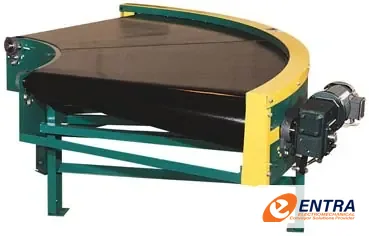
Overview
A belt conveyor carries products on a continuous moving belt supported by a frame and driven through a pulley arrangement. Belt material, width, speed, support, tracking and transfer geometry are selected for the product and operating environment. This page describes the equipment family; it is not a fixed standard design.
Transport packaged goods between production, inspection, packing and dispatch operations.
Connect machines and workstations with a continuous conveying surface.
Move suitable products between levels when belt surface, cleats and product stability are appropriate.
Provide a stable conveying surface for manual or automated inspection and packing tasks.
Operating principle
A belt conveyor carries products on a continuous moving belt supported by a frame and driven through a pulley arrangement. Belt material, width, speed, support, tracking and transfer geometry are selected for the product and operating environment. This page describes the equipment family; it is not a fixed standard design.
A simplified illustration of the motion — not to scale and not a performance simulation.
Available configurations
Straight conveying path for unit loads and packaged products.
Elevation change selected around product stability, belt surface and transfer geometry.
Cleats or profiles assist product retention on suitable inclines and controlled spacing duties.
Layout-specific curves, nose transfers or cross transfers where the selected belt system supports them.
Technical design basis
These items identify the information used to engineer this equipment. Numerical limits appear only where the referenced catalogue supports them; other values are confirmed for each project.
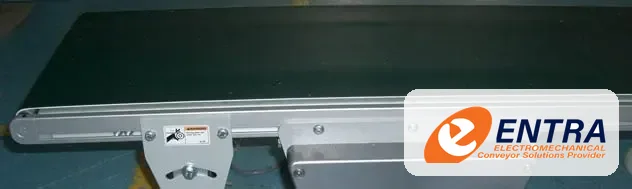
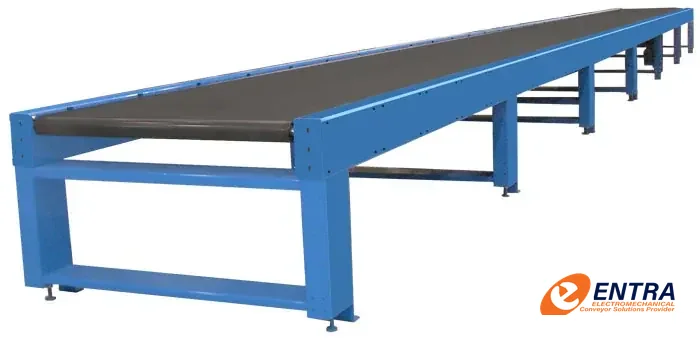
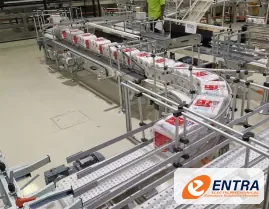
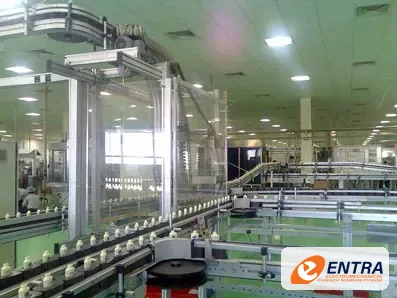
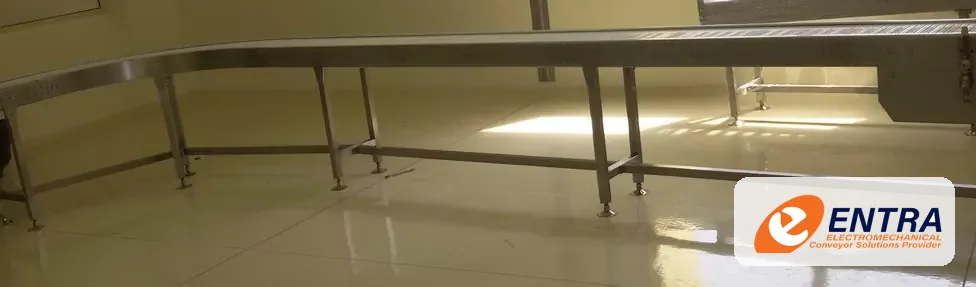
The gallery photos are ENTRA portfolio references from the belt-conveyor category. No universal belt speed, capacity, width or load rating is published here because these depend on the selected belt, drive, frame and application.
| Belt width | Selected from product footprint, edge clearance and loading pattern. |
|---|---|
| Belt speed | Set from target throughput, product pitch and connected-machine cycle time. |
| Belt material | Selected for product contact, abrasion, temperature, cleaning chemicals and applicable compliance requirements. |
| Drive duty | Motor, gearbox, pulley and starting method sized from load, incline, friction and duty cycle. |
| Frame & supports | Designed for span, loading, environment, floor fixing and access requirements. |
Engineering considerations
A useful proposal starts with operating conditions and interfaces. Final sizing is confirmed by engineering review.
Product dimensions, mass, base condition, centre of gravity, surface, packaging and allowable contact.
Required throughput, belt speed, conveying length, incline, accumulation needs and operating hours.
Belt material, surface texture, food-contact or chemical requirements, temperature, cleaning and wear conditions.
Frame material, pulley and roller arrangement, belt tensioning, tracking, supports, guarding and maintenance access.
Photographs
Captions identify the equipment shown; a photo is not a claim that every image is a completed installation of the exact configuration described.
 ENTRA
ENTRA
 ENTRA
Related equipment
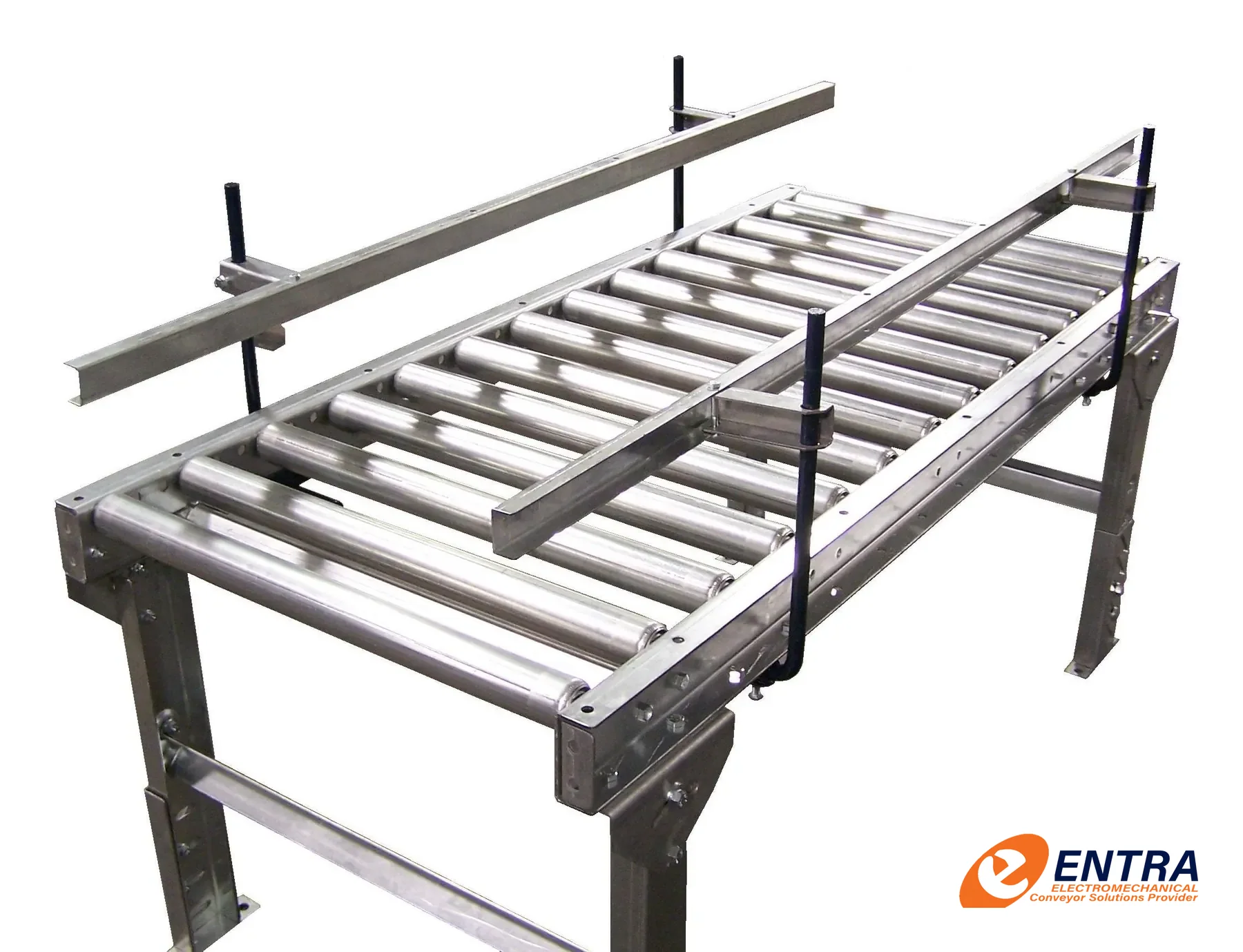
Gravity and powered roller conveyor arrangements for conveying, accumulation, transfer and distribution of co…
Modular plastic-chain conveyor platforms for compact product handling, straight runs, curves and engineered l…
Aluminium-profile conveyor frames and modular structures for production, assembly, inspection and material-tr…
Stainless conveyor structures and conveying arrangements designed around defined product-contact, cleaning an…
Request a quotation
Share the product, the layout and what the line has to do. An ENTRA engineer reviews every enquiry and replies with questions or a proposal.
