
Salt and chemicals
Move salt and other corrosive or dusty bulk materials between process stages.
Bulk material handling
Troughed belt conveyors for salt, granules and other bulk solids, with enclosed loading and discharge points to control spillage and dust.
Overview
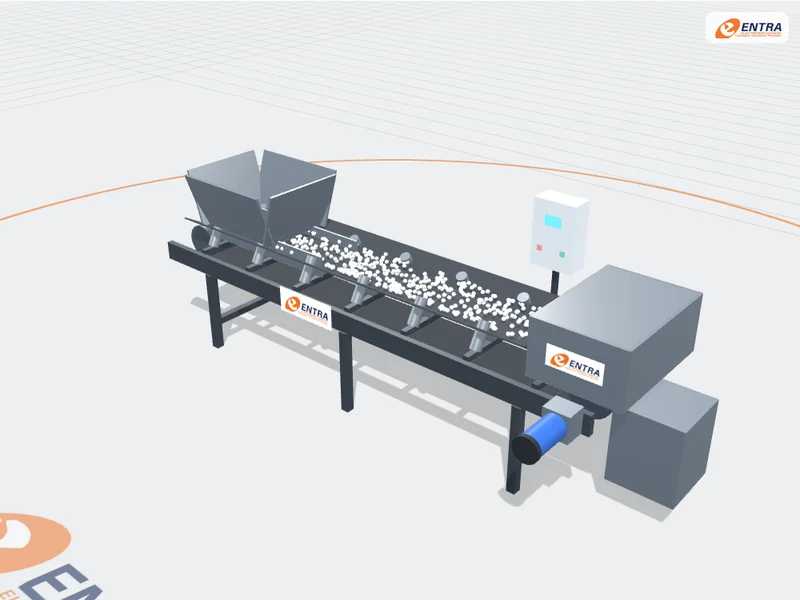
A bulk belt conveyor carries loose material on a belt that is shaped into a trough by three-roll idler sets, so the material stays centred on the belt. Material is loaded through a skirted chute and leaves through an enclosed discharge at the head end, where the drive pulls the loaded belt. ENTRA applied this approach at the Alnasr Chemicals salt factory, with a Mega Belt layout, enclosed transfer points and a variable-speed drive to control flow.
Move salt and other corrosive or dusty bulk materials between process stages.
Feed silos, hoppers and process machines at a controlled rate.
Reduce spillage and manual effort where bulk material is moved by hand or loader.
Operating principle
A bulk belt conveyor carries loose material on a belt that is shaped into a trough by three-roll idler sets, so the material stays centred on the belt. Material is loaded through a skirted chute and leaves through an enclosed discharge at the head end, where the drive pulls the loaded belt. ENTRA applied this approach at the Alnasr Chemicals salt factory, with a Mega Belt layout, enclosed transfer points and a variable-speed drive to control flow.
A 3D visualisation of the equipment — turn it and inspect its components in the gallery.
Available configurations
Three-roll idler sets form a trough for loose bulk material.
Skirted loading chutes and discharge hoods to contain material and dust.
Belt speed set to the required material flow.
Technical design basis
These items identify the information used to engineer this equipment. Numerical limits appear only where the referenced catalogue supports them; other values are confirmed for each project.
Shown as ENTRA's 3D model. The Alnasr Chemicals project is described in ENTRA's published case study. Capacities and dimensions are defined per project and are not implied here.
| Belt width & trough angle | Selected from the material and the required capacity. |
|---|---|
| Idler spacing | Set for the load on the carrying and return runs. |
| Structure & finish | Selected for the corrosion exposure of the site. |
| Drive & control | Head drive with speed control sized for the duty. |
Engineering considerations
A useful proposal starts with operating conditions and interfaces. Final sizing is confirmed by engineering review.
Bulk density, particle size, moisture, abrasiveness, corrosiveness and dust behaviour.
Required throughput, conveying length, incline and the loading and discharge points.
Corrosion exposure, cleaning, dust control and the drive and control requirements.
Photographs
Captions identify the equipment shown; a photo is not a claim that every image is a completed installation of the exact configuration described.
ENTRA 3DRelated equipment
Continuous belt transport for cartons, cases, packaged products and suitable unit loads across production, pa…
Gravity and powered roller conveyor arrangements for conveying, accumulation, transfer and distribution of co…
Modular plastic-chain conveyor platforms for compact product handling, straight runs, curves and engineered l…
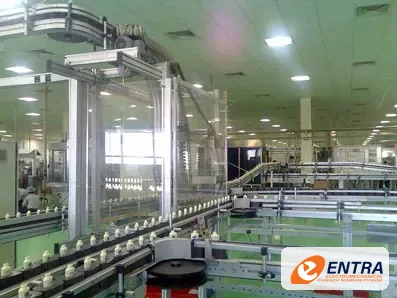
Aluminium-profile conveyor frames and modular structures for production, assembly, inspection and material-tr…
Request a quotation
Share the product, the layout and what the line has to do. An ENTRA engineer reviews every enquiry and replies with questions or a proposal.
