
Vertical elevation
Move cartons, trays, cases or suitable packaged products between production levels while preserving a continuous flow.
Vertical product flow
Continuous vertical conveying for production lines that need elevation, accumulation or controlled cooling within a compact footprint.
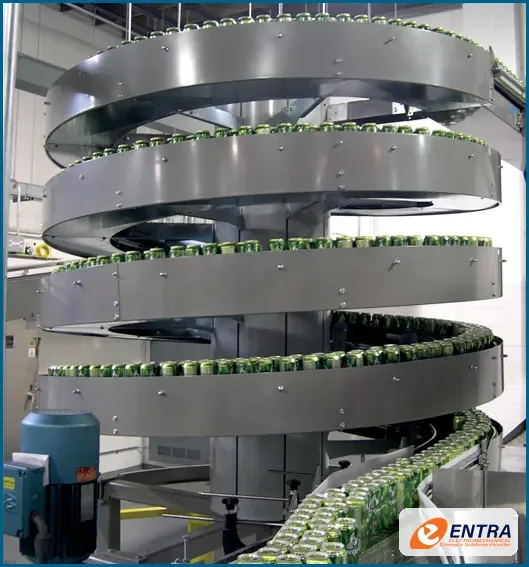
Overview
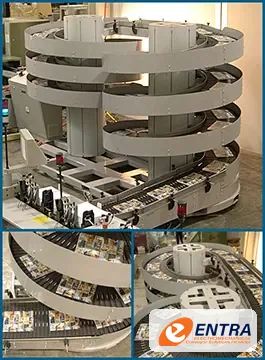
An industrial spiral conveyor transfers products between elevations while maintaining a continuous conveying path. Depending on the belt, product and process, a spiral can be used for elevation, lowering, accumulation, cooling or buffering. The final design is selected around the product and the line—not from a generic height claim.
Move cartons, trays, cases or suitable packaged products between production levels while preserving a continuous flow.
Create a long conveying dwell path for bakery, packaged food or other temperature-conditioning processes when the process and belt materials are suitable.
Use a spiral layout to add controlled product residence time and buffer adjacent processes where the line concept permits.
Use vertical space to connect equipment across mezzanines, platforms or multiple production levels.
Operating principle
An industrial spiral conveyor transfers products between elevations while maintaining a continuous conveying path. Depending on the belt, product and process, a spiral can be used for elevation, lowering, accumulation, cooling or buffering. The final design is selected around the product and the line—not from a generic height claim.
A simplified illustration of the motion — not to scale and not a performance simulation.
Available configurations
Continuous upward transfer between floor levels or production platforms.
Controlled downward transfer where product stability and discharge geometry allow.
Extended conveying path used as a buffer between processes.
Long residence path configured around product temperature, air flow and sanitation requirements.
Technical design basis
These items identify the information used to engineer this equipment. Numerical limits appear only where the referenced catalogue supports them; other values are confirmed for each project.
Spiral capacity, maximum elevation, belt speed, product loading and temperature suitability are project-specific. ENTRA confirms these after reviewing the product, layout, belt selection, drive duty and operating environment. No universal capacity or height is assumed on this page.
| Product envelope | Dimensions, mass, stability, package base and allowable contact surface. |
|---|---|
| Vertical travel | Infeed/outfeed elevations and required elevation change. |
| Spiral geometry | Tower diameter, belt path, curve geometry and available footprint. |
| Operating duty | Throughput, product pitch, accumulation target and operating hours. |
| Belt / chain and environment | Selected from product, temperature, cleaning and wear requirements. |
Engineering considerations
A useful proposal starts with operating conditions and interfaces. Final sizing is confirmed by engineering review.
Product dimensions, weight range, base stability, packaging, orientation, allowable contact and required spacing.
Required throughput, operating hours, infeed/outfeed elevation, available floor area, accumulation target and upstream/downstream interfaces.
Belt or chain type, minimum curve geometry, support structure, wear surfaces, cleaning access and guarding.
Drive arrangement, speed control, start/stop logic, accumulation sensors, interlocks and integration with the existing line.
Photographs
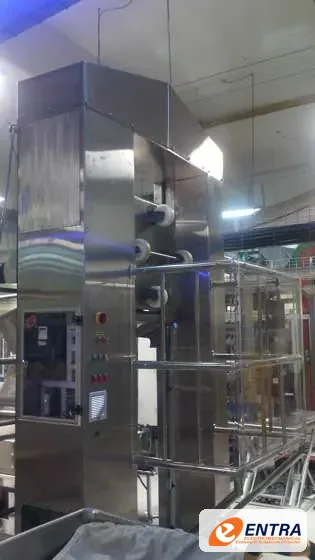
Captions identify the equipment shown; a photo is not a claim that every image is a completed installation of the exact configuration described.
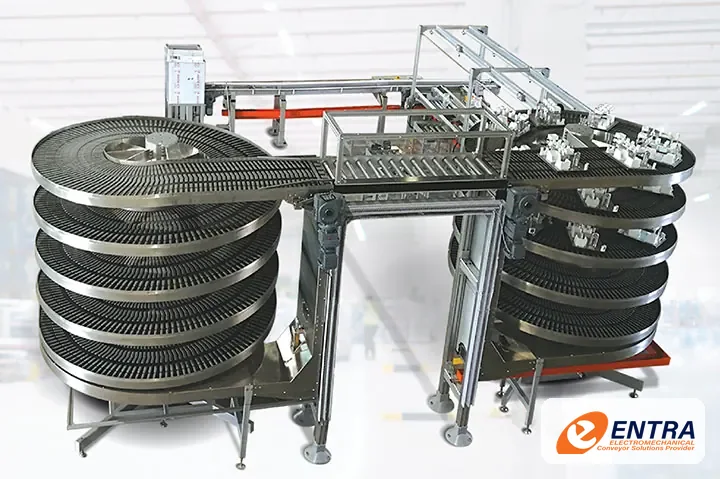 ENTRA
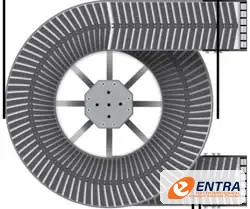 ENTRA
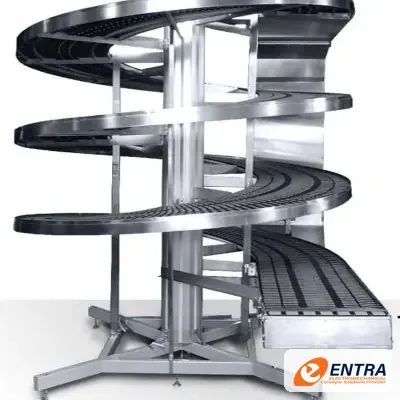 ENTRA
 ENTRA
Related equipment
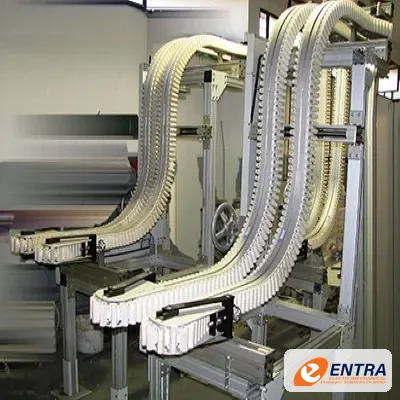
Opposed gripping belts hold suitable products at their sides to move them vertically, invert them or connect …
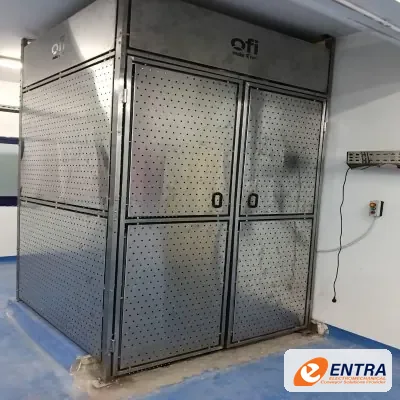
Purpose-designed vertical transfer equipment for moving compatible products or loads between conveyor levels.
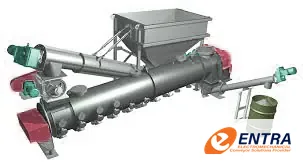
Meter, feed and transfer powders, granules and suitable bulk solids using a rotating helical flight in a trou…
Engineered stations for controlled tipping, tilting or reorientation of compatible products, containers and l…
Request a quotation
Share the product, the layout and what the line has to do. An ENTRA engineer reviews every enquiry and replies with questions or a proposal.
