
Bottle and container elevation
Transfer suitable bottles, cans, jars and rigid containers upward between conveyor levels.
Controlled vertical transfer
Opposed gripping belts hold suitable products at their sides to move them vertically, invert them or connect different conveyor levels.
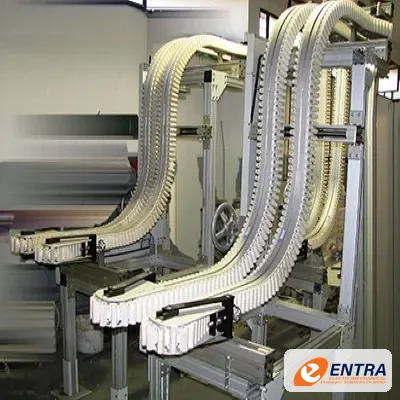
Overview
A side-gripper conveyor uses two synchronized, opposing belts or gripping elements to hold a product along its sides while it is transferred. It is useful where a conventional base-supporting conveyor cannot provide the required vertical path or where the product needs to be presented in a controlled orientation. Grip geometry and pressure must be matched to the actual container.
Transfer suitable bottles, cans, jars and rigid containers upward between conveyor levels.
Move containers downward into downstream equipment, packaging lines or accumulation zones.
Where required, a purpose-designed arrangement can turn or invert compatible products for a defined process step. This is application-specific, not an inherent feature of every side-gripper.
Route product vertically to free floor area, pass over or around equipment and connect separated production levels.
Operating principle
A side-gripper conveyor uses two synchronized, opposing belts or gripping elements to hold a product along its sides while it is transferred. It is useful where a conventional base-supporting conveyor cannot provide the required vertical path or where the product needs to be presented in a controlled orientation. Grip geometry and pressure must be matched to the actual container.
A simplified illustration of the motion — not to scale and not a performance simulation.
Available configurations
Upward product transfer between conveyor levels.
Downward transfer while maintaining side control.
Adjustment approach selected for the product size range and changeover frequency.
Custom orientation or inversion arrangement after checking product and process requirements.
Technical design basis
These items identify the information used to engineer this equipment. Numerical limits appear only where the referenced catalogue supports them; other values are confirmed for each project.
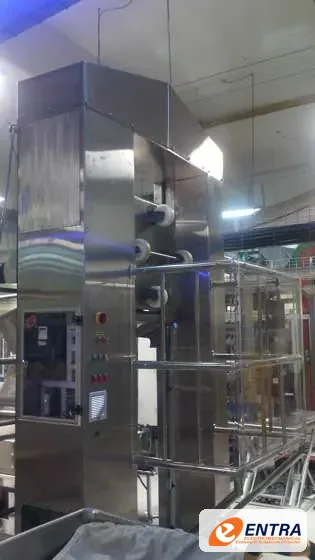
Grip dimensions, pressure, belt speed and achievable throughput depend on the actual container and line layout. Fragile, tapered, wet, slippery or highly variable products require trials or engineering review before a final design is selected. The gallery includes one ENTRA gripper reference plus separate general elevator references; the latter are not presented as side-gripper installations.
| Container geometry | Height, diameter/width, shoulder profile, mass and centre of gravity. |
|---|---|
| Grip interface | Belt material, contact length, grip gap, friction and allowable deformation. |
| Vertical travel | Required elevation, line speed, product pitch and transfer sequence. |
| Drive synchronization | Matched speed and coordinated operation of opposing grip elements. |
| Safety & guarding | Access protection, interlocks, emergency stops and jam recovery. |
Engineering considerations
A useful proposal starts with operating conditions and interfaces. Final sizing is confirmed by engineering review.
Container height, diameter or width, neck and shoulder profile, mass, centre of gravity, surface finish and dimensional variation.
Belt contact material, contact length, adjustable gap, grip force, friction, product sensitivity and allowable marking or deformation.
Required throughput, vertical travel, infeed/outfeed elevations, product pitch, accumulation behaviour and line synchronization.
Speed matching, VFD control, sensors, guarding, access for cleaning, emergency stops and interlocks with connected machines.
Photographs
Captions identify the equipment shown; a photo is not a claim that every image is a completed installation of the exact configuration described.
ENTRARelated equipment
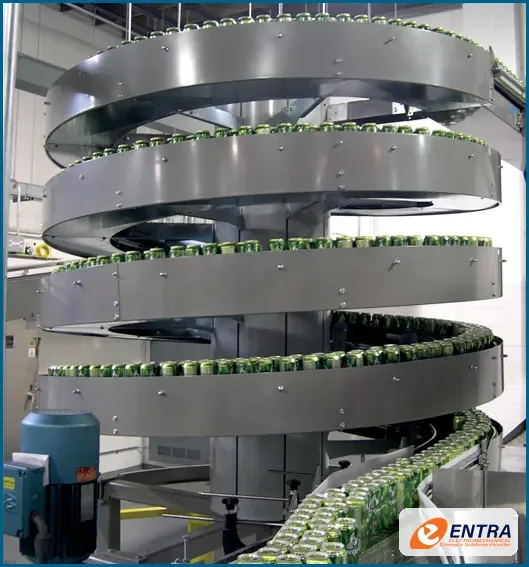
Continuous vertical conveying for production lines that need elevation, accumulation or controlled cooling wi…
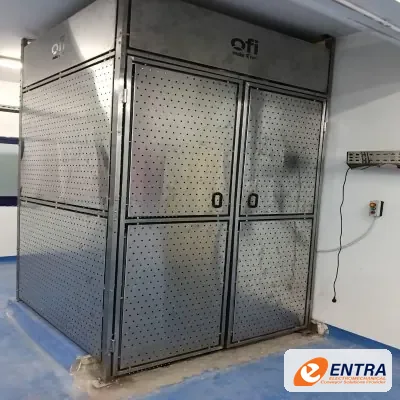
Purpose-designed vertical transfer equipment for moving compatible products or loads between conveyor levels.
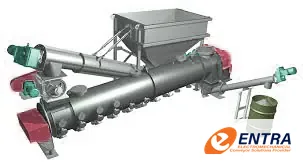
Meter, feed and transfer powders, granules and suitable bulk solids using a rotating helical flight in a trou…
Engineered stations for controlled tipping, tilting or reorientation of compatible products, containers and l…
Request a quotation
Share the product, the layout and what the line has to do. An ENTRA engineer reviews every enquiry and replies with questions or a proposal.
