
Why lines need accumulation
On any production or packaging line, individual machines stop for short periods: a label reel runs out, a carton jams, a reject gate fires, an operator adjusts a guide. Without accumulation, every short stop at one machine immediately stops the machines before and after it, and the whole line loses output. With accumulation between machines, products queue up during the stop and are released when the machine restarts, so the rest of the line keeps running.
Accumulation conveyors and accumulation tables are therefore one of the cheapest ways to raise the real output of an existing line. They do not make any machine faster; they stop small stoppages from spreading.
Accumulation methods
Zero-pressure accumulation
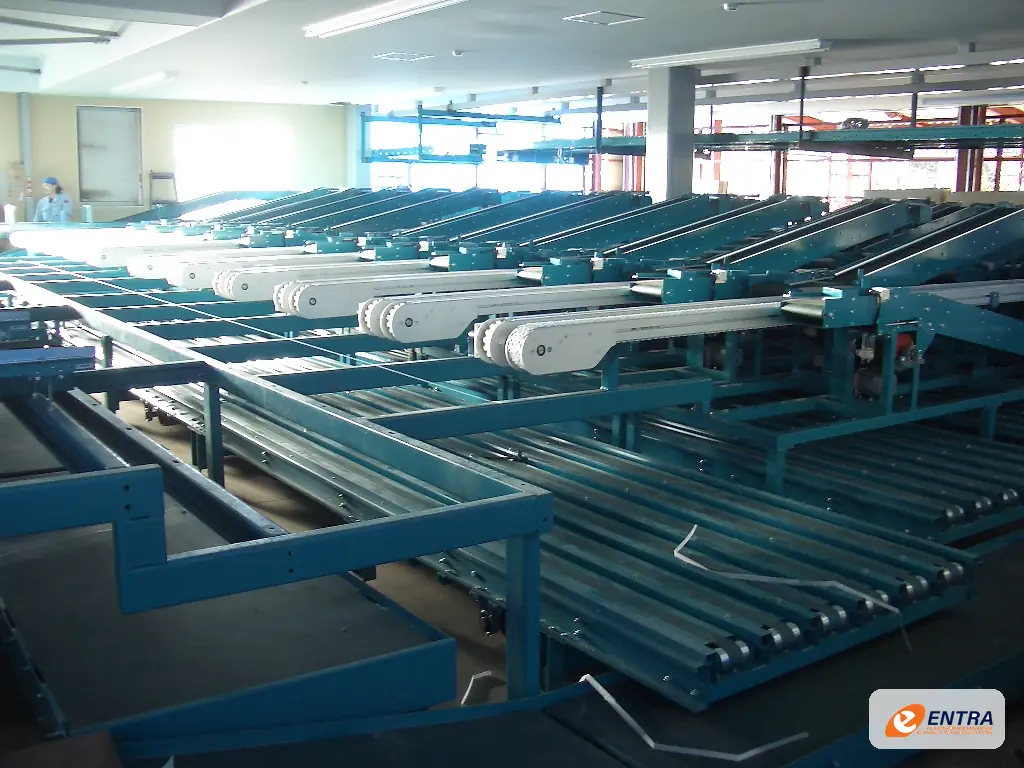
The conveyor is divided into zones. Each zone is driven independently and has a sensor that detects whether it is occupied. A zone runs only when the next zone downstream is free, so products stop in their own zones without touching each other [1]. On modern carton and tote conveyors, each zone is driven by a 24 V DC motor roller that drives several slave rollers; idle zones stop, which saves energy [2]. Zero-pressure accumulation suits fragile, unstable, labelled or high-value products and any product that must be released one at a time.
Minimum- or low-pressure accumulation
The conveyor keeps driving, but the drive force on stopped products is limited, so the queue presses only lightly on the front product. Methods include slip-clutch or friction rollers and belts pressing lightly under the rollers. A roller manufacturer’s planning rules note that friction conveyors limit accumulation pressure but should run at no more than 0.5 m/s and only in dry conditions, and that central pneumatically switched drives use more energy and are often noisier than individual motor rollers per zone [3].
Accumulation on chain
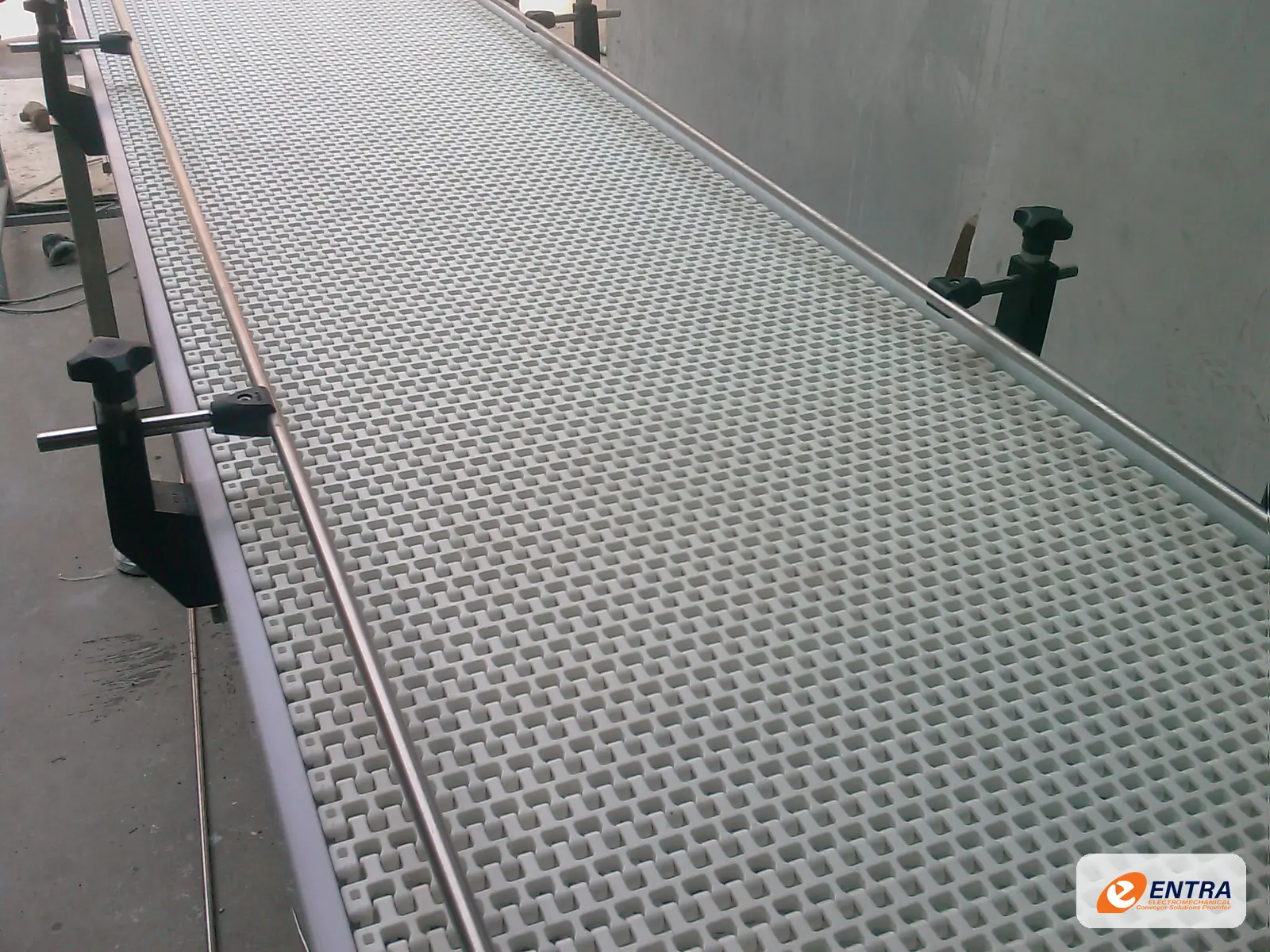
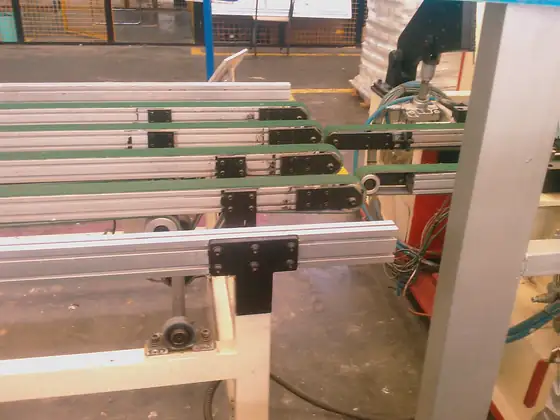
On bottling and canning lines, containers accumulate by sliding on a moving table-top chain, often in several lanes. Low-friction or roller-top chains reduce the line pressure. This is simple and robust for strong containers but needs care with light or unstable containers and with labels that scuff.
Accumulation tables and dynamic buffers
- Accumulation tables are wide, slow-moving conveyors next to or at the end of a line. Products spread across the table during a stop and are gathered back into single file when the line restarts.
- Bi-directional tables accumulate and release products first in, first out.
- Spiral buffers store products on a spiral conveyor in a small footprint.
- Long single-file conveyors with zone control act as linear buffers for cartons and cases.
How to size a buffer
The buffer must hold the products that arrive while the protected machine is stopped, for the length of stop you want to absorb. The basic relationship is:
N = R · t
L = N · p (single file) or A ≈ N · a / η (table)
- N
- number of products the buffer must hold
- R
- line rate, products per minute
- t
- stop time to be absorbed, minutes
- L, p
- buffer length and product pitch (length plus gap), m
- A, a
- table area and area occupied per product, m²
- η
- filling efficiency of the table (below 1, because products do not pack perfectly)
Illustrative example, not an ENTRA project
A line runs at 300 bottles per minute. The labeller has frequent stops of up to 2 minutes, which the line should absorb. N = 300 × 2 = 600 bottles. In single file with 70 mm diameter bottles touching, that is 600 × 0.070 = 42 m of conveyor, which is impractical. On an accumulation table, closely packed round bottles occupy about 0.866 × d² each, about 0.0042 m², so 600 bottles need about 2.5 m²; allowing for a filling efficiency of about 0.85 gives roughly 3 m² of table.
Stop times come from the line’s own records: list the stops at each machine over a few weeks, and decide which length of stop the buffer should cover. Covering every stop is rarely economic; covering the frequent short stops usually is.
The buffer only works if the machines around it can catch up. The machines downstream of a buffer must be able to run faster than the line rate for a while to empty it, and the machines upstream must be able to keep running while it fills. That is why lines are designed with a speed profile around the critical machine; see industrial automation and conveyor integration.
Choosing the accumulation method
| Product and situation | Suitable method |
|---|---|
| Cartons, totes, cases needing gentle handling and one-by-one release | Zero-pressure zones with motor-driven rollers |
| Robust cartons, moderate rates, low budget | Low-pressure roller or belt accumulation |
| Glass or PET bottles, cans between machines | Multi-lane chain accumulation or accumulation tables |
| Long stops, limited floor space | Spiral buffer or bi-directional table |
| Pallets | Zone-controlled pallet conveyors |
Controls that make accumulation work
- Sensors at the right points: “buffer low”, “buffer high” and “buffer full” signals drive the speed control of upstream and downstream conveyors and machines.
- Variable speed: conveyors slow down as the buffer fills and speed up as it empties, which keeps pressure low.
- Release logic: on zone conveyors, singulation or slug release; on tables, gentle re-forming into single file.
- Restart sequence: after a long stop, downstream machines start first so the buffer empties without overloading the next machine.
Worked example: a zone conveyor buffer for cartons
Illustrative example, not an ENTRA project
A palletiser takes about 45 seconds to change pallets, during which cartons keep arriving at 20 per minute. Cartons arriving during the change: 20 × 0.75 = 15 cartons. Cartons are up to 500 mm long, so zones of 600 mm are used, one carton per zone. A buffer of at least 15 zones, about 9 m, is needed; designing for 20 zones (12 m) gives margin for a slower change. After the change, the palletiser infeed must run faster than 20 cartons per minute to empty the buffer before the next pallet change.
Troubleshooting accumulation
| Symptom | Likely causes |
|---|---|
| Products touch or push in zero-pressure zones | Sensor position or sensitivity, zone length too short for the longest product, slow zone stop |
| Bottles fall over on accumulation | Line pressure too high, chain friction too high, guides too wide, speed changes too sudden |
| Buffer never empties | Downstream machine cannot run faster than the line rate, speed profile wrong |
| Line still stops at short stops | Buffer too small for the stop times, or “buffer full” signal set too early |
| Gaps after release | Release logic or speeds not matched to the downstream machine |
Benefits
- Higher line efficiency, because short stops no longer stop the whole line.
- Fewer damaged products and less noise, especially with zero-pressure methods.
- Calmer operation: operators fix a jam without the whole line stopping behind them.
- Energy savings with zone conveyors that stop when idle.
For carton and tote conveyors, our article on gravity vs powered roller conveyors explains motor-driven rollers in more detail; for speed and spacing calculations see speed, capacity and throughput.
Frequently asked questions
What is an accumulation conveyor?
A conveyor designed to hold and release products in a controlled way, so that a stop at one machine does not immediately stop the machines before or after it.
What is zero-pressure accumulation?
A method in which the conveyor is split into zones that stop and start individually, so accumulated products do not touch or push on each other. It is common on motor-driven roller conveyors.
When is minimum-pressure accumulation acceptable?
When products are robust enough to touch each other and the line pressure is limited, for example with low-friction chain or slip-drive rollers. Fragile, unstable or labelled products usually need zero-pressure accumulation.
How big should an accumulation buffer be?
Large enough to absorb the typical stop time of the machine it protects at the line rate: buffer capacity ≈ line rate × stop time to be covered, converted into conveyor length or table area for the product and its spacing.
Sources and references
- Google Patents, US 5,285,887 Accumulating conveyor and control system (zero-pressure zones). Checked 28 Nov 2026.
- MH&L, 24-volt conveyor line conserves power (zone activation and zero-pressure accumulation). Checked 28 Nov 2026.
- Interroll, Conveyor rollers – General technical information / planning basics, Catalogue pages 184–203, edition 01. Checked 28 Nov 2026.
Sources are listed for technical accuracy. Names of standards bodies, regulators and manufacturers appear only to credit the source; ENTRA does not claim their products or specifications as its own.

Mechanical, electrical and controls engineers at ENTRA Electromechanical, Cairo. Since 2007 the team has designed, supplied, installed and maintained conveyor and material-handling systems for plants in Egypt and the Arab region. About ENTRA
Researched and drafted with AI assistance from the sources listed above, checked by recalculating every worked example, and published by the ENTRA Engineering Team.
Copyright © 2026 ENTRA. All Rights Reserved. Text, calculations and original graphics on this page may not be reproduced without permission.
Related articles
 Material Handling & Automation
Industrial automation and conveyor integration: how modern factories improve productivity
How conveyors connect to machines, sensors and PLCs: control architecture, signals, buffers, safety and the steps to integrate a conveyor line.
 Conveyor Engineering
Roller conveyor systems: gravity vs powered roller conveyors
Gravity and powered roller conveyors compared: how each works, the drive options and how to choose the right roller conveyor for cartons, totes and pallets.
 Technical Engineering & Components
Conveyor speed, capacity and throughput: engineering calculations explained
Formulas and a calculator for conveyor speed, gear ratio, products per minute and bulk capacity in t/h, with worked examples and limits.
