
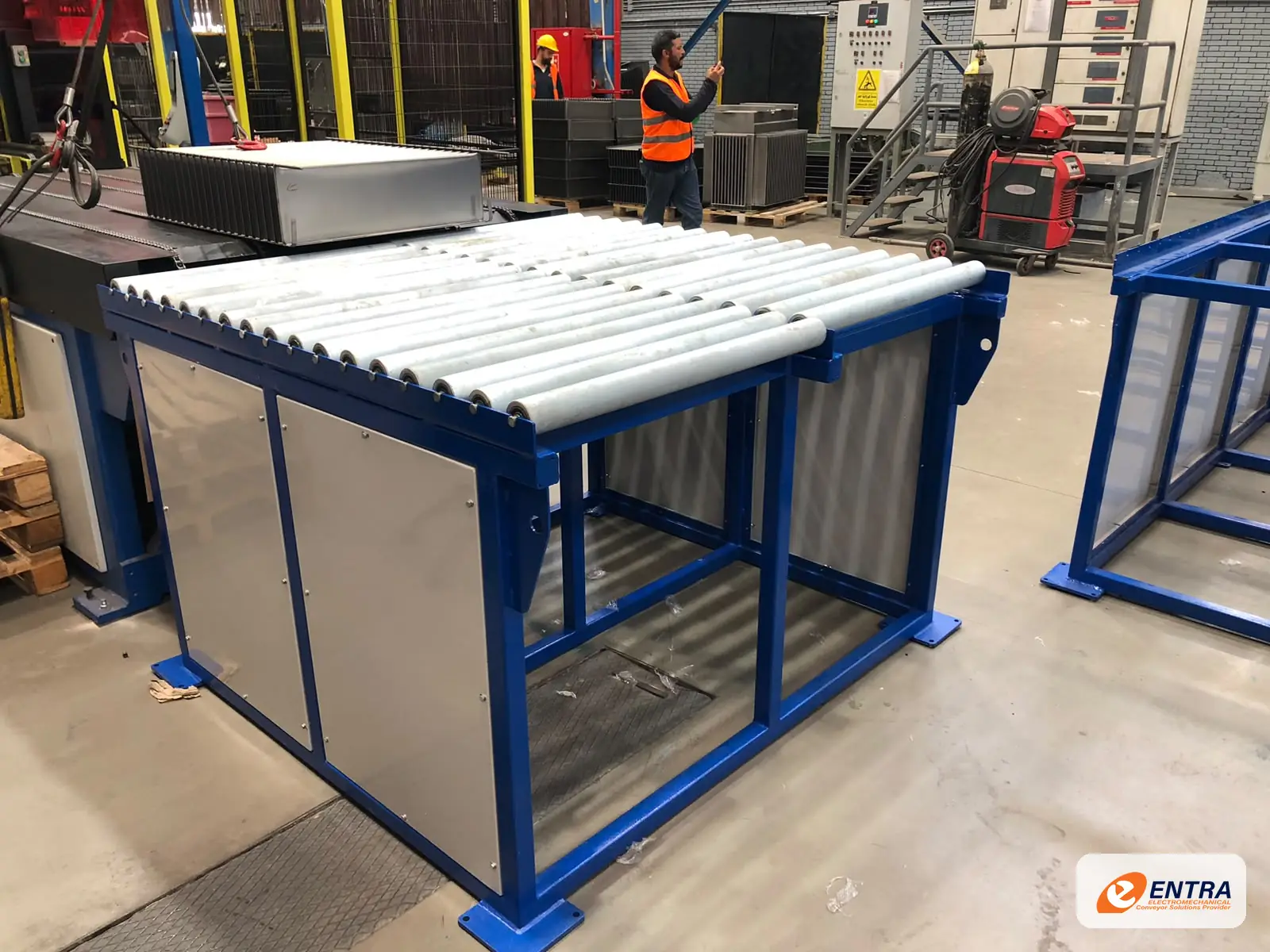
Two ways to move products on rollers
A roller conveyor carries products on a bed of rollers set across the direction of travel. The difference between the two main families is simple: on a gravity roller conveyor the rollers turn freely and the product moves because the conveyor slopes or because someone pushes it; on a powered (driven) roller conveyor some or all rollers are driven, so the conveyor controls speed, direction, spacing and stopping.
Both share the same basic rules. The product must have a firm base and be carried by at least three rollers at any time, and the reference roller length is the conveyor width plus about 50 mm, or plus 100 mm for large goods such as pallets [1]. Bags, soft packs and very small items usually belong on a belt conveyor or in a tote.
Gravity roller conveyors
Where they work well
- Packing and workstations where operators push cartons along at their own pace.
- Short buffers and run-out sections after a powered conveyor.
- Loading and unloading areas, including extendable gravity sections for trucks.
- Carton flow lanes in picking racks, where cartons roll forward as the front one is picked.
Their limits
A slope that gets light products moving lets heavy products accelerate. A roller manufacturer’s planning rules warn that goods must not reach an excessive speed, because they can collide with jammed goods or end stops and injure people removing them by hand; the same document gives no single recommended gradient and describes tests at 5% to 10% [1]. The right slope therefore depends on the product mix and is best confirmed by trial. On longer or steeper sections, speed-controller rollers or brake rollers limit the speed.
Gravity conveyors also cannot keep products apart: products that stop at the end of a lane push against each other. Where products are fragile or must arrive one by one at a machine, a powered conveyor is needed.
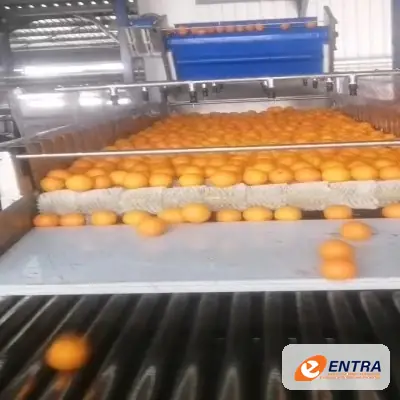
Powered roller conveyors
Powered roller conveyors drive the rollers through chains, belts or motors inside the rollers. They move products at a set speed on level or slightly inclined paths, over long distances, and they can stop, accumulate, merge and divert products under control. The drive method is the main design choice.
| Drive | How it works | Typical use and notes |
|---|---|---|
| Tangential chain | A chain runs along sprockets on each roller | Free roller pitch, simple and efficient; heavy loads and pallets |
| Roller-to-roller chain | Each roller drives the next by a short chain loop | Robust for heavy goods; pitch fixed by the chain, tight tolerances |
| Poly-V or round belt | Short belts link rollers in pairs, or belts from a line shaft | Quiet, clean drives for cartons and totes; Poly-V transmits much more torque than round belts |
| Flat belt beneath rollers | A belt presses against the underside of the rollers | Light cartons; allows low-pressure accumulation |
| Motor-driven rollers (MDR) | A 24 V DC motor inside one roller per zone drives the others | Zero-pressure accumulation, energy saving, quiet operation |
The roller manufacturer’s planning document compares these drives and notes, among other points, that chain drives should not run faster than 0.5 m/s and that chain drive lengths beyond about 15 m are often problematic [1].
Motor-driven rollers and zones
In a motor-driven roller (MDR) conveyor, the line is divided into zones. Each zone has one motor roller that drives several slave rollers, and a sensor that tells the control whether the zone is occupied. A zone runs only when the next zone is empty, so products queue without touching: this is zero-pressure accumulation [2] [3]. Because idle zones stop, the conveyor uses energy only where products are moving. Read more in accumulation conveyor systems.
Curves, merges and transfers
On curves, tapered rollers let the outer side of the product travel further than the inner side, so the product follows the curve. The planning rules recommend tapered rollers in curves, a maximum speed of about 0.8 m/s, and about 5° between rollers [1]. Merges and diverts use powered transfers (pop-up belts or chains, rollers or wheels) controlled by sensors. Transfers are where products jam or are damaged most often, so their design deserves as much attention as the straight sections.
How to choose: a decision guide
| If you need… | Consider |
|---|---|
| A short, low-cost link or workstation, operator-paced | Gravity rollers, possibly with a slight slope |
| Controlled speed on a long or level route | Powered rollers (belt or chain drive) |
| Products queuing without touching, or one-by-one release to a machine | Motor-driven rollers with zero-pressure zones |
| Pallets or heavy loads | Heavy-duty chain-driven rollers or chain conveyors; see pallet conveyor systems |
| Very small, soft or irregular products | A belt conveyor or totes instead of rollers |
| Wet or washdown areas | Stainless steel rollers and frames, sealed bearings, suitable motor protection |
Worked example: checking a roller conveyor for cartons
Illustrative example, not an ENTRA project
Cartons range from 400 mm long and 20 kg to 600 mm long and 25 kg, on a 500 mm wide conveyor. Roller length: 500 + 50 = 550 mm. Pitch: the shortest carton (400 mm) needs at least three rollers, so the pitch must not exceed 400 / 3 = 133 mm; a 120 mm pitch gives at least 3 rollers under the short carton and 5 under the long one. Load per roller in the worst case: 20 kg on 3 rollers = 20 × 9.81 / 3 = 65 N; 25 kg on 5 rollers = 49 N. These values are then compared with the roller manufacturer’s load capacity for a 550 mm roller, with a margin for impacts at the loading point.
The same check applies to gravity and powered sections. The roller conveyor design calculator does it automatically.
Energy, noise and maintenance compared
| Gravity | Chain-driven | Belt-driven | Motor-driven rollers | |
|---|---|---|---|---|
| Energy | None | Runs continuously unless stopped by controls | Runs continuously unless stopped by controls | Zones run only when needed |
| Noise | Low | Higher | Low | Low |
| Typical maintenance | Rollers, end stops | Chain tension, lubrication, sprockets | Belt wear and replacement | Motor rollers, controllers, power supplies |
| Accumulation | With pressure | With pressure unless zoned | Low pressure possible | Zero pressure |
These are general tendencies; the actual result depends on the design, the controls and the duty.
Design checks for any roller conveyor
- Roller pitch from the shortest product so that at least three rollers carry it. Our roller conveyor design guide includes a calculator.
- Load per roller from the heaviest product divided by the rollers actually in contact, compared with the roller’s rated capacity. See conveyor rollers: types and maintenance.
- Product base: open-bottom trays, ribbed bases and pallets with damaged boards need special attention.
- Height and ergonomics at manual loading and picking points.
- Safety: guarding of drive chains and belts, nip points at transfers, end stops on gravity lanes, emergency stops. EN 619 applies to both gravity and driven roller conveyors as unit-load handling equipment [4].
In many plants the best answer is a combination: powered sections where control matters and gravity sections where a simple, unpowered link is enough.
Frequently asked questions
What is a gravity roller conveyor?
A conveyor of free-turning rollers, usually set on a slight decline, along which products move by gravity or by hand. It needs no power and suits short runs, buffers, packing stations and loading areas.
When should I choose a powered roller conveyor?
When products must move at a controlled speed, over long distances, on a level or uphill path, with controlled spacing or zero-pressure accumulation, or when the conveyor connects to automated machines.
Do products need a rigid base on a roller conveyor?
Yes. Products should have a firm, flat base and be supported by at least three rollers at any time. Bags, soft packs and small items usually need a belt conveyor or a tray instead.
How is the speed controlled on gravity roller conveyors?
By the gradient and, on longer or steeper sections, by speed controllers or brake rollers. Products must never reach a speed that could injure people or damage goods at the end stop.
Sources and references
- Interroll, Conveyor rollers – General technical information / planning basics, Catalogue pages 184–203, edition 01. Checked 28 Nov 2026.
- Google Patents, US 5,285,887 Accumulating conveyor and control system (zero-pressure zones). Checked 28 Nov 2026.
- MH&L, 24-volt conveyor line conserves power (zone activation and zero-pressure accumulation). Checked 28 Nov 2026.
- EVS, EN 619:2022 Continuous handling equipment and systems — Safety requirements for equipment for mechanical handling of unit loads. Checked 28 Nov 2026.
Sources are listed for technical accuracy. Names of standards bodies, regulators and manufacturers appear only to credit the source; ENTRA does not claim their products or specifications as its own.

Mechanical, electrical and controls engineers at ENTRA Electromechanical, Cairo. Since 2007 the team has designed, supplied, installed and maintained conveyor and material-handling systems for plants in Egypt and the Arab region. About ENTRA
Researched and drafted with AI assistance from the sources listed above, checked by recalculating every worked example, and published by the ENTRA Engineering Team.
Copyright © 2026 ENTRA. All Rights Reserved. Text, calculations and original graphics on this page may not be reproduced without permission.
Related articles
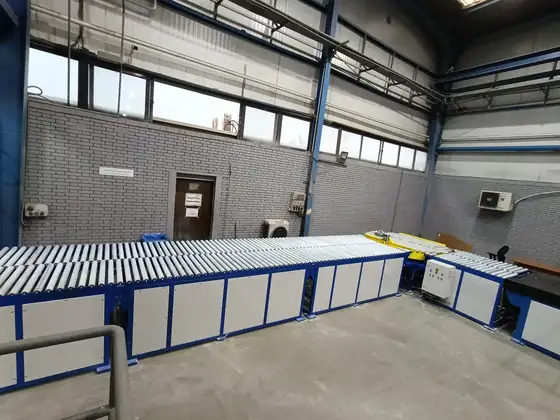 Conveyor Engineering
Roller conveyor design: length, pitch, load and drives
Choose roller length and pitch, check the load per roller, control speed on gravity sections and compare roller conveyor drives.
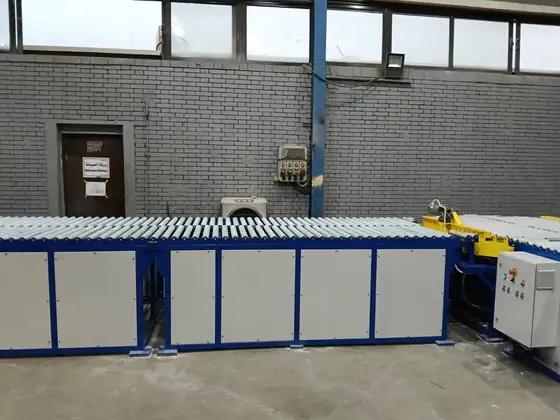 Technical Engineering & Components
Conveyor rollers: types, materials, applications and maintenance
Gravity, driven, tapered, motor and idler rollers: materials, bearings, load capacity, pitch, and how to inspect and replace them.
 Material Handling & Automation
Accumulation conveyor systems: improving production flow and reducing bottlenecks
How accumulation conveyors buffer products between machines, zero-pressure vs low-pressure accumulation, and how to size a buffer.
