The drive: where energy becomes motion
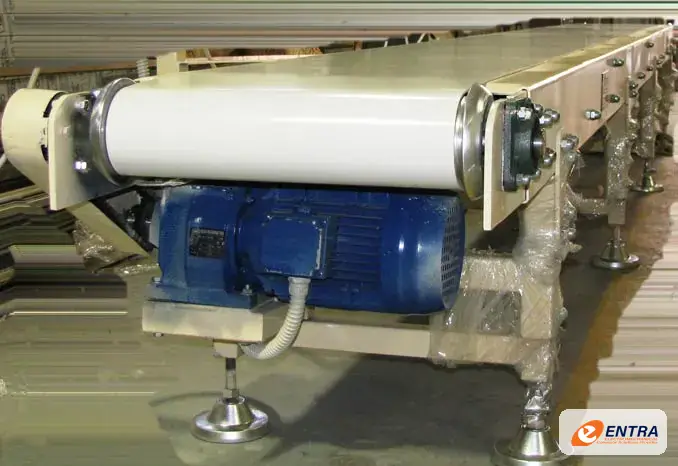
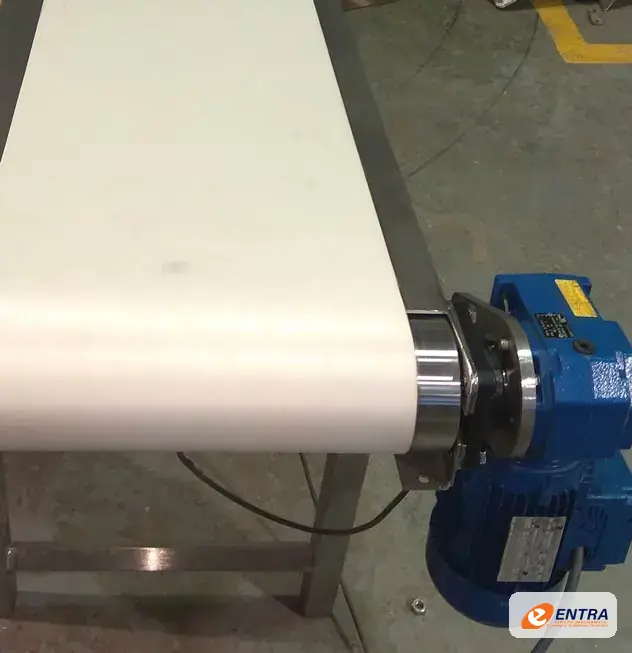
Most conveyors are driven by an AC induction motor and a gearbox, often combined in one unit as a gearmotor. The motor converts electrical energy into rotation at high speed; the gearbox reduces the speed and multiplies the torque to what the drive drum or sprocket needs. Every conveyor’s reliability and running cost depend heavily on this pair. An under-sized drive trips or overheats; an over-sized one costs more and can run inefficiently at part load; an inefficient gearbox turns electricity into heat for the whole life of the conveyor.
How to size a conveyor drive
- Effective pull F (N): the force needed at the drum or sprocket to move the belt or chain and the load, overcoming friction on beds, rollers and wear strips, lifting on inclines and accumulation friction. Methods differ by conveyor type; for unit-goods belt conveyors see belt conveyor drive power, and for bulk belt conveyors ISO 5048 defines the resistances to motion and power requirements [1].
- Power at the drum: P = F · v, with v the conveyor speed in m/s.
- Output speed and torque: drum speed n = v / (π · D) in revolutions per second (× 60 for rpm), torque T = F · D / 2.
- Motor power: Pmotor = P / η, where η is the efficiency of the gearbox and any chains or belts between gearbox and drum. Then add a margin and choose the next standard motor size.
- Gear ratio: i = motor speed / drum speed.
- Service factor and starting: check the gearbox rating against the duty (hours per day, starts per hour, shock loads) with the gear manufacturer’s service factor, and check that the motor can start the fully loaded conveyor.
Illustrative example, not an ENTRA project
A belt conveyor needs an effective pull of 1,500 N at 0.5 m/s with a 200 mm drive drum. Power at the drum: 1,500 × 0.5 = 750 W. Drum speed: 0.5 / (π × 0.2) × 60 = 47.7 rpm; torque: 1,500 × 0.2 / 2 = 150 N·m. With a helical gearbox of about 95% efficiency, the motor must deliver about 0.79 kW, so a 1.1 kW motor is the next standard size with margin. With a four-pole motor at about 1,400 rpm, the ratio is about 1,400 / 47.7 ≈ 29.
Our speed, capacity and throughput calculator handles the speed and ratio part of this calculation.
Gearbox types
| Type | Shafts | Strengths | Watch out for |
|---|---|---|---|
| Helical (in-line) | Parallel or coaxial | High efficiency, robust, wide ratio range | Length; needs space in line with the drum |
| Parallel-shaft helical | Parallel, shaft-mounted | Compact on the drum shaft, efficient | Torque arm and mounting design |
| Helical-bevel | Right angle | High efficiency in a right-angle drive | Higher purchase price than worm |
| Worm | Right angle | Compact, inexpensive, quiet, high ratio in one stage | Efficiency falls as ratio rises; more heat |
| Helical-worm | Right angle | Higher ratios, better efficiency than single worm | Still below helical-bevel efficiency |
The efficiency gap
Helical and bevel gears mesh with rolling contact; worm gears slide. As a result, a helical gear stage loses only around two percent of the power through friction in gears, bearings and lubricant [2], while industrial worm gear drives typically reach full-load efficiencies of about 45% to 90%, depending on the ratio [3]. The higher the ratio, the lower the worm efficiency. In the example above, a worm gearbox with, say, 70% efficiency at a ratio of about 29 would need about 1.07 kW from the motor instead of 0.79 kW; over 4,000 operating hours a year that difference is roughly 1,100 kWh, every year. The exact figures depend on the gearbox; the point is to compare efficiencies at your actual ratio before choosing on price.
Worm gearboxes still have a place: they are compact, quiet and inexpensive, and some designs resist back-driving. For light, intermittent duty the energy difference may be small. For conveyors that run continuously, helical or helical-bevel gearboxes usually cost less over their life.
Motor efficiency classes
IEC 60034-30-1 defines international efficiency (IE) classes for single-speed, line-operated AC motors: IE1 standard, IE2 high, IE3 premium and IE4 super-premium efficiency [4]. The 2025 second edition of the standard adds an IE5 class and states that the classes are based on a 25 °C ambient temperature [5].
Regulations turn these classes into minimum requirements. In the European Union, Regulation (EU) 2019/1781 has applied since 1 July 2021 and requires motors to reach IE2, IE3 or IE4 depending on their rating [6]; since 1 July 2023, three-phase motors from 75 kW to 200 kW with 2, 4 or 6 poles must meet IE4 [7]. In the region, Saudi Arabia notified a draft SASO standard based on IEC 60034-30-1 to the WTO in 2017 [8]. Requirements differ by country and change over time, so check the current national rules for the country where the conveyor will be installed; for export-oriented plants and multinational clients, IE3 is a sensible minimum for continuously running conveyor drives.
Variable-frequency drives (VFDs)
A VFD feeds the motor with variable frequency and voltage, so the conveyor speed can be adjusted. VFDs are worth considering when:
- The speed must be matched to machines or changed for different products.
- Soft starting and stopping protect the product, the belt splice and the gearbox.
- Several conveyors must run in synchronisation, or speed up and slow down with buffer levels.
- Energy can be saved by slowing down or stopping idle sections.
Points to check: motor cooling at low speed (self-ventilated motors lose cooling as they slow down), cable length and EMC measures, and whether the gearbox ratio still keeps the motor in a good speed range across the required conveyor speeds.
Other selection details
- Mounting: foot-mounted with coupling, flange-mounted, or shaft-mounted with hollow shaft and torque arm; shaft-mounted drives save space and alignment work.
- Brakes: needed on inclines and declines to hold the load when stopped, and wherever run-on is a hazard.
- Backstops: prevent run-back on loaded inclined conveyors.
- Enclosure and protection: the motor and gearbox protection degree, surface finish and lubricant must suit washdown, dust or outdoor use; food areas may need food-grade lubricants and smooth, stainless housings.
- Ambient conditions: high ambient temperatures and altitude reduce the power a motor can deliver continuously; confirm derating with the motor manufacturer for hot plant rooms and outdoor installations.
- Standardisation: using a small range of gearmotor sizes across a plant reduces spare-parts stock.
What to specify when ordering a gearmotor
- Output speed (rpm) or ratio, and output torque with the service factor for the duty.
- Motor power, poles, voltage and frequency, efficiency class, enclosure protection.
- Gearbox type and mounting position (the position affects lubrication quantity).
- Output shaft: solid or hollow, diameter and keyway; torque arm or flange.
- Brake (holding torque, voltage, manual release) or backstop if required.
- Operation with a VFD, speed range, and any encoder or forced-ventilation fan.
- Ambient temperature, altitude, washdown or outdoor conditions, paint or stainless finish.
Listing these on the enquiry avoids drives that fit mechanically but not electrically, or the reverse.
Maintenance of conveyor drives
- Check oil level and leaks; change oil at the intervals the gearbox manufacturer specifies.
- Listen for bearing noise and feel for unusual heat; record motor current on critical drives.
- Check torque arms, couplings and chain drives for wear and alignment.
- Keep motor cooling fins and fans clean.
- Keep a spare gearmotor for drives whose failure stops the line.
See the full conveyor maintenance guide.
Frequently asked questions
How do I calculate the motor power for a conveyor?
Calculate the force needed to move the belt or chain and the load (effective pull), multiply by the conveyor speed to get power at the drive drum, then divide by the gearbox and transmission efficiency and add a margin. Our drive-power guide shows the method for unit-goods belt conveyors.
Is a worm gearbox or a helical-bevel gearbox better for a conveyor?
Helical and helical-bevel gearboxes are much more efficient, especially at high ratios, so they cost less to run. Worm gearboxes are compact and inexpensive and can suit light, intermittent duty. Compare efficiency at your actual ratio.
What do IE2, IE3 and IE4 mean on a motor?
They are international efficiency classes for line-operated AC motors defined in IEC 60034-30-1. Higher numbers mean lower losses. In the EU, most three-phase motors from 0.75 kW to 1000 kW have had to meet at least IE3 since July 2021.
When should a conveyor have a VFD?
When the speed must be adjusted or matched to machines, when soft starting and stopping protect the product or the belt, when several sections must be synchronised, or when energy can be saved by running slower or idling.
Sources and references
- ISO, ISO 5048:1989 Belt conveyors with carrying idlers — Calculation of operating power and tensile forces. Checked 28 Nov 2026.
- AGMA Power Transmission Engineering / Siemens, Two-stage helical bevel gearboxes: an alternative to three-stage helical bevel and worm gearing, February 2016. Checked 28 Nov 2026.
- USPTO, US patent 8,474,347 High efficiency right angle gearbox (background on worm gear efficiency). Checked 28 Nov 2026.
- ABB, Technical note: IEC 60034-30-1 standard on efficiency classes for low voltage AC motors (IE1 to IE4), 05-2018. Checked 28 Nov 2026.
- iTeh Standards, IEC 60034-30-1:2025 Efficiency classes of line operated AC motors (IE code), edition 2. Checked 28 Nov 2026.
- European Commission, Energy Efficient Products: electric motors and variable speed drives (Regulation (EU) 2019/1781). Checked 28 Nov 2026.
- IEA 4E, IE4 motors are required in the EU from 1 July 2023. Checked 28 Nov 2026.
- WTO / SASO, Saudi Arabia TBT notification: draft SASO IEC 60034-30-1 efficiency classes of line operated AC motors, 2017. Checked 28 Nov 2026.
Sources are listed for technical accuracy. Names of standards bodies, regulators and manufacturers appear only to credit the source; ENTRA does not claim their products or specifications as its own.
Mechanical, electrical and controls engineers at ENTRA Electromechanical, Cairo. Since 2007 the team has designed, supplied, installed and maintained conveyor and material-handling systems for plants in Egypt and the Arab region. About ENTRA
Researched and drafted with AI assistance from the sources listed above, checked by recalculating every worked example, and published by the ENTRA Engineering Team.
Copyright © 2026 ENTRA. All Rights Reserved. Text, calculations and original graphics on this page may not be reproduced without permission.
Related articles
 Technical Engineering & Components
Belt conveyor drive power: a first estimate
Estimate effective pull, drum power and motor power for unit-goods belt conveyors with a published method and a checked example.
 Technical Engineering & Components
Conveyor speed, capacity and throughput: engineering calculations explained
Formulas and a calculator for conveyor speed, gear ratio, products per minute and bulk capacity in t/h, with worked examples and limits.
 Industrial Solutions & Business
How to reduce industrial handling costs through conveyor automation
Where handling costs hide, how conveyor automation cuts labour, damage, waiting and energy, and how to calculate payback with your figures.
