
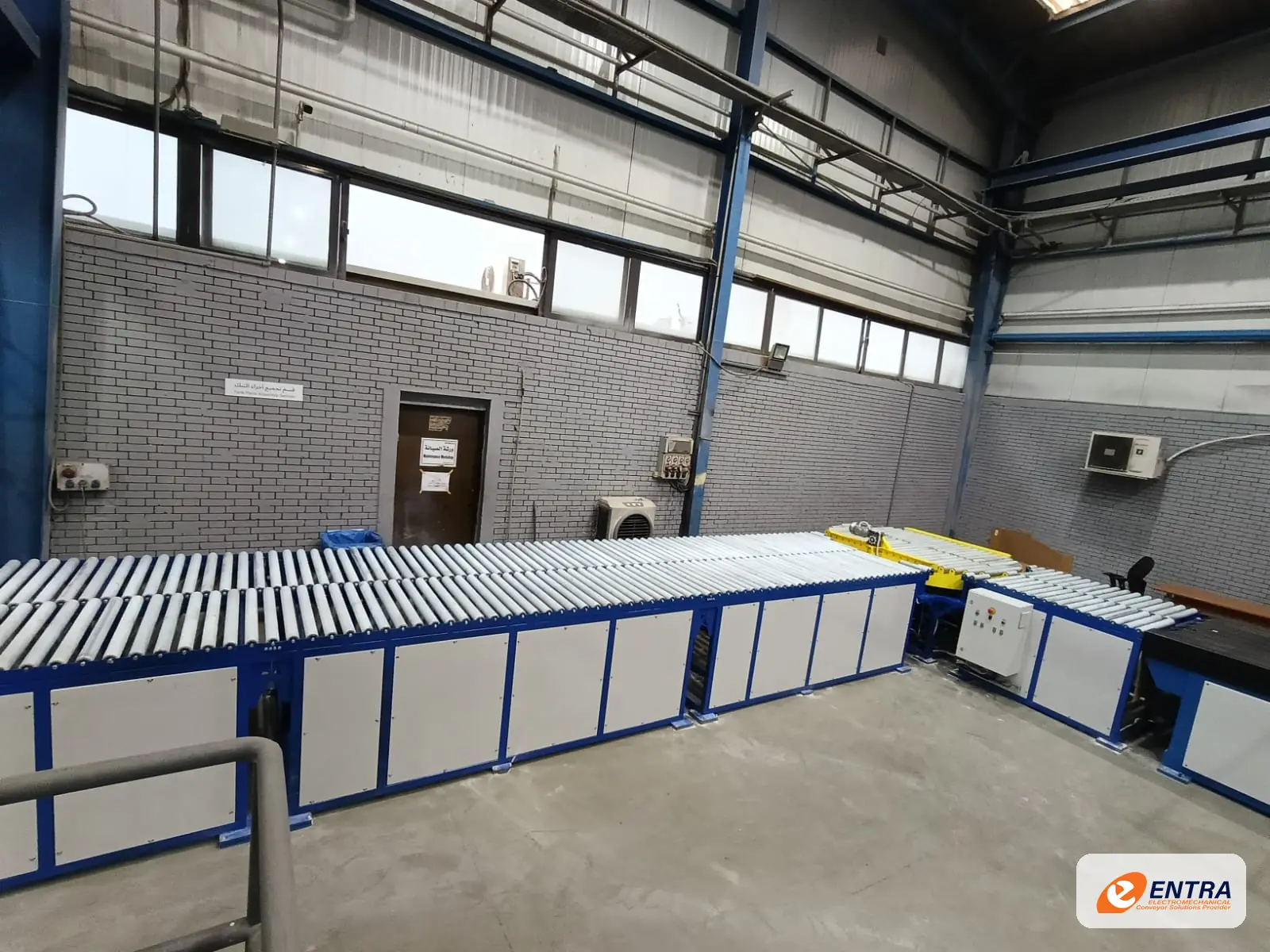
Why preventive maintenance pays
Conveyors rarely fail without warning. A bearing gets noisy weeks before it seizes; a belt drifts before its edge is torn; a chain stretches gradually until it starts climbing the sprocket; a guard is left off after a repair and stays off. Preventive maintenance is simply the habit of finding these signs early and acting on them while the fix is still small and can be planned. Breakdown maintenance on a production line costs not only the part, but the lost output of every machine the conveyor feeds.
This guide gives a practical structure for a conveyor maintenance plan, the safety rules that must come first, a checklist by component, and a troubleshooting table for the most common faults.
Safety first: isolation before intervention
Most serious conveyor injuries happen during cleaning, clearing jams and maintenance, when people reach into nip points that guards normally protect. Two rules apply to every task:
- Stop, isolate and lock out every energy source before working inside guards: electrical supply, compressed air, stored energy in tensioned belts and springs, and loads that can move under gravity on inclines. Prevention of unexpected start-up is the subject of its own machine-safety standard, ISO 14118, alongside the guard and interlock standards ISO 14120 and ISO 14119 [1].
- Never clean, adjust or clear a jam on a running conveyor unless the task has been specifically designed and assessed to be done safely while running, for example with fixed cleaning devices or adjustment points outside the guards.
Safety requirements for conveyors explicitly cover maintenance and cleaning as phases of the machine’s life, not only normal operation: EN 620 for bulk belt conveyors [2] and EN 619 for unit-load equipment [3]. After any repair, refit every guard and test every emergency stop and interlock before restarting. Guard openings and distances to hazard zones are set according to ISO 13857 [4]; a guard that has been modified or replaced with a different mesh may no longer comply.
Building the maintenance plan
- List the conveyors and rank them by criticality: which ones stop the line, which have back-up, which handle hazardous loads.
- Collect the manufacturers’ instructions for gearboxes, motors, belts, chains and safety devices, and note their inspection and lubrication intervals.
- Define tasks by frequency: per shift, weekly, monthly, and every six to twelve months, adjusted to the operating hours and the environment.
- Assign responsibility: operators for daily checks and cleaning, maintenance technicians for inspections and repairs.
- Record findings: a short checklist per conveyor, with readings such as motor current, chain elongation or belt tension, so trends become visible.
- Hold critical spares and review the plan after every significant breakdown.
Checklist by frequency
Every shift or daily (operators)
- Walk the conveyor and listen for unusual noise: squealing, grinding, knocking.
- Watch the belt or chain running: is it central, smooth, without jerking?
- Check that guards, covers and emergency stops are in place and undamaged.
- Remove debris, spilled product, labels and stretch film around drums, rollers and sensors (with the conveyor isolated).
- Report any change immediately rather than “waiting to see”.
Weekly
- Clean sensors, reflectors and photo-eyes; check their mounting.
- Check belt tracking and tension; check chain catenary or take-up position.
- Look for rollers that do not turn, and for wear on side guides and transfer plates.
- Test emergency stops and pull-wire switches.
Monthly
- Gearboxes: oil level, leaks, temperature, noise; torque arm and mounting bolts.
- Motors: cooling fins clean, terminal box closed, current within rating on critical drives.
- Chains and sprockets: wear, lubrication, elongation trend.
- Belts: edge wear, cover damage, splice condition; drum lagging wear.
- Bearings on drums and shafts: noise, heat, lubrication where greasable.
Every six to twelve months
- Full alignment check of frames, drums and sprockets; levelling of long conveyors.
- Gearbox oil change at the manufacturer’s interval.
- Electrical inspection of panels, terminals, cables and earthing.
- Functional test of all safety functions, interlocks and light curtains, with records.
- Review of breakdown history, spare parts and the plan itself.
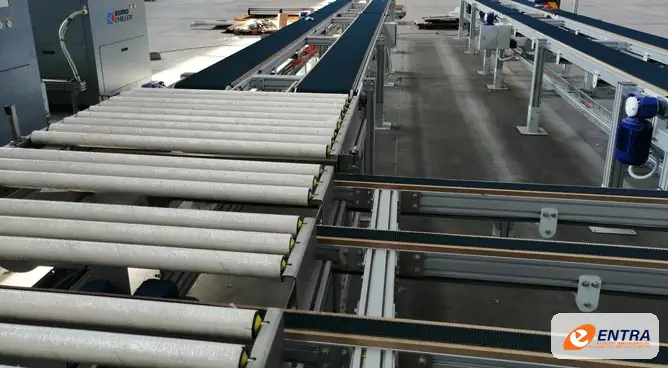
Troubleshooting common faults
| Symptom | Likely causes | First checks |
|---|---|---|
| Belt runs to one side | Drums or rollers not square, uneven tension, build-up on drums, splice not square | See belt tracking guide |
| Belt slips on the drive drum | Low tension, wet or contaminated drum, worn lagging, overload | See belt slip guide |
| Chain jerks or climbs the sprocket | Chain elongation, worn sprocket teeth, wrong catenary, dirt in guides | Measure elongation; inspect sprockets and wear strips |
| Products jam at transfers | Height or gap mismatch, worn transfer plates, speed mismatch, guide rails set wrong | Check heights, gaps and guide settings for the current format |
| Products stop on rollers | Seized rollers, worn drive belts, slope too low on gravity sections | Turn rollers by hand (isolated); inspect drive belts |
| Motor trips or overheats | Overload, jam, accumulation pressure, failing bearing, dirty cooling fins, supply problem | Measure current; check for mechanical drag; clean motor |
| Gearbox hot or noisy | Low or wrong oil, worn bearings or gears, overload, misalignment | Check oil level and type; check mounting and alignment |
| Sensors give false signals | Dirt, misalignment, reflective packaging, loose mounting | Clean and realign; check sensor type suits the product |
| Unusual noise along the conveyor | Failing roller or idler bearings, loose parts, rubbing guards | Locate by walking the conveyor; inspect after isolation |
Bearing calculations under ISO 281 do not account for wear, corrosion or electrical erosion [5], so in dusty, wet or washdown conditions real bearing life can be much shorter than the catalogue life. Seal condition and cleanliness matter as much as the bearing rating.
Spare parts strategy
Keep in stock the parts that stop the line when they fail and that take longer to obtain than you can afford to wait:
- A complete gearmotor (or gearbox and motor) for each critical drive size.
- Belt material or a spare belt, plus splice kits, for critical belt conveyors; spare chain links and pins.
- Bearings for drums and shafts; a set of rollers of each type.
- Sprockets, wear strips and guide rail profiles.
- Sensors, emergency stop components, fuses, contactors and a spare drive (VFD) if used.
Standardising components across conveyors reduces the number of different spares you need. When conveyors are bought, ask the supplier for a recommended spare parts list with lead times.
Designing for maintainability
Many maintenance problems are designed in. When planning new conveyors, ask for: access to drives and take-ups without dismantling the line, belts and chains that can be changed without removing the frame, guards that are easy to remove and refit with tools (and interlocked where access is frequent), grease points outside guards, and standard components available locally. Our guide to designing an efficient conveyor system covers these points at the design stage.
Lubrication and cleaning: do it the manufacturer’s way
- Gearboxes: use the oil type and quantity specified for the mounting position; mixing oil types can damage seals and gears.
- Steel chains: lubricate the chain joints, not the outside of the plates; excess oil collects dirt and becomes abrasive.
- Plastic chains and modular belts: many run dry or with water or a specific conveyor lubricant; the wrong lubricant can attack the plastic or make products slip.
- Bearings: greasable bearings need the right grease and quantity; over-greasing pushes seals out and overheats bearings.
- Cleaning: high-pressure water at bearings, motors and electrical components drives water and dirt into them; aim cleaning at product-contact surfaces and use the method the equipment was designed for.
Measure to improve
Record every conveyor stoppage with its duration and cause. After a few months, a simple ranking shows which conveyors and which causes cost the most time, and where improvements will pay. Typical findings are a few transfers, one drive or one product format that cause most of the stops. Fixing those, rather than spreading effort evenly, gives the quickest improvement in line availability.
For component-level detail, see conveyor rollers: types and maintenance and chain conveyor systems.
Frequently asked questions
How often should a conveyor be maintained?
Short visual and listening checks every shift or day, cleaning and functional checks weekly, and detailed inspections of drives, belts, chains, bearings and safety devices monthly to annually, adjusted to the duty, environment and manufacturer’s instructions.
What is the most important rule before working on a conveyor?
Stop it and isolate and lock out all energy sources (electrical, pneumatic, stored tension and gravity) before any work inside guards. Never clean or adjust a running conveyor unless the task has been specifically designed and assessed to be done safely while running.
Which spare parts should be kept in stock?
Parts with long delivery times or that stop the line when they fail: belts or chain links, splice or joining kits, a spare gearmotor or gearbox for critical drives, bearings, rollers, sprockets, wear strips, sensors and fuses.
What are the most common conveyor problems?
Belt mistracking and slip, worn or stretched chains, seized rollers, noisy bearings, product jams at transfers, sensor faults and drive overloads. Most can be traced to alignment, tension, cleanliness or wear.
Sources and references
- Pilz, Overview of generic machine-safety standards (EN ISO 12100, ISO 13849, ISO 14120, ISO 14119, IEC 60204). Checked 28 Nov 2026.
- BSI, BS EN 620:2021 Continuous handling equipment and systems — Safety requirements for fixed belt conveyors for bulk materials. Checked 28 Nov 2026.
- EVS, EN 619:2022 Continuous handling equipment and systems — Safety requirements for equipment for mechanical handling of unit loads. Checked 28 Nov 2026.
- ISO, ISO 13857:2019 Safety of machinery — Safety distances to prevent hazard zones being reached by upper and lower limbs. Checked 28 Nov 2026.
- ISO, ISO 281:2007 Rolling bearings — Dynamic load ratings and rating life. Checked 28 Nov 2026.
Sources are listed for technical accuracy. Names of standards bodies, regulators and manufacturers appear only to credit the source; ENTRA does not claim their products or specifications as its own.

Mechanical, electrical and controls engineers at ENTRA Electromechanical, Cairo. Since 2007 the team has designed, supplied, installed and maintained conveyor and material-handling systems for plants in Egypt and the Arab region. About ENTRA
Researched and drafted with AI assistance from the sources listed above, checked by recalculating every worked example, and published by the ENTRA Engineering Team.
Copyright © 2026 ENTRA. All Rights Reserved. Text, calculations and original graphics on this page may not be reproduced without permission.
Related articles
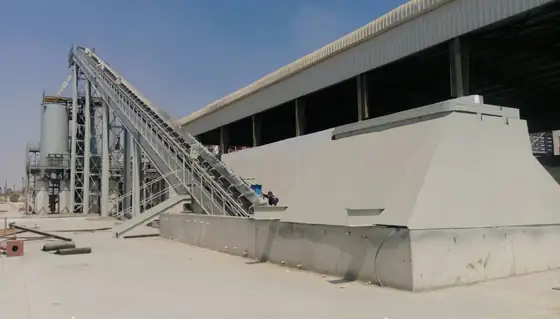 Maintenance & Troubleshooting
Belt tracking problems: causes, checks and fixes
Why a conveyor belt runs off to one side, how to check drums, rollers and slider beds in the right order, and which fixes a belt manufacturer recommends.
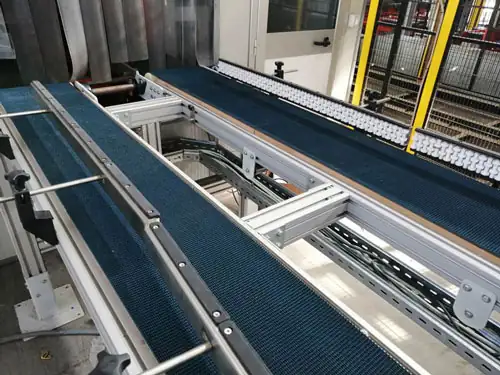 Maintenance & Troubleshooting
Belt slipping on the drive drum
Why a belt slips on its drive drum, how wet drums, lagging, wrap angle and tension change grip, and the checks and fixes to apply.
 Technical Engineering & Components
Conveyor rollers: types, materials, applications and maintenance
Gravity, driven, tapered, motor and idler rollers: materials, bearings, load capacity, pitch, and how to inspect and replace them.
