Where handling costs hide
Material handling adds cost without adding anything the customer pays for. Yet in many plants nobody knows what handling actually costs, because it is spread across many budgets: operators’ time, forklift fleets, product damage, machines waiting for material, injuries and absence, floor space used for work-in-progress, and overtime at peaks. Before deciding whether conveyor automation is worth it, it helps to make these costs visible.
| Cost | How it shows up | How to measure it |
|---|---|---|
| Labour for moving and carrying | Staff walking, pushing carts, loading and unloading | Hours per shift spent on handling tasks × cost per hour |
| Forklift and vehicle use | Fleet, fuel or charging, drivers, maintenance, damage to racks | Annual fleet cost; share used for routine transport |
| Product damage | Dropped cartons, crushed packs, scuffed labels, rework | Damage reports and write-offs |
| Waiting and lost output | Machines starved of material or blocked by full outfeeds | Line stoppage records by cause |
| Injuries and absence | Back injuries from lifting, accidents with vehicles | Incident and absence records |
| Space and stock | Floor used for buffers and work-in-progress | Area × cost per m²; stock value |
| Peaks and overtime | Extra shifts or temporary staff at peaks | Overtime and temporary labour cost |
How conveyor automation reduces these costs
- Less walking and carrying. A conveyor moves loads continuously along a fixed route. People are freed from transport for work that adds value.
- Fewer touches, less damage. Each pick-up and set-down is a damage risk; conveyors with gentle transfers and zero-pressure accumulation reduce both.
- Machines kept running. Conveyors with buffers keep machines supplied and cleared, which raises output from existing equipment; see accumulation conveyor systems.
- Less forklift traffic in production areas, which improves safety and frees vehicles for other tasks.
- Better ergonomics. Loads arrive at working height instead of being lifted from the floor. ISO 11228-1 sets recommended limits for manual lifting, lowering and carrying, taking into account intensity, frequency and duration [1]; repetitive tasks that exceed them are strong candidates for mechanisation.
- Predictable capacity at peaks without adding temporary staff.
- Energy efficiency. Modern conveyors use efficient drives and can stop sections that are not carrying product. Zone-controlled 24 V roller conveyors activate a zone only when needed [3], and efficient motor classes reduce losses on continuously running drives; in the EU, minimum motor efficiencies are regulated by Regulation (EU) 2019/1781 [2]. See conveyor motors and gearboxes.
First simplify, then automate
Automating a bad flow makes it expensive and permanent. Before specifying conveyors:
- Map the current flow and measure loads, distances and times; see material handling systems guide.
- Remove unnecessary moves: change the layout or sequence so that material moves less.
- Combine moves into unit loads (cases, totes, pallets) where possible.
- Mechanise the remaining heavy or repetitive moves with conveyors, lifts or handling aids.
- Automate controls and data where volume, accuracy or labour cost justify it.
Building a payback calculation
A credible business case uses your own measured figures, not generic percentages. The simple payback method is:
Net annual saving = Σ savings − added running costs
Payback (years) = total investment / net annual saving
- Savings
- labour hours released, damage reduction, avoided downtime, reduced overtime, vehicle costs avoided, space released
- Added running costs
- energy, maintenance, spare parts, any additional supervision or software fees
- Total investment
- equipment, controls, installation, civil works, commissioning, training, project management
Illustrative example, not an ENTRA project (generic currency units)
A conveyor link between a packing area and the dispatch zone costs 1,000,000 units in total. It releases two operators on each of two shifts from carrying cartons (4 positions at an assumed 120,000 units per year each: 480,000), reduces damaged cartons by an estimated 40,000 per year, and adds 50,000 per year in energy and maintenance. Net annual saving: 480,000 + 40,000 − 50,000 = 470,000 units. Simple payback: 1,000,000 / 470,000 ≈ 2.1 years.
Larger projects deserve a fuller analysis (net present value, sensitivity to volume and labour cost), but the inputs are the same. Two cautions: count released labour only if it is actually redeployed or not hired, and include the cost of disruption during installation.
When automation does not pay
- Low or highly variable volumes on routes that change often: trucks or simple carts may be cheaper.
- Over-sized systems designed for volumes that never arrive.
- Automating an unnecessary movement that a layout change would have removed.
- Systems the site cannot maintain, because of missing skills or spare parts.
- Ignoring the people: operators who were not involved may work around the system.
Where small projects pay back fastest
- An incline conveyor that removes repeated lifting to a mezzanine or truck.
- An accumulation conveyor before a machine that stops often.
- A conveyor link between two departments that currently use carts or forklifts.
- Powered roller conveyors replacing pushing on long gravity lanes.
- A lift table or tilting station that ends manual lifting at a workstation.
These projects are small enough to decide quickly and big enough to prove the concept for larger steps.
Estimating handling hours from observation
Illustrative example, not an ENTRA project
An operator carries cartons from a packing table to a pallet 25 m away, two cartons per trip. A round trip, including picking up and setting down, takes about 45 seconds. At 600 cartons per shift, that is 300 trips × 45 s = 13,500 s, about 3.75 hours per shift spent on transport alone, before any time for stacking. Over two shifts and 300 working days a year, about 2,250 hours of transport could be released by a conveyor link, plus the reduction in lifting and carrying load on the operator.
Simple time observations like this, repeated for each handling task, give a much more reliable basis for the payback calculation than general percentages.
Benefits that are hard to price but real
- Safety and health: fewer lifting injuries and fewer vehicle movements near people.
- Quality: less damage, fewer mix-ups, more consistent presentation to machines and inspection.
- Predictability: a controlled flow makes planning easier and shows bottlenecks clearly.
- Staff retention: physically demanding handling jobs are difficult to staff.
- Customer audits: multinational customers increasingly assess ergonomics and safety at suppliers’ sites.
Measure the results
Agree before the project which indicators will show success: handling hours per unit produced, damage rate, line stoppages caused by material supply, overtime at peaks, injuries. Measure them before and after. Results that are measured are believed, and they make the case for the next improvement. ENTRA’s approach starts with exactly this: study the current line, propose a solution that shortens the path and cuts losses, then supply and support it [4].
Frequently asked questions
How does a conveyor reduce handling costs?
By replacing manual carrying and repeated handling, reducing product damage, keeping machines supplied so they do not wait, reducing forklift traffic, and improving safety and ergonomics.
How do I calculate the payback of a conveyor system?
Estimate the annual savings (labour hours, damage, downtime, energy and other measurable costs) minus the added running and maintenance costs, and divide the total investment by the net annual saving. Use your own measured figures.
Can automation increase costs?
Yes, if it automates an unnecessary movement, is oversized for the real volume, or is hard to maintain. Simplify the flow first, then automate what remains.
Is conveyor automation only for large factories?
No. Small, well-targeted conveyors, such as one incline, one buffer or one link between two processes, often pay back faster than large projects.
Sources and references
- ISO, ISO 11228-1:2021 Ergonomics — Manual handling — Part 1: Lifting, lowering and carrying. Checked 28 Nov 2026.
- European Commission, Energy Efficient Products: electric motors and variable speed drives (Regulation (EU) 2019/1781). Checked 28 Nov 2026.
- MH&L, 24-volt conveyor line conserves power (zone activation and zero-pressure accumulation). Checked 28 Nov 2026.
- ENTRA Electromechanical, About ENTRA (company history, scope and certifications as published by ENTRA). Checked 28 Nov 2026.
Sources are listed for technical accuracy. Names of standards bodies, regulators and manufacturers appear only to credit the source; ENTRA does not claim their products or specifications as its own.
Mechanical, electrical and controls engineers at ENTRA Electromechanical, Cairo. Since 2007 the team has designed, supplied, installed and maintained conveyor and material-handling systems for plants in Egypt and the Arab region. About ENTRA
Researched and drafted with AI assistance from the sources listed above, checked by recalculating every worked example, and published by the ENTRA Engineering Team.
Copyright © 2026 ENTRA. All Rights Reserved. Text, calculations and original graphics on this page may not be reproduced without permission.
Related articles
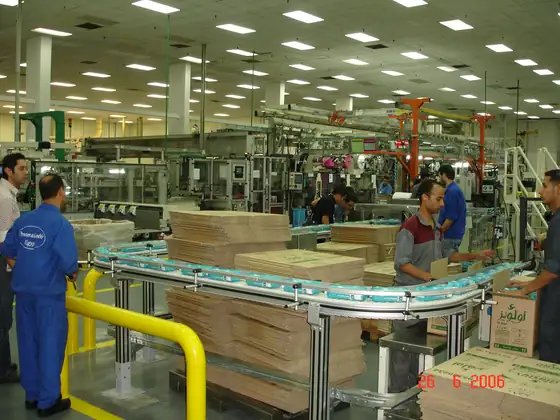 Material Handling & Automation
Material handling systems: a complete guide to industrial material flow
How to map, measure and improve material flow in a factory or warehouse, and how conveyors, lifts and handling equipment form one system.
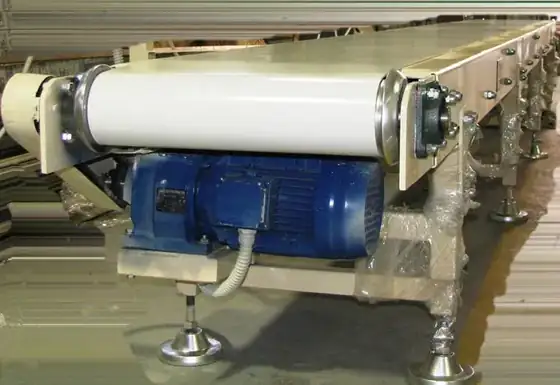 Technical Engineering & Components
Conveyor motors and gearboxes: selection, performance and efficiency
How to select a conveyor gearmotor: torque, speed, service factor, gearbox type, IE efficiency classes, VFDs and brakes, with an example.
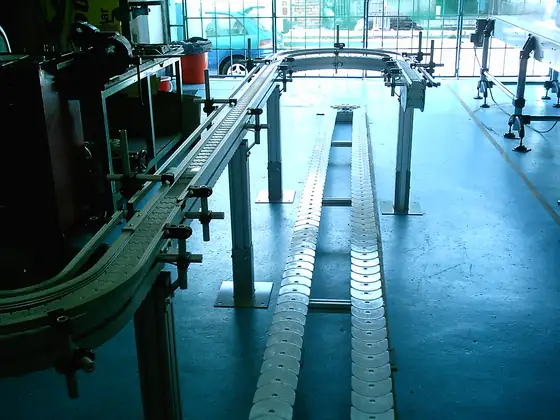 Industrial Solutions & Business
Choosing the right conveyor and material handling solutions provider in Egypt and the Middle East
How to compare conveyor and material handling suppliers in Egypt and the Middle East: engineering, references, service, spares and safety.
