
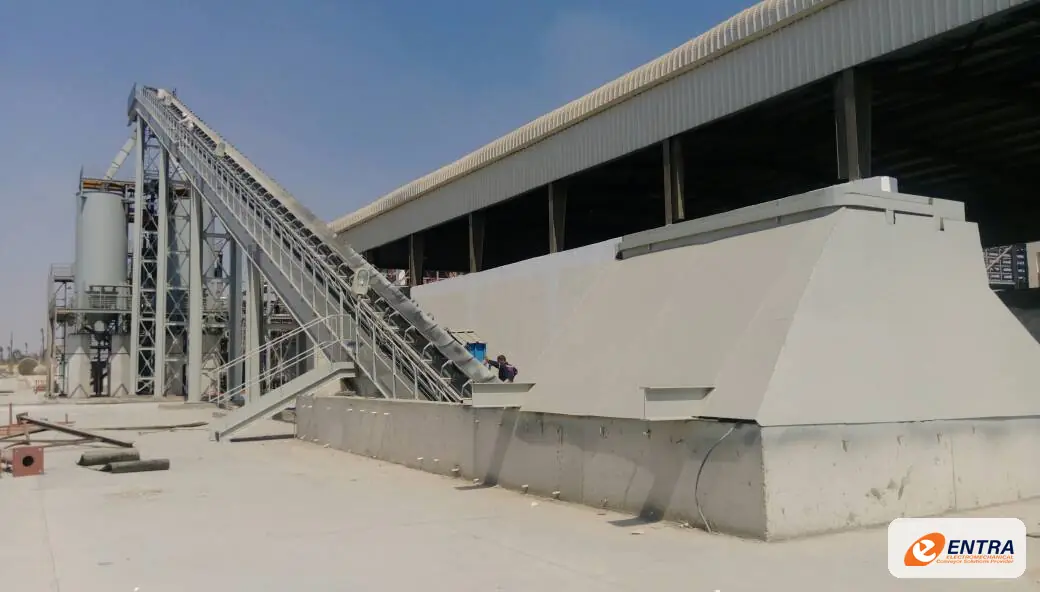
Why a belt runs off to one side
A conveyor belt follows the forces acting on it. Whenever one side of the belt is pulled, pushed or tensioned more than the other, it moves sideways until the forces balance again, or until its edge reaches the frame. Mistracking is therefore a symptom, and adjusting a tracking screw only moves the problem unless the cause is found.
The causes below are the ones a belt manufacturer lists for light conveyor belts [1]. They fall into four groups.
| Group | Causes listed by the manufacturer |
|---|---|
| Geometry | Drums or support rollers not parallel; belt wider than the drum, or drum proportions not matched to the belt width; too much crown (conicity) on the drums; drums that bend under belt tension on wide belts. |
| Tension | Too little elongation at fitting on short conveyors, so the belt edges do not hug the drum; uneven heat or uneven load across the width, which makes the tension uneven. |
| Loading and side forces | Products fed off-centre, unevenly, or dropped from a height; cleaners, side skirts or ploughs pressing on the belt. |
| Condition and use | Dirt, damage or wear on drums, rollers and slider beds; guides that damage the belt edge; a belt adjusted for one direction then run in reverse. |
A check sequence for the maintenance team
This order starts with the quick checks that do not involve adjusting anything, so you do not "fix" alignment that was never wrong. It is compiled from the manufacturer's causes above.
Safety first
Stop the conveyor and isolate and lock out its energy sources before reaching into it, following your site's lockout procedure. Observe tracking only from outside the guards while it runs.
- Watch it run, empty and loaded. Note where the belt starts to drift (near the drive drum, the tail drum, or along the carrying side) and whether it drifts the same way empty and loaded. Drift only under load points to the loading; drift when empty points to the conveyor.
- Check the loading. Is product placed in the centre of the belt, evenly, and without falling from height? Off-centre feeding is one of the listed causes [1].
- Look for side forces. Check that scrapers, side skirts, ploughs and guides do not press on the belt and are not pushing one edge [1].
- Clean. Remove product build-up, oil and dirt from drums, rollers and the slider bed. On a new or rebuilt conveyor, also remove rust inhibitor and paint residues: the manufacturer notes that residues of protective paints cause tracking problems [1].
- Check condition. Look for worn lagging, flat spots, seized rollers, grooves worn into drum faces and damaged belt edges. Replace damaged or heavily worn parts [1].
- Check alignment. With the belt slack, check that the drums are square to the conveyor. One method from the manufacturer: adjust the end drums until the centre distances on both sides are equal and the two diagonals are equal. Another: square the drive drum first, then adjust the end drum until both centre distances match. Then align each support roller or slider-bed section parallel, working from the end drum [1].
- Check tension. On short conveyors, too little tension lets the belt lift away from the drum edges so the crown cannot steer it [1]. Tension to the belt supplier's recommended elongation, evenly on both sides.
- Only now, fine-adjust. Make small adjustments to the tail or snub roller, wait for several belt revolutions after each one, and record what you changed.
Design measures that keep a belt tracking
Crowned drums
A drum with a cylindrical centre and tapered edges centres the belt. The manufacturer recommends a cylindrical length of half the belt width, and notes that the centring effect increases with belt speed and drum diameter. Too much taper is counter-productive: the belt no longer hugs the drum and is not guided [1]. Its maximum crown heights for its own light belts are:
| Belt construction | Drum Ø ≤ 200 mm | > 200 to 500 mm | > 500 mm |
|---|---|---|---|
| Single-ply | 0.5 mm | 0.8 mm | 1.0 mm |
| Double-ply | 0.7 mm | 1.3 mm | 1.5 mm |
| 3-ply | 1.0 mm | 1.6 mm | 2.0 mm |
These are maximum values. The manufacturer says to reduce them to the single-ply values where lateral forces cause creasing, for centre drives, and for wide belts with a short distance to the drive. For conveyors 5 m long or more, both end drums should be crowned, and drums must be adjustable [1]. For other belt makes, use that manufacturer's crown table.
Proportions and stiffness
- The belt should not be wider than the drum. The manufacturer says to avoid this "at all costs" [1].
- Drums should be as large as practical. On wide conveyors, undersized drums bend under belt tension, which causes creasing and mistracking [1].
- The frame should be rigid enough that belt forces do not change its shape [1].
- Drum faces should be smooth: the source gives a roughness limit of Rz ≤ 25 µm and warns that pronounced turning grooves harm tracking [1].
Short, wide conveyors
When the distance between drum centres is about the same as the belt width or less, crowned drums alone cannot control the belt, and the manufacturer recommends automatic belt control [1].
Tracking rollers and guide profiles
- A snub roller next to the end drum gives the most efficient control, especially if it can be adjusted in both directions or motorised for automatic control [1].
- On flat belts, support rollers that can pivot by about 2–4° help steer long belts. On troughed belts, some side idlers can be turned up to about 3° in the direction of travel [1].
- On reversing conveyors, adjust tracking on the crowned drums, not on snub rollers, because a belt set up for one direction often drifts in the other [1].
- Guide profiles welded to the underside of the belt run in grooves in the slider bed. They must not push sideways against the end drums: the source specifies end-drum grooves at least 8–10 mm wider than the profile on conveyors with centre distances over 1.5 m. Rigid edge guides that rub the belt edge should be avoided [1].
Automatic tracking
Where side forces are large or the conveyor is long, edge sensors (mechanical, electrical, optical, pneumatic or hydraulic) can drive a swivelling snub roller through an electric spindle or pneumatic cylinder. The manufacturer notes this is generally used on long knife-edge conveyors such as cooling tunnels [1].
When to call for engineering help
If a belt still drifts after cleaning, alignment and tension have been checked, the cause is usually in the design: drum proportions, crown, frame stiffness or the loading arrangement. Changing those needs an engineering review of the conveyor, not further adjustment.
Sources and references
- Forbo Siegling, Recommendations for machine design (Siegling Transilon), ref. no. 305, Ref. no. 305-2, edition 02/21. Checked 27 Nov 2026.
Sources are listed for technical accuracy. Names of standards bodies, regulators and manufacturers appear only to credit the source; ENTRA does not claim their products or specifications as its own.

Mechanical, electrical and controls engineers at ENTRA Electromechanical, Cairo. Since 2007 the team has designed, supplied, installed and maintained conveyor and material-handling systems for plants in Egypt and the Arab region. About ENTRA
Researched and drafted with AI assistance from the sources listed above, checked by recalculating every worked example, and published by the ENTRA Engineering Team.
Copyright © 2026 ENTRA. All Rights Reserved. Text, calculations and original graphics on this page may not be reproduced without permission.
Related articles
 Maintenance & Troubleshooting
Belt slipping on the drive drum
Why a belt slips on its drive drum, how wet drums, lagging, wrap angle and tension change grip, and the checks and fixes to apply.
 Maintenance & Troubleshooting
Conveyor system maintenance: preventive maintenance, common problems and solutions
A preventive maintenance plan for belt, roller and chain conveyors: routine checks, safe isolation, spare parts and a troubleshooting table.
 Conveyor Engineering
Belt conveyor systems: design, components, working principles and applications
How a belt conveyor works, what each component does, the design choices that matter, and where belt conveyors fit in food, packaging and bulk plants.
