
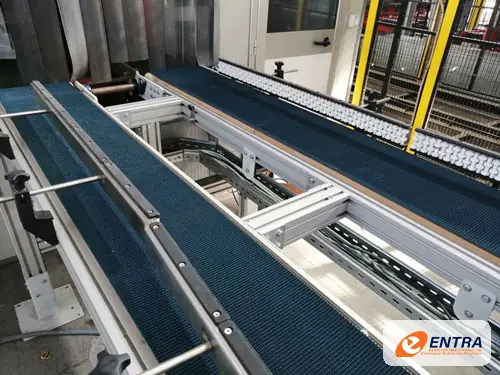
Why a belt slips on its drive drum
The drive drum moves the belt only through friction. That friction depends on how hard the belt presses on the drum and how well the two surfaces grip. A belt slips when the pull it must transmit (the effective pull FU) is more than the grip available. So every cause of slip falls into one of two groups: too little grip, or too much load.
A belt manufacturer’s published calculation method [1] expresses the grip side in its calculation method. The maximum belt pull the belt must carry is
F1 = FU · C1
- F1
- maximum belt pull, N
- FU
- effective pull, N
- C1
- drive-drum factor from the table below
C1 depends on the drum surface, whether it is wet or dry, the belt's underside, and the arc of contact [1]. A higher C1 means the belt needs more tension to transmit the same effective pull: there is less grip to work with.
| Drive drum | Underside V3, V5, U2, A5, E3 | Underside 0, U0, NOVO, E0, A0, T, P |
|---|---|---|
| Smooth steel, dry | 1.5 / 1.4 / 1.3 | 2.1 / 1.9 / 1.7 |
| Smooth steel, wet | 3.7 / 3.2 / 2.9 | not recommended |
| Lagged, dry | 1.4 / 1.3 / 1.2 | 1.5 / 1.4 / 1.3 |
| Lagged, wet | 1.8 / 1.6 / 1.5 | 2.1 / 1.9 / 1.7 |
Three patterns in the table explain most slip problems: on a smooth steel drum, water more than doubles the belt pull needed; lagging reduces it, and a larger arc of contact reduces it.
Illustrative example, not an ENTRA project
Take the effective pull from the manufacturer's worked example, 4,350 N, and a lagged drive drum with 180° contact and a belt in the 0/U0 group.
Dry: F1 = 4,350 × 1.5 = 6,525 N
Wet: F1 = 4,350 × 2.1 = 9,135 N
The same conveyor needs 40% more belt pull to drive reliably once the drum gets wet. If it was tensioned for dry running, it can slip after a washdown.
Causes, grouped
Too little grip
- Not enough tension. The contact pressure that transmits the effective pull comes from stretching the belt with the take-up [2]. The source gives elongation-at-fitting ranges by belt type: 0.3–1.0% for standard polyester, 0.2–0.8% for high-tech polyester, 0.15–0.8% for aramid [1]. A belt fitted below its range, or one whose take-up has backed off, slips.
- Wet, oily or dirty drum. See the table: on a smooth steel drum, water more than doubles C1, and for some belt undersides a wet smooth drum is not recommended at all [1].
- Missing or worn lagging. Lagging is often applied to improve friction on the drive drum. The manufacturer recommends abrasion-resistant polyurethane or rubber: plastic lagging at least 85 Shore A, rubber lagging more than 65 Shore A [2]. Worn-smooth lagging loses this benefit.
- Small arc of contact. C1 falls as the wrap increases from 180° to 240° [1]. Snub rollers are used to increase the arc of contact on the drive drum [2].
- Drum too small. The manufacturer says drums should be as large as possible, with the minimum diameter set by the effective pull to be transmitted [2].
- Temperature. Belts lengthen as they warm, and a rigid (screw) take-up cannot compensate. The source recommends force-dependent take-ups (weight, pneumatic, hydraulic or spring) in high and fluctuating temperatures, though not for reversing drives [2].
Too much load
- More product than the design allowed, for example a full belt after a downstream stop.
- Extra drag. Scrapers and cleaning devices add their own frictional pull, which the source says must be included in the power calculation [2]. Residues of paint, varnish or dirt increase friction on sliding supports [2].
- Seized rollers or a dragging slider bed, which raise FU in the same way.
- Drive at the wrong end. The manufacturer calls the head drive (drive drum at the discharge end) the best configuration, as forces are applied more efficiently than with a tail drive [2].
Checks on site
Safety first
Stop the conveyor and isolate and lock out its energy sources before touching drums, lagging or the take-up, following your site's lockout procedure. Never try to stop a slipping belt by hand or by pressing on the drum.
- Note when it slips. Only under full load points to load or drag. After washdown or on wet days points to a wet drum. When cold at start-up, or after the line warms up, points to tension changing with temperature.
- Check for extra drag. With the belt off load, turn rollers and drums by hand where safe, and check scrapers, skirts and slider beds for build-up or contact pressure.
- Inspect the drive drum. Look for water, oil or product on the drum, and for worn, smooth or detached lagging.
- Check tension. Compare the belt's elongation with the supplier's recommended value for that belt type, and check that the take-up has not moved or run out of travel.
- Check the arc of contact. If a snub roller has been moved or removed, the wrap on the drive drum, and the grip, are lower.
- Only then increase tension, evenly on both sides, staying within the belt's permitted elongation. Over-tensioning to cure slip overloads the belt, drums and bearings.
Permanent fixes
- Lag the drive drum if it is plain steel, or replace worn lagging.
- Keep the drive drum dry: move or shield wash points, and add scraping where product reaches the drum.
- Add or reposition a snub roller to increase the arc of contact.
- Fit a force-dependent take-up where temperature varies, unless the conveyor reverses.
- Recalculate the effective pull with the real load and all drag sources; see Belt conveyor drive power. If the belt pull needed exceeds what the belt type allows, the belt, drum or drive arrangement must change.
Sources and references
- Forbo Siegling, Calculation methods – conveyor belts (Siegling Transilon), ref. no. 304, Ref. no. 304-2, edition 07/21. Checked 27 Nov 2026.
- Forbo Siegling, Recommendations for machine design (Siegling Transilon), ref. no. 305, Ref. no. 305-2, edition 02/21. Checked 27 Nov 2026.
Sources are listed for technical accuracy. Names of standards bodies, regulators and manufacturers appear only to credit the source; ENTRA does not claim their products or specifications as its own.

Mechanical, electrical and controls engineers at ENTRA Electromechanical, Cairo. Since 2007 the team has designed, supplied, installed and maintained conveyor and material-handling systems for plants in Egypt and the Arab region. About ENTRA
Researched and drafted with AI assistance from the sources listed above, checked by recalculating every worked example, and published by the ENTRA Engineering Team.
Copyright © 2026 ENTRA. All Rights Reserved. Text, calculations and original graphics on this page may not be reproduced without permission.
Related articles
 Maintenance & Troubleshooting
Belt tracking problems: causes, checks and fixes
Why a conveyor belt runs off to one side, how to check drums, rollers and slider beds in the right order, and which fixes a belt manufacturer recommends.
 Maintenance & Troubleshooting
Conveyor system maintenance: preventive maintenance, common problems and solutions
A preventive maintenance plan for belt, roller and chain conveyors: routine checks, safe isolation, spare parts and a troubleshooting table.
 Technical Engineering & Components
How to select the right conveyor belt for your industrial application
A step-by-step method to choose a conveyor belt: product, carcass, covers, surface, food contact, temperature, pulleys and joining.
