
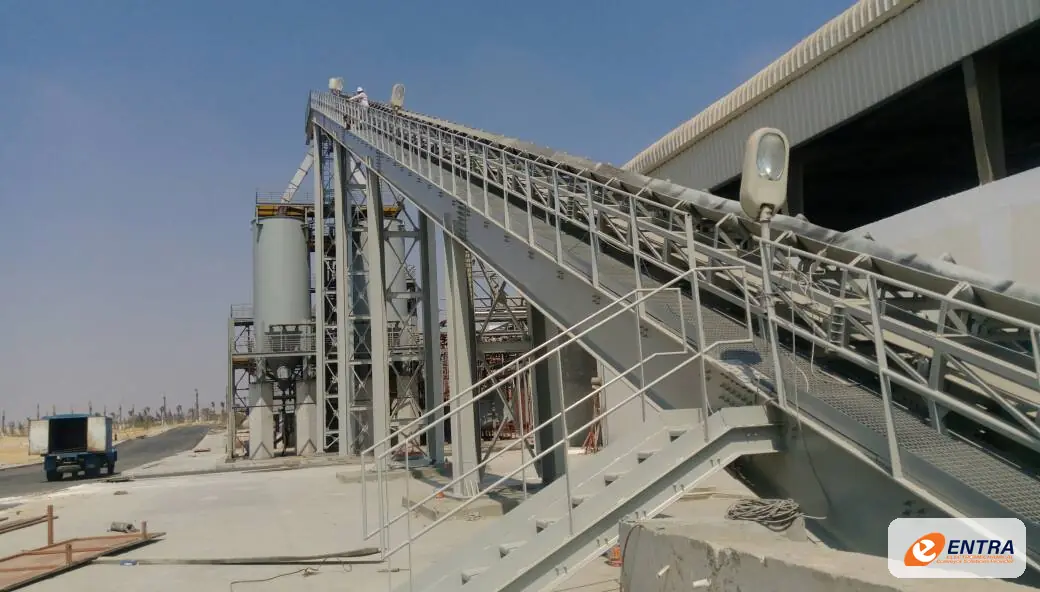
How a belt conveyor works
A belt conveyor is a closed loop of belt stretched between two drums. A geared motor turns the drive drum, friction between drum and belt pulls the belt, and the belt carries the load along the top (carrying) side before returning underneath. The whole design is about three things: transmitting enough pull to the belt without slip, keeping the belt running straight, and supporting the load without excessive friction or sag.
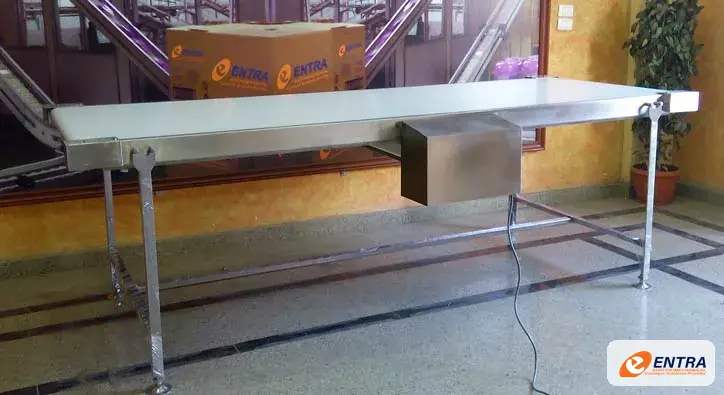
Two broad families exist. Unit-goods belt conveyors carry cartons, bags, trays and products on light fabric belts, usually over a flat slider bed or closely spaced rollers. Light conveyor belts of this kind are described in ISO 21183-1 [1]. Bulk belt conveyors carry loose materials on heavier rubber belts formed into a trough by idler sets; their belts are specified under standards such as ISO 14890 [2], and their power and belt tensions are calculated with methods such as ISO 5048 [3].
Components and what each one does
| Component | Function | Design points |
|---|---|---|
| Belt | Carries the product and transmits the pull | Carcass strength, cover material, surface, food contact, minimum drum diameter |
| Drive drum (head pulley) | Transmits torque to the belt by friction | Diameter, lagging, crown, wrap angle, position (head or centre drive) |
| Gearmotor | Provides torque and speed | Power, ratio, efficiency, mounting, brake, speed control |
| Tail (return) drum | Turns the belt at the other end | Diameter, crown, often the tensioning point |
| Take-up / tensioner | Sets and maintains belt tension | Screw or gravity take-up, travel for belt stretch |
| Bed or carrying idlers | Supports the loaded belt | Slider bed vs rollers; idler spacing and class for bulk belts |
| Return rollers | Support the empty return belt | Spacing, cleaning, sag |
| Frame and supports | Hold alignment and carry loads | Stiffness, squareness, levelling, cleanability |
| Side guides, skirts, scrapers | Keep products and material in place, clean the belt | Gaps, wear, contact pressure |
| Guards, emergency stops, sensors | Protect people and control the conveyor | Nip-point guarding, stop circuits, product detection |
The design decisions that matter
Slider bed or roller bed
On a slider bed, the belt slides over a flat steel or plastic plate. The surface is stable and quiet, small products do not fall between rollers, and it suits light loads and short lengths. The price is friction: the drive must overcome the sliding resistance of the loaded belt on the bed. On a roller bed, the belt runs over rollers, which reduces friction and power on longer or heavier conveyors and on accumulating lines. The belt’s underside coating is chosen to match the bed.
Drive position and grip
The simplest arrangement is a head drive, where the drum at the discharge end pulls the loaded belt. Centre drives with snub rollers are used on reversing conveyors and where the ends must be compact. In every case the drum must transmit the effective pull without slipping; grip depends on belt tension, wrap angle, the friction between belt and drum, and whether the drum is wet. Our guide to belt slip on the drive drum explains these factors, and belt conveyor drive power shows how to estimate the pull and motor power.
Tensioning
Fabric belts stretch slightly in the first period of operation and over their life. A screw take-up at the tail is common on unit-goods conveyors; long or bulk conveyors use gravity take-ups that keep tension constant. Too little tension causes slip; too much overloads bearings, shafts and the belt splice and makes tracking harder.
Tracking
A belt runs towards the side it touches first. Square frames and drums, crowned drums, even tension and clean surfaces keep it central. On short, wide conveyors, crowning alone may not be enough and automatic belt control is used. See belt tracking problems: causes, checks and fixes.
Inclines, declines and transfers
The safe incline angle depends on the product’s base, its centre of gravity and the friction of the belt surface. Rough-top and profiled belts, cleats and sidewalls allow steeper angles than smooth belts, but the angle must be confirmed with the real product, including wet or dusty conditions. Transfers between belts need small gaps, transfer plates or knife-edge ends for small products, and matched speeds or a slight speed increase to separate products.
Bulk belt conveyors: what is different
For bulk materials the belt is troughed by sets of idlers, typically three rolls, which increases the load cross-section. Idler classes are standardised in North America by CEMA in classes B to F for troughing, return and picking idlers [4], and the class is chosen from the calculated idler load and required bearing life. ISO 5048 defines the resistances to motion of a belt conveyor, the driving force and power requirements, and the capacity and cross-section for a smooth belt [3]. The capacity formula is covered in our speed and capacity calculations.
Bulk conveyors also need loading chutes and skirts that place material centrally at belt speed, belt cleaners at the discharge, and protection of nip points along the whole length. EN 620 sets safety requirements specific to fixed belt conveyors for bulk materials [5].
Where belt conveyors are used
- Food processing: inspection, sorting, cooling and packing lines, with food-contact belts and hygienic frames. See conveyors for food processing and packaging.
- Packaging and end of line: carton transport, inclines to mezzanines, case erectors and sealers.
- Logistics: parcel and carton handling, loading and unloading of trucks, inclines between floors.
- Bulk and process industries: chemicals, fertiliser, cement, aggregates, grain and recycling.
Quick troubleshooting for belt conveyors
| Symptom | Typical causes |
|---|---|
| Belt runs to one side | Drums or rollers not square, uneven tension, dirt on drums, frame twisted |
| Belt slips or stalls under load | Low tension, wet or worn drum surface, overload, too small a wrap angle |
| Edges fray | Mistracking against the frame, damaged side guides |
| Cracks near the splice | Drums smaller than the belt’s minimum diameter, over-tension, poor splice |
| Products slide back on inclines | Angle too steep for belt surface, wet or dusty belt, sudden starts |
| Noise and high power | Slider bed friction, seized return rollers, belt underside worn |
For detailed procedures see belt tracking, belt slip and the conveyor maintenance guide.
Belt conveyor specification checklist
- Product range: dimensions, mass, base, temperature, whether loose or packed.
- Rate at normal and peak operation, and the product spacing.
- Length, width, height at infeed and discharge, inclines and declines.
- Bed type, belt type and surface, food-contact or antistatic requirements.
- Drive position, speed range, reversing, start and stop frequency.
- Transfers to and from other conveyors and machines.
- Environment: dust, water, washdown, temperature, outdoor exposure.
- Frame material and finish: painted steel, galvanised, stainless steel, aluminium.
- Controls: local or central, sensors, speed control, signals to machines.
- Guarding, emergency stops and access for cleaning and maintenance.
Sending this information with the first enquiry shortens the design and quotation stage considerably, and avoids surprises during installation.
Safety checklist for belt conveyors
- Guard the in-running nips at every drum, snub roller and take-up, and at return rollers within reach. Safety distances for guards are given in ISO 13857 [6].
- Fit emergency stops within reach along the conveyor and pull-wire switches on long conveyors.
- Plan safe isolation for cleaning, tracking adjustment and belt changes.
- Prevent products or material falling from height onto walkways, with guards or catch trays.
Belt conveyors are simple machines that reward good engineering. When the belt, drive, bed and frame are chosen together, they run straight, quietly and for many years.
Frequently asked questions
What are the main components of a belt conveyor?
The belt, the drive drum with its gearmotor, the tail (return) drum, a take-up or tensioning device, the bed that supports the belt (slider bed or idlers/rollers), return rollers, the frame and supports, and safety devices such as guards and emergency stops.
What is the difference between a slider bed and a roller bed?
On a slider bed the belt slides over a flat plate, which gives a stable, quiet surface for small or unstable products but more friction. On a roller bed the belt runs over rollers, which lowers friction and drive power for longer and heavier conveyors.
Why does my conveyor belt run to one side?
Usually because drums, rollers or the frame are not square to the belt, the belt is not tensioned evenly, material has built up on a drum, or the belt splice is not square. Our belt tracking guide gives a full check sequence.
What is the maximum incline for a belt conveyor?
It depends on the product and the belt surface. Smooth belts suit gentle inclines; profiled or cleated belts allow steeper ones. The safe angle must be confirmed with the actual product and belt, not taken from a general table.
Sources and references
- ISO, ISO 21183-1:2005 Light conveyor belts — Part 1: Principal characteristics and applications. Checked 28 Nov 2026.
- ISO, ISO 14890:2026 Conveyor belts — Specification for rubber- or plastics-covered conveyor belts of textile construction for general use. Checked 28 Nov 2026.
- ISO, ISO 5048:1989 Belt conveyors with carrying idlers — Calculation of operating power and tensile forces. Checked 28 Nov 2026.
- CEMA / ANSI Webstore, CEMA 502-2015 Bulk material belt conveyor troughing and return idlers — Selection and dimensions (classes B to F). Checked 28 Nov 2026.
- BSI, BS EN 620:2021 Continuous handling equipment and systems — Safety requirements for fixed belt conveyors for bulk materials. Checked 28 Nov 2026.
- ISO, ISO 13857:2019 Safety of machinery — Safety distances to prevent hazard zones being reached by upper and lower limbs. Checked 28 Nov 2026.
Sources are listed for technical accuracy. Names of standards bodies, regulators and manufacturers appear only to credit the source; ENTRA does not claim their products or specifications as its own.

Mechanical, electrical and controls engineers at ENTRA Electromechanical, Cairo. Since 2007 the team has designed, supplied, installed and maintained conveyor and material-handling systems for plants in Egypt and the Arab region. About ENTRA
Researched and drafted with AI assistance from the sources listed above, checked by recalculating every worked example, and published by the ENTRA Engineering Team.
Copyright © 2026 ENTRA. All Rights Reserved. Text, calculations and original graphics on this page may not be reproduced without permission.
Related articles
 Technical Engineering & Components
How to select the right conveyor belt for your industrial application
A step-by-step method to choose a conveyor belt: product, carcass, covers, surface, food contact, temperature, pulleys and joining.
 Technical Engineering & Components
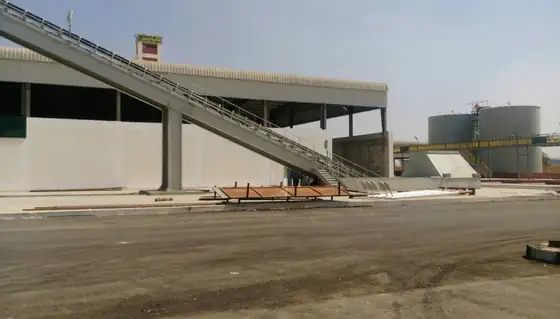
Belt conveyor drive power: a first estimate
Estimate effective pull, drum power and motor power for unit-goods belt conveyors with a published method and a checked example.
 Maintenance & Troubleshooting
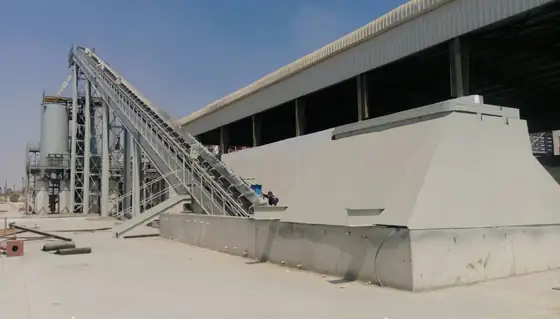
Belt tracking problems: causes, checks and fixes
Why a conveyor belt runs off to one side, how to check drums, rollers and slider beds in the right order, and which fixes a belt manufacturer recommends.
