
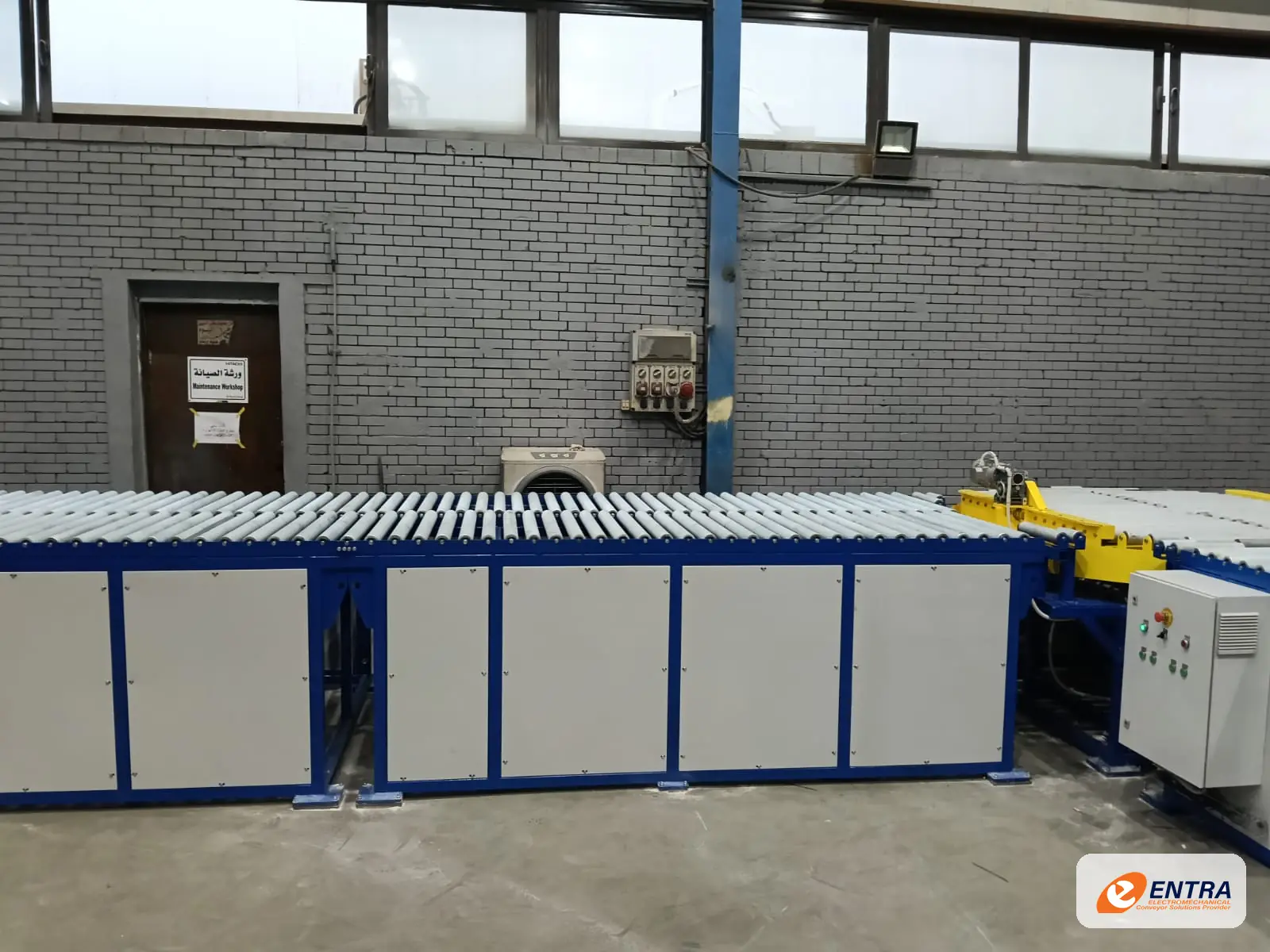
What conveyor rollers do
Rollers are the most numerous moving parts in most conveyor systems. On roller conveyors they carry the product directly; on belt conveyors they support the belt as carrying and return rollers; on bulk conveyors they are grouped in idler sets that form the belt into a trough. A single roller is a simple part, a tube turning on bearings around a shaft, but a conveyor may have hundreds of them, so their choice and condition have a large effect on noise, energy, product damage and maintenance effort.
Types of conveyor roller
| Type | Description | Typical use |
|---|---|---|
| Gravity (idler) roller | Free-turning, no drive element | Gravity conveyors, belt support, slave rollers |
| Sprocket roller | Single or double sprocket welded or moulded on the tube | Chain-driven roller conveyors, pallets, heavy goods |
| Grooved / Poly-V roller | Grooves or Poly-V profile for belt drives between rollers | Quiet drives for cartons and totes |
| Friction or slip roller | Drive head slips at a set torque | Low-pressure accumulation |
| Tapered roller | Conical tube or sleeve | Curves, keeping products aligned |
| Motor roller (MDR) | Motor and gearbox inside the tube, often 24 V DC | Zone-controlled, zero-pressure conveyors |
| Idler sets and impact rollers | Steel rollers in frames; rubber rings on impact rollers | Bulk belt conveyors, loading zones |
| Return rollers | Plain, rubber-disc or spiral rollers under the belt | Supporting and cleaning the return belt |
Materials
Tubes
- Zinc-plated or galvanised steel: the general-purpose choice for dry areas and most loads.
- Stainless steel: wet, washdown, food and corrosive areas.
- Aluminium: light weight, low inertia.
- Plastic (PVC, PP): light loads, quiet running, corrosion-free, low cost.
- Coatings and sleeves: PVC, PU or rubber sleeves increase grip, reduce noise or protect sensitive products.
Bearings and seals
Precision ball bearings give low rolling resistance and long life under heavy loads and higher speeds. Semi-precision and plastic bearings suit light loads, low speeds and wet areas. Seals and labyrinths keep dust and water out; in washdown areas, stainless or plastic bearings and sealed designs avoid rust and lubricant loss. Bearing life is calculated according to ISO 281, whose basic rating life is the life associated with 90% reliability under conventional operating conditions [2]; roller manufacturers publish load capacities that already take this into account for their designs.
Shafts and fixings
Spring-loaded shafts make rollers quick to insert and remove on light conveyors; female-threaded or flatted shafts fixed by screws stiffen the frame and suit heavier duties, drives and inclines. Hexagonal shafts stop the shaft turning in the frame and wearing the holes.
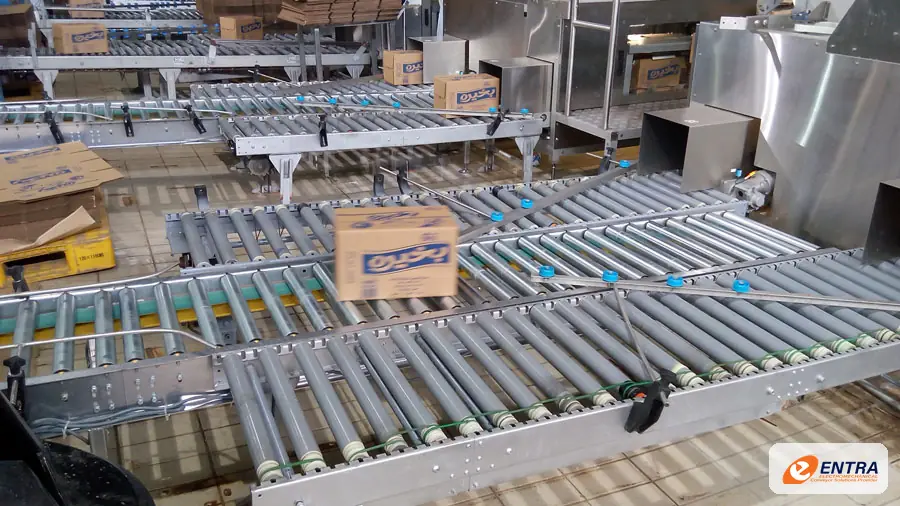
Selecting rollers
- Length: a roller manufacturer’s planning rules take the reference roller length as conveyor width plus 50 mm, or plus 100 mm for large goods such as pallets [1].
- Pitch: close enough that the product is carried by at least three rollers at any time [1]; see the calculator in our roller conveyor design guide.
- Load per roller: the heaviest product’s weight divided by the rollers actually in contact with it; for pallets, only the rollers under the bulk of the pallet carry the load [1]. Compare with the roller’s rated capacity for its length, and allow for impacts and uneven bases.
- Diameter and wall thickness: larger diameters and thicker walls carry more load and run more smoothly over gaps; they also cost more and add inertia.
- Speed: bearing type and tube balance must suit the conveyor speed.
- Environment: moisture, cleaning chemicals, temperature, dust and food contact decide tube, bearing and seal materials.
- Drive: sprockets, grooves or Poly-V heads, or motor rollers, to match the drive design.
Idlers for bulk belt conveyors
On bulk belt conveyors, idler selection follows the calculated idler load from belt mass, material load, idler spacing and belt tension. In North America, CEMA standardises troughing, return and picking idlers in classes B, C, D, E and F [3], and the class is chosen from load and required bearing life. Impact idlers with rubber rings protect the belt at loading points.
Inspection and maintenance
Rollers fail gradually. A roller that has stopped turning becomes a brake: it scuffs products, wears belts, and on belt conveyors can be cut through by the belt and form a sharp edge. A simple routine catches problems early:
- Walk and listen: grinding, squealing or clicking bearings are audible long before they seize.
- Look: rollers that do not turn under load, flat spots, bent tubes, missing or loose shafts, worn or missing drive belts.
- Feel (with the conveyor isolated): rough rotation, play in the bearing, shafts turning in the frame.
- Clean: remove stretch film, labels, product residue and dust wrapped around rollers and shafts.
- Check drives: chain tension and lubrication on chain-driven rollers, wear on Poly-V and round belts.
- Replace promptly and with the same type and length; mixing roller types in one section causes uneven support and noise.
Before any work inside guards, stop the conveyor and isolate and lock out all energy sources. Our conveyor maintenance guide includes a full checklist.
Common roller problems and causes
| Problem | Likely causes |
|---|---|
| Products skew or drift | Rollers not square to the frame, uneven roller height, worn sleeves, mixed roller types |
| Products stop on gravity sections | Seized bearings, dirt, too gentle a slope for the lightest products |
| Products run away on gravity sections | Slope too steep for heavy products, missing speed controllers |
| Noise | Worn bearings, loose shafts, unbalanced tubes at high speed |
| Bent or dented rollers | Overload, impacts at loading points, pitch too wide for the load |
| Rust | Wrong material or seals for wet or washdown conditions |
Roller specification checklist
- Roller type (gravity, driven with sprocket, groove, Poly-V or friction head, tapered, motor roller).
- Tube diameter, wall thickness and material; any sleeve or coating.
- Between-frame width and overall roller length; shaft type, diameter and fixing (spring, female thread, flats, hexagon).
- Bearing type and seal; expected speed and load per roller.
- Environment: wet, washdown, cold, hot, dusty, food contact.
- Quantity, including spares, and drive elements (chains, belts) if part of the supply.
When replacing rollers, measure the between-frame dimension and shaft details on the existing conveyor rather than relying on drawings, which may not reflect modifications made over the years.
Safety note
Driven rollers create in-running nips between rollers and between rollers and belts or chains, which can trap fingers, clothing and hair. EN 619 sets safety requirements for unit-load handling equipment including gravity and driven roller conveyors [4]. Guard drive chains and belts, use roller covers or narrow gaps where people can reach, and never clear a jam on a running conveyor.
Frequently asked questions
What are conveyor rollers made of?
Tubes are usually zinc-plated or galvanised steel, stainless steel, aluminium or plastic (PVC, PP). Shafts are steel or stainless steel. Bearings are precision or semi-precision ball bearings, or plastic bearings for light duty and washdown.
How do I know which roller load capacity I need?
Divide the weight of the heaviest product by the number of rollers actually in contact with it and compare the result with the roller’s rated capacity for its length. Allow for impact and uneven bases.
What are tapered rollers used for?
On roller conveyor curves, so that the outer end of the roller turns faster than the inner end and products follow the curve without skewing.
How often should conveyor rollers be checked?
Include them in routine inspections: look for rollers that do not turn, noisy or rough bearings, bent tubes, loose shafts and worn drive belts. Replace damaged rollers promptly because a stopped roller damages products and belts.
Sources and references
- Interroll, Conveyor rollers – General technical information / planning basics, Catalogue pages 184–203, edition 01. Checked 28 Nov 2026.
- ISO, ISO 281:2007 Rolling bearings — Dynamic load ratings and rating life. Checked 28 Nov 2026.
- CEMA / ANSI Webstore, CEMA 502-2015 Bulk material belt conveyor troughing and return idlers — Selection and dimensions (classes B to F). Checked 28 Nov 2026.
- EVS, EN 619:2022 Continuous handling equipment and systems — Safety requirements for equipment for mechanical handling of unit loads. Checked 28 Nov 2026.
Sources are listed for technical accuracy. Names of standards bodies, regulators and manufacturers appear only to credit the source; ENTRA does not claim their products or specifications as its own.

Mechanical, electrical and controls engineers at ENTRA Electromechanical, Cairo. Since 2007 the team has designed, supplied, installed and maintained conveyor and material-handling systems for plants in Egypt and the Arab region. About ENTRA
Researched and drafted with AI assistance from the sources listed above, checked by recalculating every worked example, and published by the ENTRA Engineering Team.
Copyright © 2026 ENTRA. All Rights Reserved. Text, calculations and original graphics on this page may not be reproduced without permission.
Related articles
 Conveyor Engineering
Roller conveyor design: length, pitch, load and drives
Choose roller length and pitch, check the load per roller, control speed on gravity sections and compare roller conveyor drives.
 Conveyor Engineering
Roller conveyor systems: gravity vs powered roller conveyors
Gravity and powered roller conveyors compared: how each works, the drive options and how to choose the right roller conveyor for cartons, totes and pallets.
Maintenance & Troubleshooting
Conveyor system maintenance: preventive maintenance, common problems and solutions
A preventive maintenance plan for belt, roller and chain conveyors: routine checks, safe isolation, spare parts and a troubleshooting table.
