
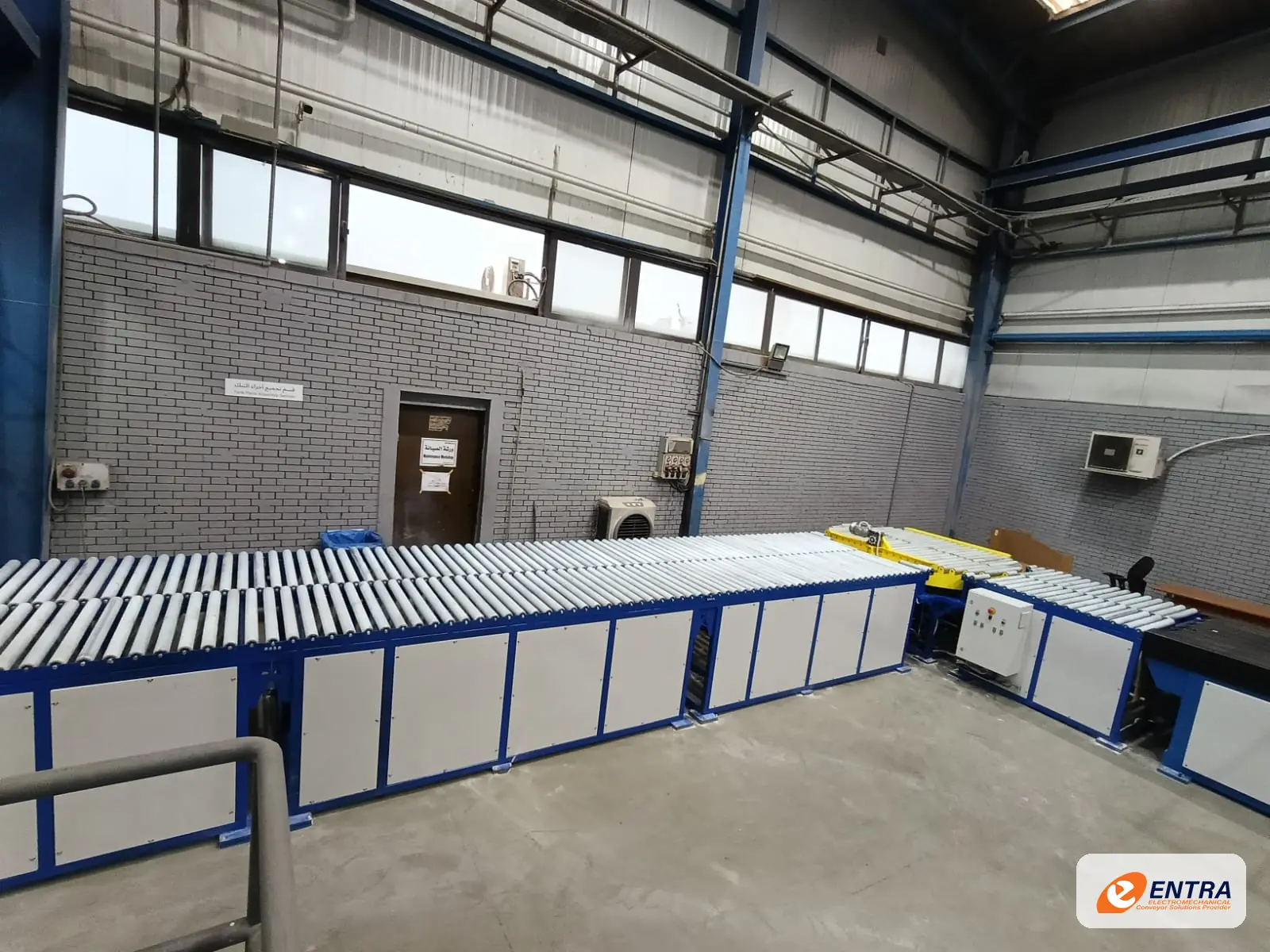
Four decisions that define a roller conveyor
Most roller conveyor problems, such as products tipping between rollers, rollers bending or wearing early, and loads running away on gravity sections, come from four early decisions: roller length, roller pitch, load per roller, and how the rollers are driven. This guide follows the planning rules published by a major roller manufacturer [1]. Its values apply to its own rollers; for other makes, use that manufacturer's catalogue.
1. Roller length
The source takes the reference roller length as the conveyor width plus 50 mm, or plus 100 mm for large goods such as pallets [1]. It also notes that roller load capacities assume the product bears on the full usable tube length: if a product touches less than about half of it, the application should be checked by the roller supplier [1].
2. Roller pitch
The rule is that the product must be carried by three rollers at any time [1]. For a product with a flat base of length L, that means:
p ≤ L / 3
nmin = ⌊ L / p ⌋
- p
- roller pitch (centre to centre), mm
- L
- length of the product's base in the direction of travel, mm
- nmin
- fewest rollers under the product in any position (rounded down)
Use the shortest product the conveyor will ever carry. The source warns that bases with cross ribs, or other uneven shapes, may need the pitch to be found by trial [1].
Illustrative example, not an ENTRA project
The shortest carton is 400 mm long and weighs 20 kg. Maximum pitch: 400 / 3 = 133 mm. At 120 mm pitch at least 3 rollers are under the carton; at 100 mm, at least 4.
3. Load per roller
Divide the product's weight by the number of rollers that are actually in contact with it, not the number underneath it. The source's example: if 20 rollers lie under a long product but only 15 touch it, each roller must be able to carry one fifteenth of the weight [1]. Pallets are the extreme case: only the rollers under the bulk of the pallet actually carry the load [1].
Froller = m · g / ncontact
Compare Froller (N) with the roller's static load capacity for the actual roller length, from the manufacturer's table.
Illustrative example, not an ENTRA project
The 20 kg carton on three rollers: 20 × 9.81 / 3 = 65.4 N per roller. On four rollers: 49.1 N.
Calculator
- Maximum pitch (3-roller rule)
- –
- Rollers under product (minimum)
- –
- Load per roller in contact
- –
Preliminary check for products with a flat base. Compare the load with the roller manufacturer's static capacity for your roller length. Pallets and ribbed bases need separate checks.
Gravity sections: control the speed
On a gravity (unpowered, sloping) conveyor, the slope that gets light products moving lets heavy ones accelerate. The source warns that goods must not reach excessive speed, because of collisions with stopped goods or end stops and the risk of injury when people remove goods by hand [1]. It does not give one recommended gradient; its own tests covered inclines of 5% to 10% [1]. Speed controllers (for example magnetic speed-controller rollers for goods of 0.5 to 35 kg) limit the speed, and lighter or heavier goods need a powered solution [1]. Test the slope with the lightest and heaviest real products before fixing it.
Driven roller conveyors: drive options
| Drive | What the source says [1] |
|---|---|
| Tangential chain | One chain drives all rollers; pitch can be chosen freely; simple and efficient. |
| Roller-to-roller chain | Each roller chained to the next; pitch fixed by the chain, with tight tolerances. |
| Toothed belt | Roller to roller; cannot go round curves; quiet; tight pitch tolerances. |
| Poly-V belt | Roller to roller; up to 300% more torque than round belts and longer life; suits containers and cartons. |
| Round belt | Inexpensive and flexible, but weaker power transmission and shorter life. |
| Flat belt (tangential) | For fixed-drive and friction conveyors, about 1% pretension. |
| Motor rollers (one per zone) | Generally more efficient for accumulation than a central drive with pneumatic switching, which uses more energy and is often noisier. |
The source also notes that chain drive lengths beyond about 15 m are often problematic, and that chains should not run faster than 0.5 m/s [1].
Accumulation and curves
- Zero-pressure accumulation divides the conveyor into zones, each as long as the longest product, and each zone can be switched on or off so products queue without pushing on each other [1].
- Friction (slip) conveyors limit accumulation pressure rather than removing it, and the source rates them for 0.5 m/s maximum in dry conditions only [1].
- Curves should use tapered rollers (the source lists 1.8° and 2.2° tapers), with about 5° between rollers and not more than 5.5°. Above about 0.8 m/s, products drift away from the centre of the curve [1].
- Wet areas: for motor rollers the source gives IP54 as standard and recommends IP66 where water jets are expected [1].
Sources and references
- Interroll, Conveyor rollers – General technical information / planning basics, Catalogue pages 184–203, edition 01. Checked 27 Nov 2026.
Sources are listed for technical accuracy. Names of standards bodies, regulators and manufacturers appear only to credit the source; ENTRA does not claim their products or specifications as its own.

Mechanical, electrical and controls engineers at ENTRA Electromechanical, Cairo. Since 2007 the team has designed, supplied, installed and maintained conveyor and material-handling systems for plants in Egypt and the Arab region. About ENTRA
Researched and drafted with AI assistance from the sources listed above, checked by recalculating every worked example, and published by the ENTRA Engineering Team.
Copyright © 2026 ENTRA. All Rights Reserved. Text, calculations and original graphics on this page may not be reproduced without permission.
Related articles
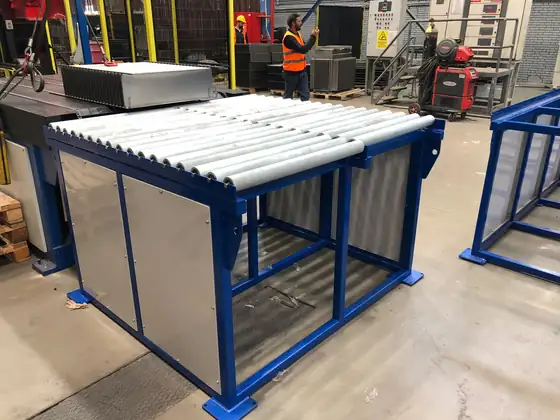 Conveyor Engineering
Roller conveyor systems: gravity vs powered roller conveyors
Gravity and powered roller conveyors compared: how each works, the drive options and how to choose the right roller conveyor for cartons, totes and pallets.
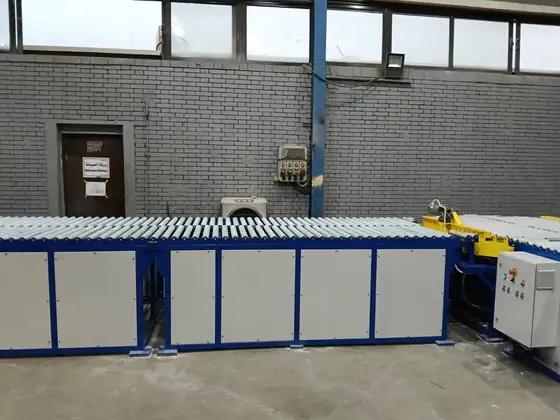 Technical Engineering & Components
Conveyor rollers: types, materials, applications and maintenance
Gravity, driven, tapered, motor and idler rollers: materials, bearings, load capacity, pitch, and how to inspect and replace them.
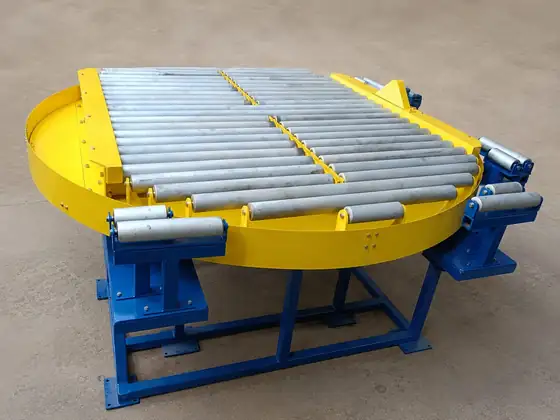 Material Handling & Automation
Pallet conveyor systems: design, applications and industrial uses
Pallet conveyor design: heavy roller and chain conveyors, transfers, turntables and safety for moving full pallets at the end of the line.
