
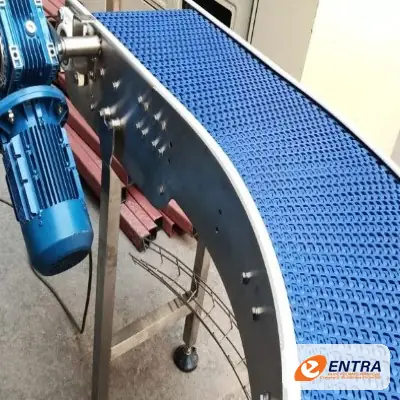
What a modular belt conveyor is
A modular belt is assembled from rigid moulded plastic modules linked by hinge rods, like bricks in a wall. The belt engages sprockets on the drive shaft, so it is positively driven: the sprocket teeth push the belt instead of a drum pulling it by friction. Narrow versions with a single row of links are usually called plastic chains or table-top chains; wide versions with many modules side by side are called modular plastic belts.
This construction changes how the conveyor behaves. There is no belt slip, no tracking to adjust, no splice to fail, and a damaged section can be replaced by swapping a few modules. Open or flush grid surfaces drain water and let air or cleaning fluid pass through. That is why modular belts and plastic chains are found everywhere from bottling halls and dairies to meat plants and parcel handling.
Advantages over fabric belts
- Positive drive: the belt cannot slip on the drum, even when wet or greasy, and the speed is exact.
- No tracking: the sprockets and the frame guide the belt, so it does not wander.
- Curves and spirals: radius belts and side-flexing chains turn corners without transfers, so products keep their orientation.
- Repairable: damaged modules are replaced on site; the belt does not have to be re-spliced.
- Cleanable: open hinges and frames can be washed and inspected, which supports hygienic design.
- Robust: moulded plastic tolerates cuts, impacts and many chemicals better than fabric covers.
Limits to keep in mind
- The surface is not perfectly continuous, so very small or soft products may need a fine-pitch or flush-grid belt, or a fabric belt instead.
- Sprocket drives produce a small speed variation (the chordal or polygon effect) that matters for some precision transfers.
- Plastic belts expand and contract with temperature, so the return way and take-up must allow for it.
- For simple, dry, straight runs a fabric belt is often cheaper.
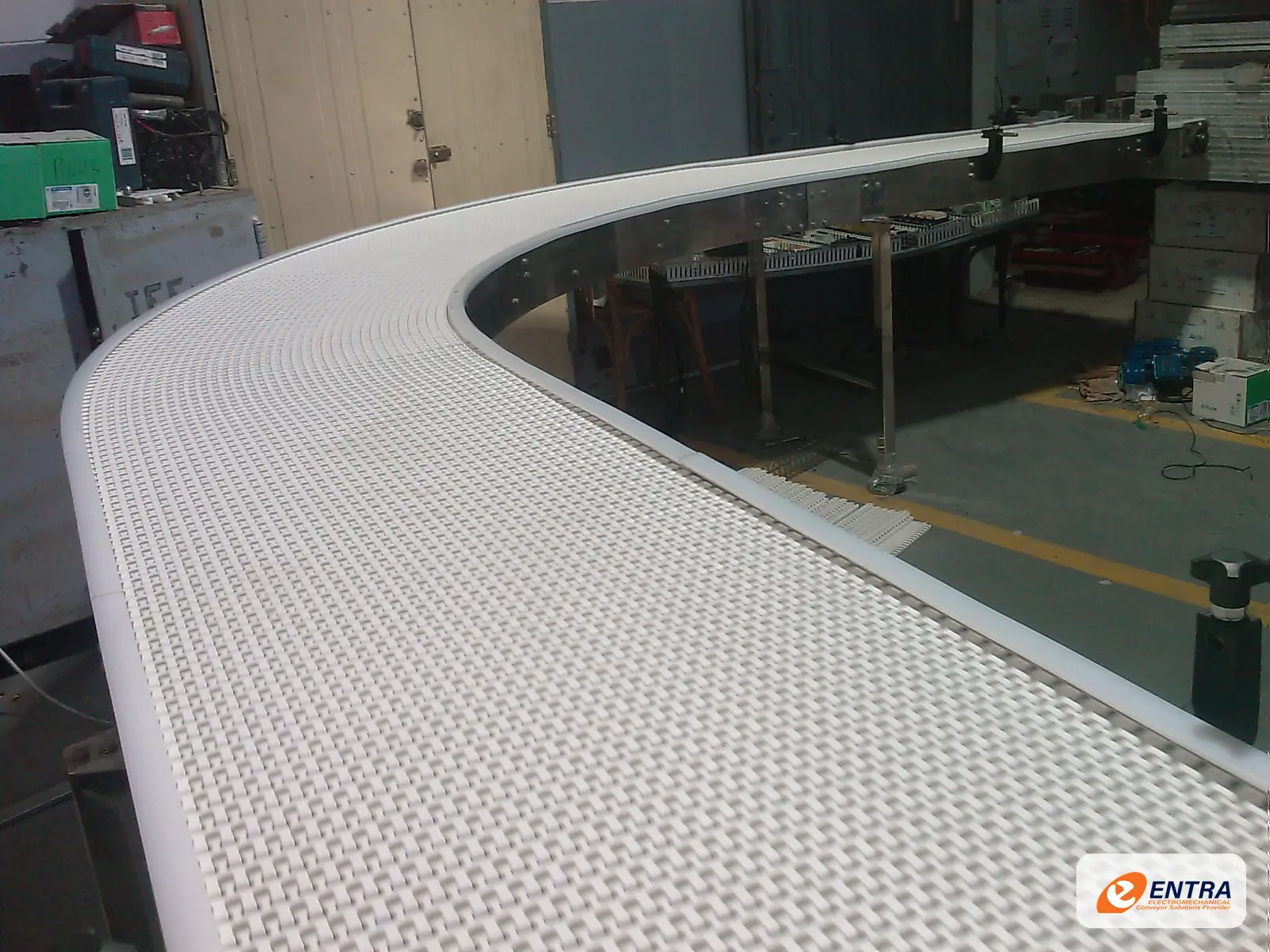
Belt materials
Modular belts and chains are moulded from engineering plastics. The most common are polypropylene, polyethylene and acetal (POM). They differ in temperature range, chemical resistance, strength, friction and price, and manufacturers publish limits for each material and belt series. Acetal is the standard material for the MODU system’s plastic chains and belts [1]. Selection always starts from the product temperature, the cleaning chemicals, any oil or fat in the product, and whether the product slides on the belt during accumulation.
For food contact, the material must comply with the applicable rules, such as the EU framework Regulation 1935/2004 and Regulation 10/2011 for plastics, or the US FDA regulations [4]. Ask for a declaration of compliance for the exact belt series and colour.
Engineering considerations
Sprockets and shafts
The number of sprockets across the shaft and their spacing determine how evenly the load is shared and how well the belt is supported. Usually one sprocket is fixed axially and the others float so that the belt can expand sideways. Square or hexagonal shafts transmit the torque; shaft deflection under full load must stay within the belt manufacturer’s limit, or the outer sprockets lose engagement.
Return way and catenary
Modular belts are not tensioned like fabric belts. They are allowed to hang in a controlled sag, the catenary, usually just after the drive, which keeps the belt engaged on the sprockets and absorbs length changes from temperature and wear. Too much sag lets the belt jump teeth; too little loads the shafts and bearings.
Wear strips and frame
The carrying side runs on wear strips of low-friction plastic. Their arrangement (straight, chevron, or full-width) and material affect friction, belt wear, cleanability and power. Frames for plastic chains are often anodised aluminium profiles that bolt together with standard tools, which makes lines easy to extend or re-route; the MODU system is designed on this principle [2].
Accumulation
Plastic chains are widely used to accumulate bottles and packs: products slide on the moving chain while they queue. Accumulation pressure, product stability and the friction of the chain surface must be checked; low-friction or roller-top chains reduce the pressure on the products at the front of the queue.
Standard sizes
Modular systems come in standard widths. As an example, the MODU system offers plastic chains 63, 83, 140 and 220 mm wide and plastic belts 315, 438 and 585 mm wide, on aluminium or stainless steel frames [1]. Older table-top chain dimensions were standardised internationally in ISO 4348, which has since been withdrawn without replacement [3], so today the manufacturer’s series data is the reference.
Typical applications
| Application | Why modular |
|---|---|
| Bottling and canning lines | Narrow plastic chains, curves, accumulation and single-filing between machines |
| Dairy, bakery, meat and poultry | Washdown, cut resistance, open hinges for cleaning; see food processing conveyors |
| Packaging and end of line | Wide belts for cases and shrink packs, transfers to palletisers |
| Vertical transport and buffering | Spiral conveyors and side-gripper conveyors built on plastic chains |
| Assembly and electronics | Reconfigurable aluminium frames, pallet systems for workpiece carriers |
Cleaning and hygiene
In food plants, a modular conveyor is only as hygienic as its frame. EHEDG has published a guideline dedicated to the hygienic design of belt conveyors for the food industry [5]. Practical points include open frame designs without hollow sections, belts that can be lifted or removed for cleaning, minimal flat surfaces where water collects, and sprockets and shafts that can be cleaned without dismantling.
Maintaining modular conveyors
- Sprockets: check tooth wear regularly; worn sprockets damage a new belt quickly, so replace them together.
- Belt pitch elongation: modular belts and chains lengthen slowly as hinge holes and rods wear. Measure over a fixed length and replace before the belt rides up on the sprockets.
- Catenary: check the return-way sag; remove modules to shorten the belt when it becomes too long.
- Wear strips: grooves and edges in wear strips increase friction and damage the belt underside.
- Hinge rods and retention: check that rods are retained and not migrating out of the belt edges.
- Cleaning: follow the belt manufacturer’s guidance on chemicals and temperatures; some plastics are sensitive to particular cleaners.
Modular conveyor specification checklist
- Products, their base and stability, temperature, oils and fats, and whether they accumulate.
- Rate, speed, and number of lanes or the belt width.
- Layout: straights, curves (radius), inclines, transfers to machines.
- Environment and cleaning: dry, wet, washdown, chemicals, temperatures.
- Food-contact requirements and documentation.
- Frame: aluminium profile, stainless steel, or painted steel; leg and guide-rail system.
- Drives and controls, including accumulation and speed control.
Modular or fabric belt: how to decide
- Choose modular for wet or washdown areas, curves without transfers, cut-prone or heavy products, accumulation on chain, and lines that change often.
- Choose a fabric belt for small or soft products that need a continuous surface, precise inclines with light products, and simple, dry straight runs.
Many lines use both. Our guides to chain conveyor systems and conveyor belt selection cover the neighbouring choices.
Frequently asked questions
What is a modular plastic belt conveyor?
A conveyor whose belt is made of moulded plastic modules joined by hinge rods, driven positively by sprockets rather than by friction on a drum. Damaged modules can be replaced individually.
Are modular belts better than fabric belts?
Not always. Modular belts are positively driven, do not need tracking, resist cuts and suit washdown and curves. Fabric belts give a smoother, continuous surface for small products and usually cost less for simple straight runs.
What materials are modular belts made of?
Common materials are polypropylene, polyethylene and acetal (POM). Each has different limits for temperature, chemicals, friction and strength, so the material is chosen for the application with the belt manufacturer’s data.
Does ENTRA supply modular conveyors?
Yes. ENTRA designs, supplies and installs plastic-chain and modular conveyor lines and has been the sole agent for the MODU modular conveyor system in Egypt since 2009.
Sources and references
- Food & Beverage Industry News (Australia), MODU System conveyors (chain and belt widths, POM material, aluminium and stainless options). Checked 28 Nov 2026.
- DirectIndustry / MODU System, MODU System Smart Manufacturing catalogue (assembly with standard tools, anodized aluminium and moulded plastic). Checked 28 Nov 2026.
- Standards New Zealand, ISO 4348:1983 Flat-top chains and associated chain wheels for conveyors (withdrawn). Checked 28 Nov 2026.
- Trelleborg, Food contact regulations and international standards (EU 1935/2004, 2023/2006, 10/2011; FDA; 3-A; NSF). Checked 28 Nov 2026.
- EHEDG, Conveying Clean: EHEDG Doc. 43 Hygienic Design of Belt Conveyors for the Food Industry (press report), October 2016. Checked 28 Nov 2026.
- ENTRA Electromechanical, About ENTRA (company history, scope and certifications as published by ENTRA). Checked 28 Nov 2026.
Sources are listed for technical accuracy. Names of standards bodies, regulators and manufacturers appear only to credit the source; ENTRA does not claim their products or specifications as its own.

Mechanical, electrical and controls engineers at ENTRA Electromechanical, Cairo. Since 2007 the team has designed, supplied, installed and maintained conveyor and material-handling systems for plants in Egypt and the Arab region. About ENTRA
Researched and drafted with AI assistance from the sources listed above, checked by recalculating every worked example, and published by the ENTRA Engineering Team.
Copyright © 2026 ENTRA. All Rights Reserved. Text, calculations and original graphics on this page may not be reproduced without permission.
Related articles
 Conveyor Engineering
Chain conveyor systems: types, applications and industrial benefits
Slat, table-top, roller, drag and pallet chain conveyors: how they work, where they are used and how to specify chain, sprockets and drive.
 Industrial Solutions & Business
Conveyor systems for food processing and packaging industries
Hygienic design, food-contact materials, washdown and conveyor types for food processing and packaging lines, with the rules to check.
 Technical Engineering & Components
How to select the right conveyor belt for your industrial application
A step-by-step method to choose a conveyor belt: product, carcass, covers, surface, food contact, temperature, pulleys and joining.
