
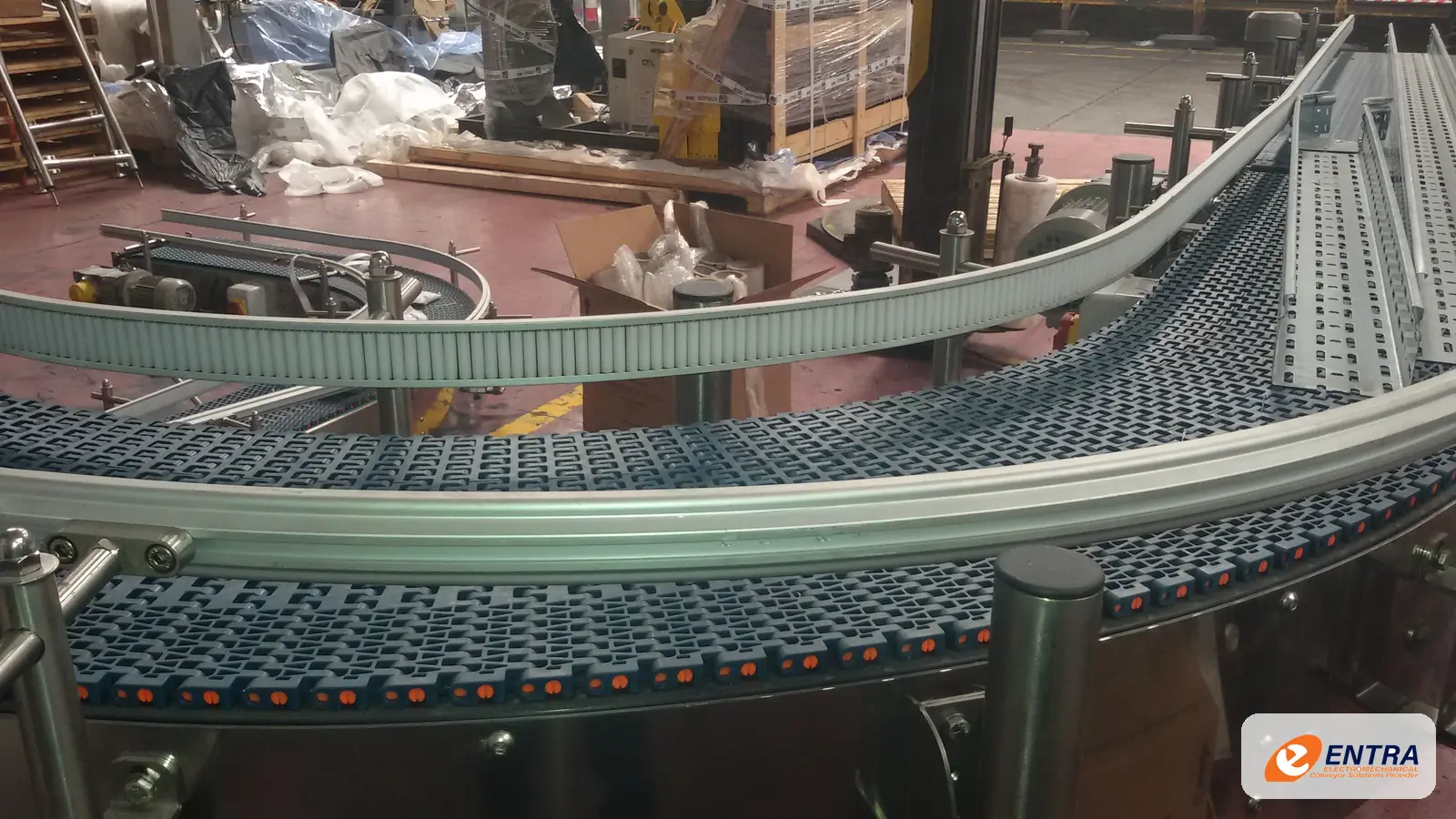
What food plants need from a conveyor
In a food plant, a conveyor has two jobs. The first is the same as anywhere: move product reliably at the right rate without damage. The second is specific to food: never become a source of contamination. A conveyor that harbours product residue, water or bacteria in crevices, sheds particles, or cannot be cleaned and inspected properly is a food-safety risk, however well it conveys.
That is why food-industry conveyors are designed to hygienic design principles from the start. ISO 14159 sets hygiene requirements for the design of machinery used where hygiene risks to the consumer of the product can occur; unlike most machine-safety standards, it is concerned with risks to the consumer, not to the operator [1]. The European Hygienic Engineering & Design Group (EHEDG) has published a guideline specifically on the hygienic design of belt conveyors for the food industry, covering conveyor and component types, lateral guides, drive stations and motors, and basic design rules [2].
Hygienic design principles for conveyors
- Cleanable surfaces: smooth, non-absorbent, corrosion-resistant materials in all product zones; no paint that can flake.
- No harbourage: no crevices, overlapping plates, hollow tubes open to the product zone, threads or exposed fasteners where residue can collect.
- Self-draining: no horizontal flat surfaces where water and product pool; round or sloped profiles, frames that drain.
- Open construction: frames that can be seen through and reached with water and brushes; belts and chains that can be lifted, slackened or removed for cleaning without tools.
- Separation: drives, bearings and lubricants kept away from the product zone, or sealed and food-compatible.
- Inspectability: every product-contact surface can be inspected after cleaning.
- Material compatibility: all materials resist the product and the cleaning and disinfection chemicals at their temperatures.
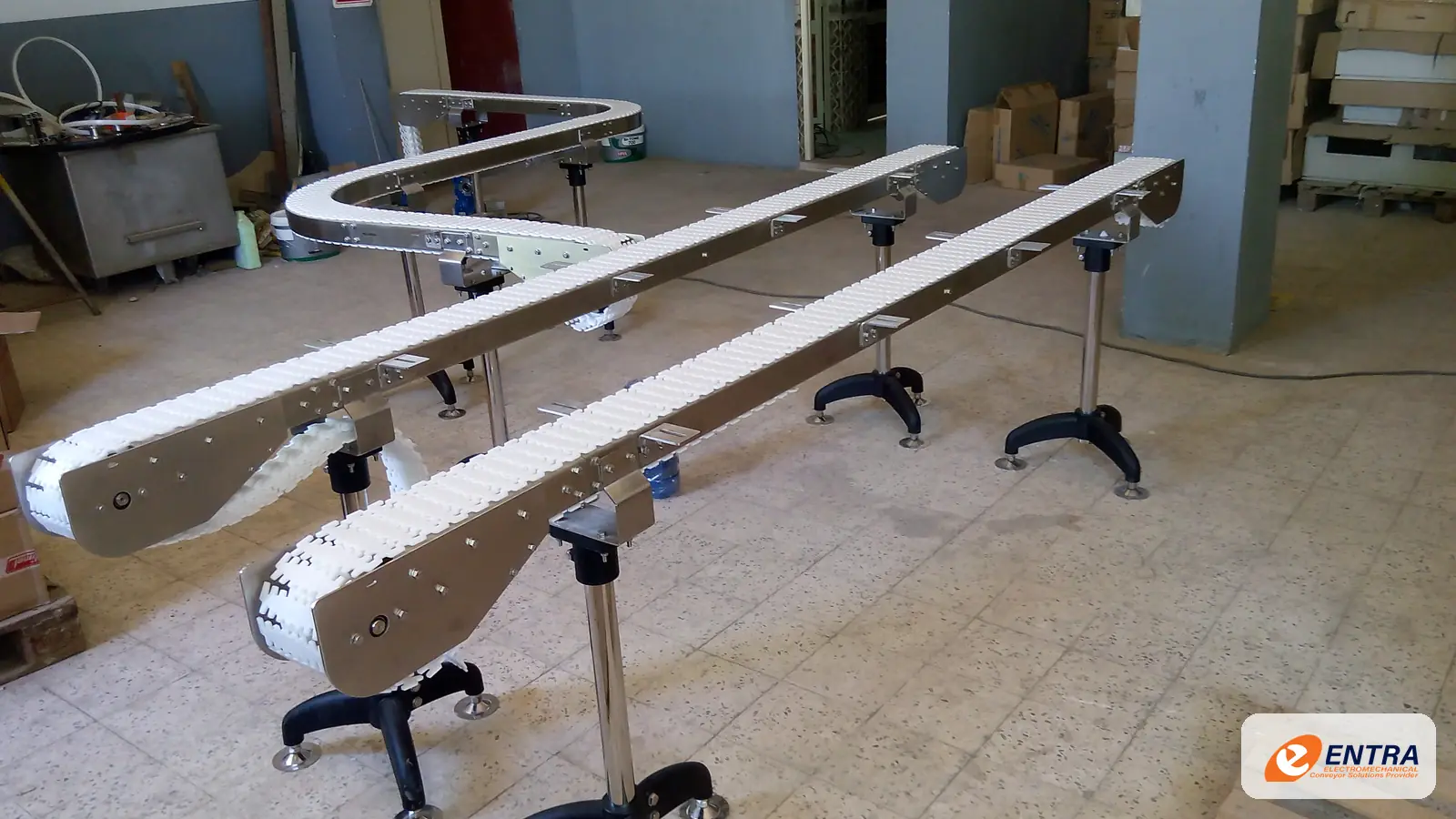
Materials for food conveyors
Stainless steel
Austenitic stainless steels are the standard frame and contact material. Grade 304 (1.4301) is widely used for general food equipment. Grade 316 adds about 2–3% molybdenum [6], which improves resistance to chlorides and acids; 316L (1.4404), a low-carbon version, offers superior corrosion resistance to 304L because of its molybdenum content and is widely used in the food industry [5]. Salty products, brines, acidic products and aggressive cleaning chemicals are reasons to choose 316L. Surface finish and weld quality matter as much as the grade: rough welds and scratches harbour bacteria and start corrosion.
Belts, chains and plastics
Belts, plastic chains, wear strips and guides that touch food must be made from food-contact materials. In the EU, the framework Regulation 1935/2004 applies to all food-contact materials, Regulation 2023/2006 to their good manufacturing practice, and Regulation 10/2011 to plastics [3]; in the US, FDA regulations apply, for example 21 CFR 177.2600 for rubber articles intended for repeated use [4]. Ask the supplier for a declaration of compliance for each product-contact component. Blue or white colour alone does not make a component food compliant, although coloured components help visual detection of fragments.
Conveyor types along a food line
| Stage | Typical conveyors | Key requirements |
|---|---|---|
| Raw material intake and preparation | Belt conveyors, screw conveyors, bucket elevators | Washdown, abrasion, dust control |
| Processing (cutting, cooking, cooling, freezing) | Modular plastic belts, open-mesh belts, spiral conveyors | Temperature range, open belts, cleaning in place |
| Inspection and sorting | Light belts, roller conveyors with good lighting | Contrasting colours, access for operators |
| Filling and primary packaging | Stainless table-top chains, plastic chains, side-gripper conveyors | Single-filing, accumulation, gentle transfers, washdown |
| Secondary packaging and end of line | Plastic-chain and belt conveyors, roller conveyors, pallet conveyors | Accumulation, format changes, robust operation |
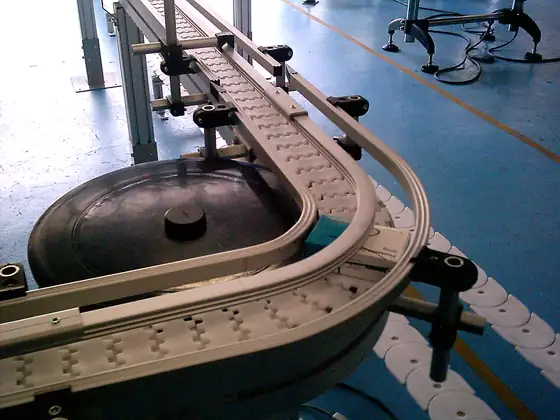
Modular plastic belts and plastic chains are common in wet zones because they are positively driven and can be washed down; see modular belt conveyors.
Hygiene zones
Not every conveyor in a food plant needs the same level of hygienic design. A practical approach is to classify zones:
- Open product zones, where unpackaged food is exposed: the highest hygienic standard, food-contact materials, full washdown construction.
- Closed product zones, where product is in sealed primary packaging: easy-clean construction, corrosion-resistant materials, protection against contamination of the packaging.
- Secondary packaging and logistics: standard industrial construction is often sufficient, provided it is cleanable and does not shed debris into upstream zones.
Defining the zones with the client’s quality team at the start avoids both under-specifying and over-spending.
Washdown construction
- Motors and gearboxes with suitable ingress protection, smooth housings, food-grade lubricants, and stainless or coated finishes; or drives placed outside the wash zone.
- Sealed or stainless bearings; no grease points that drip into the product zone.
- Electrical equipment protected for the washdown method and chemicals; cable routing that does not create ledges. The electrical equipment of machines generally follows IEC 60204-1 [7].
- Sensors with suitable protection and hygienic mounting brackets.
- Legs with hygienic feet, and frames standing clear of walls and floors for cleaning underneath.
Packaging lines
On filling and packaging lines, the main challenges are handling many container types and formats at speed, keeping containers stable through transfers, and absorbing stops between machines. Plastic-chain conveyors with adjustable guide rails, accumulation tables and side-gripper or vertical conveyors are typical solutions; see accumulation conveyor systems and conveyor integration. Quick format changes, with tool-free or motorised guide adjustment, have a direct effect on line availability.
How the cleaning method shapes the design
| Cleaning method | Design consequences |
|---|---|
| Dry cleaning (brushes, vacuum) | Smooth surfaces, no ledges for dust, access for vacuum nozzles; suitable for dry products where water would create a hazard |
| Wet cleaning, low pressure, with detergents | Corrosion-resistant materials, self-draining frames, protected drives and electrics, compatible plastics |
| Foam and sanitiser | Material compatibility with the chemicals, open structure so foam reaches all surfaces and rinses off |
| Belt lift-off or removal | Quick-release tension, lift-up conveyor frames, belts that can be removed without tools |
| Clean-in-place belt washers | Space and drainage for spray bars and brushes, water management under the conveyor |
Foreign-body control
- Avoid loose fasteners above the product: use captive fasteners or locate fixings away from the product zone.
- Use detectable or brightly coloured plastics for parts that could break off, such as scrapers and guides.
- Keep glass and brittle materials out of product zones; specify guards in polycarbonate or stainless mesh.
- Position metal detectors and X-ray systems where products are well spaced and stable, with secure reject paths.
- Include conveyors in the plant’s inspection routine for wear debris from belts, chains and wear strips.
Food conveyor specification checklist
- Products, formats, temperatures and whether product is open or packed.
- Hygiene zone and the client’s hygiene requirements.
- Cleaning method, frequency, chemicals and temperatures.
- Material requirements: stainless grade, food-contact declarations for plastics and belts.
- Rates, accumulation needs and format changes.
- Interfaces with processing and packaging machines.
- Documentation expected for audits.
Frequently asked questions
What makes a conveyor hygienic?
Smooth, cleanable, corrosion-resistant surfaces; no gaps, crevices or horizontal ledges where product and water collect; open frames and belts that can be lifted or removed for cleaning; food-contact materials; and drives and bearings placed or sealed to avoid contamination.
Which stainless steel is used for food conveyors?
Austenitic grades such as 304 (1.4301) are common for frames and guards; 316 or 316L (1.4401/1.4404) is chosen where salt, acids or aggressive cleaning chemicals are present. The grade is chosen for the product and cleaning regime.
Which regulations apply to food-contact conveyor belts?
In the EU, Regulation (EC) 1935/2004 for all food-contact materials and Regulation (EU) 10/2011 for plastics; in the US, the FDA regulations in 21 CFR, for example 177.2600 for rubber articles intended for repeated use. Ask for a declaration of compliance.
Are plastic-chain conveyors suitable for food?
Yes, with food-contact chain materials and an open, cleanable frame design. They are widely used in bottling, dairy, bakery and packaging lines.
Sources and references
- ISO, ISO 14159:2002 Safety of machinery — Hygiene requirements for the design of machinery. Checked 28 Nov 2026.
- EHEDG, Conveying Clean: EHEDG Doc. 43 Hygienic Design of Belt Conveyors for the Food Industry (press report), October 2016. Checked 28 Nov 2026.
- Trelleborg, Food contact regulations and international standards (EU 1935/2004, 2023/2006, 10/2011; FDA; 3-A; NSF). Checked 28 Nov 2026.
- US eCFR, 21 CFR 177.2600 Rubber articles intended for repeated use. Checked 28 Nov 2026.
- Alfa Laval, EN 1.4404 / AISI 316L stainless steel. Checked 28 Nov 2026.
- Design World, The difference between the two most popular stainless steels (304 and 316). Checked 28 Nov 2026.
- IEC / AFNOR, IEC 60204-1:2016 Safety of machinery — Electrical equipment of machines — Part 1: General requirements. Checked 28 Nov 2026.
Sources are listed for technical accuracy. Names of standards bodies, regulators and manufacturers appear only to credit the source; ENTRA does not claim their products or specifications as its own.

Mechanical, electrical and controls engineers at ENTRA Electromechanical, Cairo. Since 2007 the team has designed, supplied, installed and maintained conveyor and material-handling systems for plants in Egypt and the Arab region. About ENTRA
Researched and drafted with AI assistance from the sources listed above, checked by recalculating every worked example, and published by the ENTRA Engineering Team.
Copyright © 2026 ENTRA. All Rights Reserved. Text, calculations and original graphics on this page may not be reproduced without permission.
Related articles
 Conveyor Engineering
Modular belt conveyors: advantages, applications and engineering considerations
Modular plastic belt and plastic-chain conveyors: where they beat fabric belts, and the checks for material, sprockets, catenary and cleaning.
 Technical Engineering & Components
How to select the right conveyor belt for your industrial application
A step-by-step method to choose a conveyor belt: product, carcass, covers, surface, food contact, temperature, pulleys and joining.
 Industrial Solutions & Business
Conveyor systems for pharmaceutical, FMCG and distribution industries
What pharma, FMCG and distribution operations need from conveyors: GMP-friendly design, traceability, gentle handling and flexible flows.
