
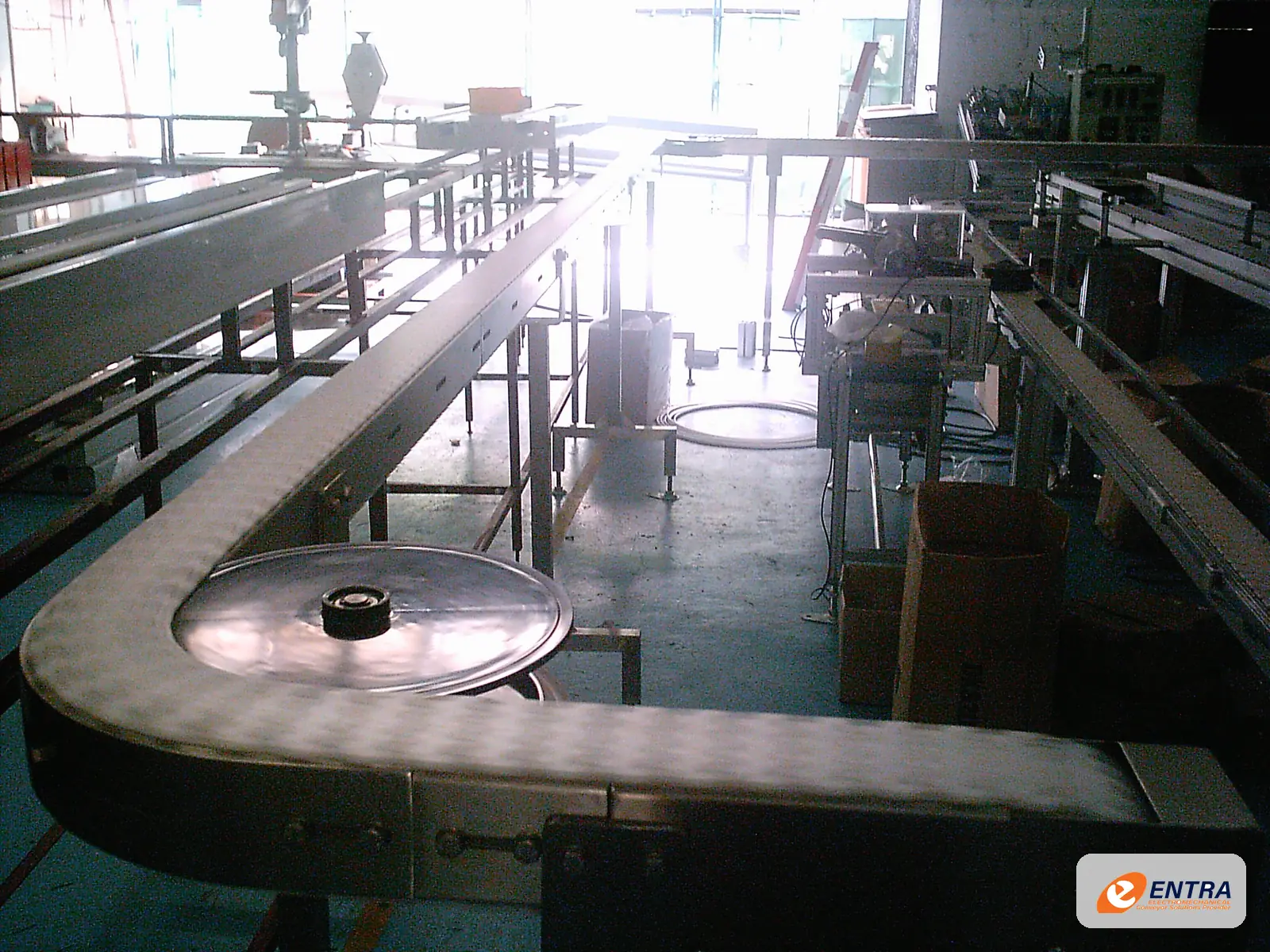
What a chain conveyor is
A chain conveyor uses one or more endless chains, driven by sprockets, either to carry products on the chain itself or to pull them along. Because the sprocket teeth engage the chain, the drive is positive: there is no slip and the speed is fixed by the sprocket speed. This makes chain conveyors the natural choice for heavy loads, for accumulation, for hot or oily environments where belts suffer, and for lines that need exact positioning.
European safety standards treat carrying chain conveyors and plate conveyors as unit-load handling equipment under EN 619 [1], while drag-chain conveyors for bulk materials fall under the bulk-handling standards.
Types of chain conveyor
Table-top and slat chain conveyors
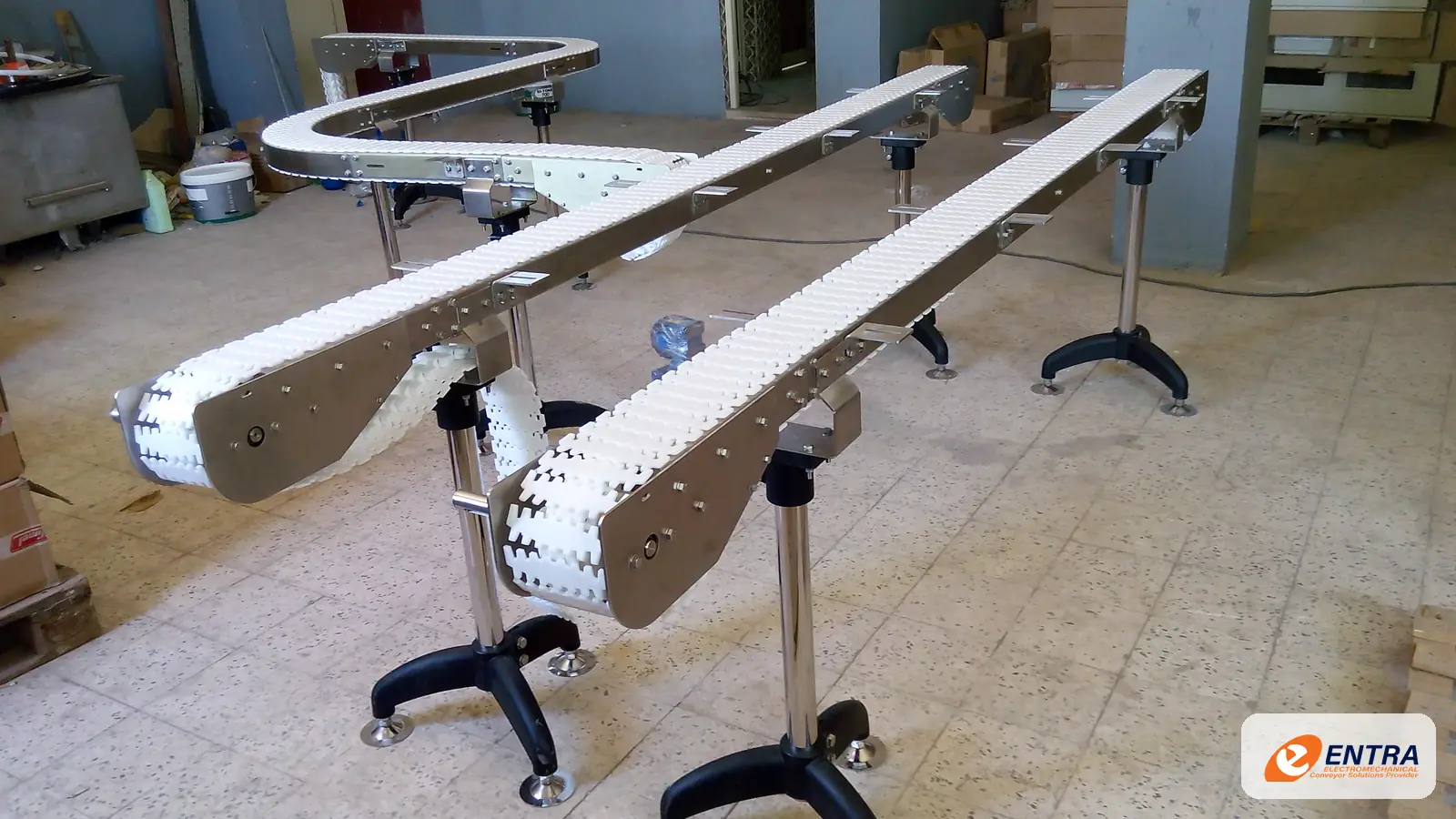
Each link carries a flat top plate, so products stand directly on the chain. Table-top chains in stainless steel or plastic are the standard conveyor in bottling, canning and many packaging lines, where they single-file, accumulate and guide containers between machines. Flat-top chains for conveyors were once standardised internationally in ISO 4348, which covered dimensions, interchangeability and minimum tensile loads, mainly for bottle conveyors; that standard has been withdrawn without replacement [2], so today chains are specified from the manufacturer’s series data. Side-flexing versions run around curves.
Roller-chain conveyors
Precision roller chains, often with attachments (lugs, plates, pins), carry or push products, pallets, workpiece carriers and heavy parts. Double-pitch roller chains derived from ISO 606 transmission chains are standardised in ISO 1275 for conveying under less onerous speed and power conditions than the equivalent short-pitch chains [3].
Pallet chain conveyors
Two or three strands of heavy chain run on guide profiles and carry pallets on their bottom boards. Chain conveyors suit pallets whose bottom boards run across the direction of travel, which would not ride well on rollers. See pallet conveyor systems.
Drag and en-masse chain conveyors
Paddles or flights on a chain drag bulk material along an enclosed trough. They handle powders, granules, ash and chips, including hot materials, and can be enclosed for dust control.
Overhead and power-and-free conveyors
Chains running in an overhead track carry hooks or trolleys. Power-and-free systems let carriers stop and accumulate while the chain keeps running, which is common in paint shops and assembly.
Industrial benefits
- Positive, slip-free drive with fixed speed and good synchronisation with machines.
- Heavy and hot loads: steel chains carry loads and temperatures that would damage belts.
- Accumulation: products can queue on low-friction chains while the chain keeps moving.
- Curves and long runs without transfers, with side-flexing chains.
- Long life when alignment, tension and lubrication are right, and easy repair by replacing links.
How to specify a chain conveyor
- Product and load: mass per product, products per metre at maximum accumulation, impact loads at loading points.
- Chain pull: friction of the chain on its wear strips, friction of accumulated products sliding on the chain, inclines and the number of curves. The chain pull must stay within the manufacturer’s allowable working load with a margin.
- Chain type and material: steel, stainless steel or plastic; plain, low-friction or roller-top; straight-running or side-flexing; open or closed top.
- Sprockets: number of teeth (more teeth give smoother running and less wear), material, and whether one sprocket is fixed and others float.
- Wear strips and guides: material, layout, and alignment between conveyors at transfers.
- Drive: gearmotor torque and speed from the chain pull and chain speed; see conveyor motors and gearboxes. Planning rules for roller-conveyor chain drives, for example, recommend that such chains do not run faster than 0.5 m/s [4]; other chain types have their own limits.
- Tension and catenary: a take-up or a controlled return-way sag after the drive.
- Lubrication and cleaning: dry-running, water or lubricant, and the cleaning method.
Maintenance and wear
Chain conveyors wear at four points: the chain joints (which elongate), the sprocket teeth, the wear strips and the guides. Typical warning signs are chain climbing on the sprocket teeth, jerky motion, noise, increased motor current and products tipping at transfers. A simple routine keeps them under control:
- Measure chain elongation over a fixed number of pitches and replace the chain before it exceeds the manufacturer’s limit; replace worn sprockets with the chain.
- Check wear strips for grooves and alignment, especially at curves and transfers.
- Keep the catenary or take-up within its range.
- Lubricate (or keep dry) exactly as the chain manufacturer specifies; the wrong lubricant attracts dirt and accelerates wear.
- Clean away broken glass, labels and product residue that jam chains and guides.
Our conveyor maintenance guide includes a full preventive checklist.
Worked example: a first estimate of chain pull
On a horizontal table-top chain conveyor that accumulates products, the chain pull at the drive comes mainly from two friction forces: the chain sliding on its wear strips, and the accumulated products sliding on the moving chain. A first estimate is:
F ≈ g · L · [ μw · (mc + mp) + μp · ma ]
- F
- chain pull at the drive, N
- L
- conveyor length, m
- mc
- chain mass per metre, kg/m
- mp
- mass of products carried per metre, kg/m
- ma
- mass of products accumulated (held back) per metre, kg/m
- μw, μp
- friction coefficients chain/wear strip and product/chain, from the chain manufacturer
Illustrative example, not an ENTRA project (friction values assumed)
A 10 m chain conveyor with chain mass 1.5 kg/m carries bottles of 20 kg/m along its whole length, all of them accumulated. Assuming μw = 0.2 and μp = 0.2: F ≈ 9.81 × 10 × [0.2 × (1.5 + 20) + 0.2 × 20] = 9.81 × 10 × 8.3 ≈ 814 N. Curves, inclines and start-up add to this. The result is compared with the chain’s allowable working load, and used with the chain speed to size the drive.
Chain manufacturers publish their own calculation methods, friction values for different material pairs and lubrication conditions, and factors for curves and speed; use them for the final design.
Common chain conveyor layouts
- Single-file transport between machines, with guide rails set to the container size.
- Mass transport on several parallel chains, with transfers that combine or split lanes.
- Side transfers where one chain runs alongside another and products slide across a short dead plate or directly from chain to chain.
- Curves with side-flexing chains or magnetic curve tracks.
- Inclines with high-friction chain tops or cleats, for stable products.
- Pallet loops with transfers, stops and lifts for workpiece carriers in assembly.
Chain or belt?
Choose a chain conveyor when the load is heavy, hot or oily, when products accumulate on the conveyor, when exact speed matters, or when the line must turn corners without transfers. Choose a belt when products are small, soft or loose, when a continuous surface is needed, or when the conveyor must incline steeply with light products. Modular plastic belts sit between the two; see modular belt conveyors.
Frequently asked questions
What is a chain conveyor used for?
Carrying products directly on a chain (table-top and slat chains for bottles, cans and packs), moving heavy unit loads such as pallets on two or more chain strands, and dragging bulk material along a trough.
What is a table-top chain?
A chain whose links form a flat top plate on which products stand, also called a slat chain or flat-top chain. It is widely used in bottling and packaging lines and is made in steel or plastic.
How often should conveyor chain be lubricated?
It depends on the chain type, material, speed, load and environment. Some plastic chains run dry or with water; steel roller chains usually need regular lubrication. Follow the chain manufacturer’s instructions and inspect chain elongation and wear on a fixed schedule.
What causes chain conveyor wear?
Common causes are misaligned sprockets and wear strips, worn sprocket teeth, incorrect chain tension or catenary, abrasive dirt, lack of or wrong lubrication, and overloads during accumulation.
Sources and references
- EVS, EN 619:2022 Continuous handling equipment and systems — Safety requirements for equipment for mechanical handling of unit loads. Checked 28 Nov 2026.
- Standards New Zealand, ISO 4348:1983 Flat-top chains and associated chain wheels for conveyors (withdrawn). Checked 28 Nov 2026.
- DIN, DIN ISO 1275 Double-pitch precision roller chains, attachments and sprockets for transmission and conveyors. Checked 28 Nov 2026.
- Interroll, Conveyor rollers – General technical information / planning basics, Catalogue pages 184–203, edition 01. Checked 28 Nov 2026.
Sources are listed for technical accuracy. Names of standards bodies, regulators and manufacturers appear only to credit the source; ENTRA does not claim their products or specifications as its own.

Mechanical, electrical and controls engineers at ENTRA Electromechanical, Cairo. Since 2007 the team has designed, supplied, installed and maintained conveyor and material-handling systems for plants in Egypt and the Arab region. About ENTRA
Researched and drafted with AI assistance from the sources listed above, checked by recalculating every worked example, and published by the ENTRA Engineering Team.
Copyright © 2026 ENTRA. All Rights Reserved. Text, calculations and original graphics on this page may not be reproduced without permission.
Related articles
 Conveyor Engineering
Modular belt conveyors: advantages, applications and engineering considerations
Modular plastic belt and plastic-chain conveyors: where they beat fabric belts, and the checks for material, sprockets, catenary and cleaning.
 Material Handling & Automation
Pallet conveyor systems: design, applications and industrial uses
Pallet conveyor design: heavy roller and chain conveyors, transfers, turntables and safety for moving full pallets at the end of the line.
 Maintenance & Troubleshooting
Conveyor system maintenance: preventive maintenance, common problems and solutions
A preventive maintenance plan for belt, roller and chain conveyors: routine checks, safe isolation, spare parts and a troubleshooting table.
