
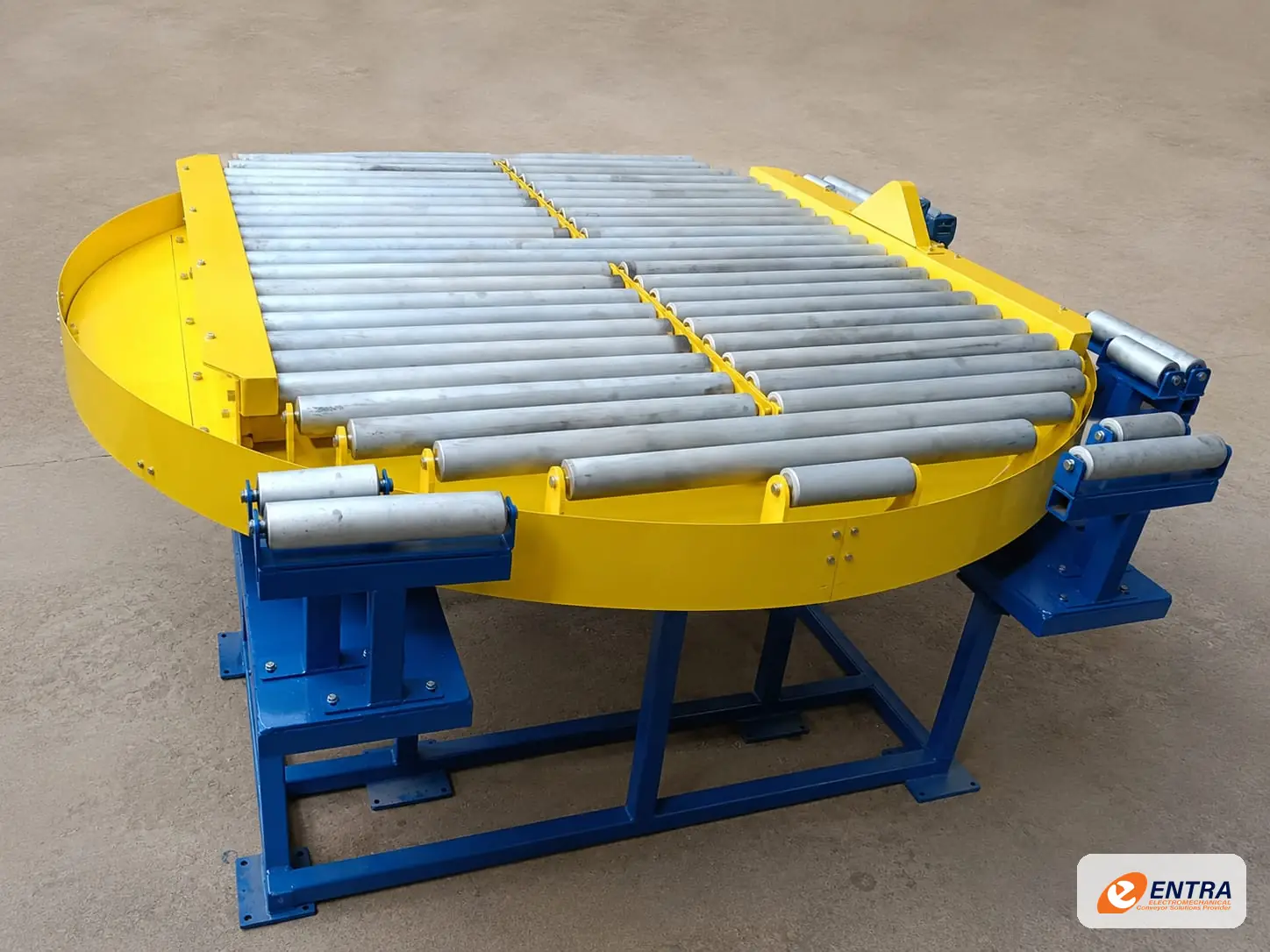
What pallet conveyors do
Pallet conveyors move loaded pallets without forklifts: from palletisers and stretch wrappers to a pick-up point, along accumulation lines that buffer the end of production, into and out of storage, and to loading docks. A typical load weighs several hundred kilograms to more than a tonne, so pallet conveyors are built very differently from carton conveyors: heavier rollers and chains, stronger frames, larger drives and more attention to safety.
Replacing forklift journeys with a conveyor reduces traffic in production areas, takes the load off drivers at the busiest point of the line, and gives a predictable, measurable flow from production to the warehouse.
Types of pallet conveyor
Heavy-duty roller conveyors
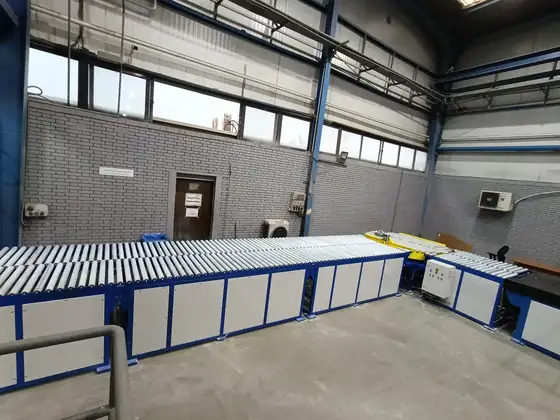
Chain-driven rollers, typically of large diameter and thick wall, carry the pallet on its bottom boards. They suit pallets whose bottom boards run in the direction of travel. A roller manufacturer’s planning rules point out that, with pallets, only the rollers under the bulk of the pallet actually carry the load, so the load per roller must be calculated from those rollers only, and that roller length should be the conveyor width plus about 100 mm for large goods [2].
Chain conveyors
Two or three strands of heavy chain run on guide rails and carry the pallet on its bottom boards across the direction of travel. Chain conveyors handle pallets that would not ride well on rollers, and they are used for transfers at right angles to roller conveyors. See chain conveyor systems.
Transfers, turntables and lifts
- Chain transfers lift slightly between rollers and move the pallet at 90°.
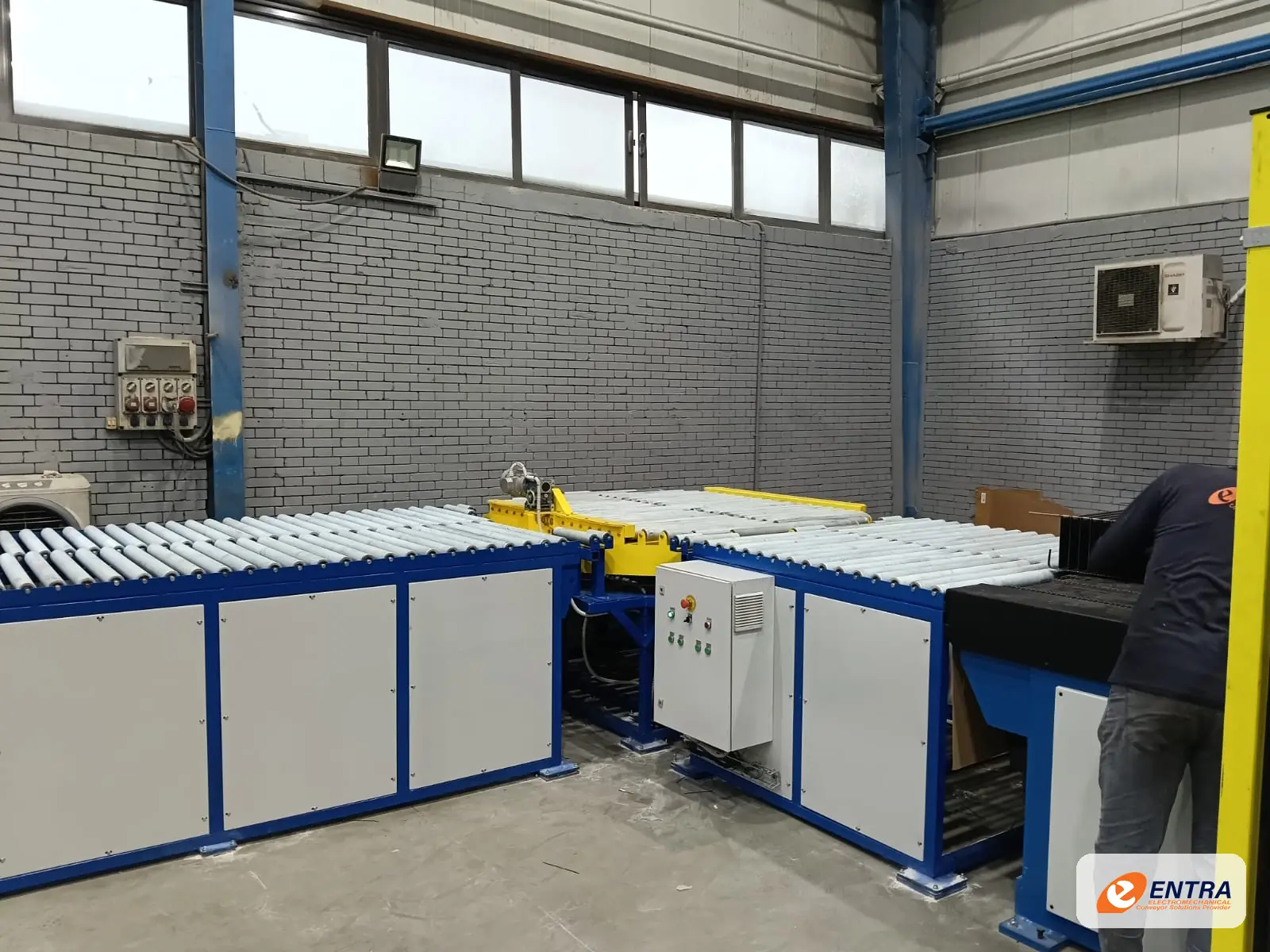
- Turntables rotate the pallet to change direction or present a different face.
- Lifts and vertical conveyors move pallets between levels.
- Transfer cars and shuttles move pallets sideways between parallel lines.
- Pallet inverters and tilting stations turn the load to change a damaged pallet or to discharge product.
Gravity pallet flow
In pallet flow racks, pallets roll on inclined roller tracks from the loading side to the picking side, with brake rollers controlling the speed. They support first-in, first-out storage without powered conveyors.
Design checks
Know your pallets
ISO 6780 specifies the principal dimensions and tolerances of flat pallets for intercontinental materials handling [1]; 1200 × 1000 mm and 1200 × 800 mm pallets are among the most widely used. In practice, a site rarely has only one pallet type. Make a list of every pallet type, size, orientation and condition that will reach the conveyor, including broken boards, overhanging loads and slip sheets. Poor pallets are the most common cause of jams on pallet lines; a pallet inspection or rejection point at the entry often pays for itself.
Loads and structure
- Maximum load mass and its distribution, including the worst case of a load concentrated on a few boards.
- Load per roller from the rollers actually under the load; load per chain strand.
- Accumulation: the drive and structure must handle a line full of pallets, and accumulation must prevent pallets pushing on each other. Zone control stops each pallet in its own zone.
- Impact loads where forklifts set pallets down on the conveyor.
Speed and spacing
Pallet conveyors run slowly compared with carton conveyors, and start and stop smoothly to keep tall loads stable. Rate is set by the slowest station (wrapper, turntable, transfer), so cycle times of each station must be checked against the required pallets per hour.
Heights and interfaces
The conveyor height must match the palletiser, wrapper and pick-up stations, and forklift pick-up points need correct fork clearance and guides that centre the pallet.
Safety on pallet lines
A pallet line combines heavy moving loads, nip points at rollers and chains, shear points at transfers and turntables, and forklift traffic. The risk assessment and risk reduction process of ISO 12100 applies, and pallet conveyors, transfer cars and turntables are unit-load handling equipment under EN 619 [3] [4]. Typical measures:
- Fencing around automatic sections, with interlocked access doors.
- Pallet entry and exit openings protected by light curtains with muting, so pallets pass but people are detected [4].
- Fence heights and distances to hazard zones designed to ISO 13857 [5].
- Clearly marked forklift pick-up and drop-off points outside the fenced area.
- Emergency stops at operator positions and access points, and safe procedures for clearing jams.
Typical applications
| Application | Typical layout |
|---|---|
| End of a packaging line | Palletiser → wrapper → labeller → accumulation → forklift pick-up or warehouse link |
| Empty pallet supply | Pallet dispenser → conveyor to palletiser |
| Warehouse inbound/outbound | Dock conveyors → turntables → storage infeed and outfeed |
| Production feeding | Pallet conveyors bringing raw material pallets to process lines; tilting stations to empty them |
| Pallet exchange | Inverters transferring loads from wooden to plastic or hygienic pallets |
Worked example: can the pallet line keep up?
Illustrative example, not an ENTRA project
A packaging line produces 30 cases per minute, with 60 cases per pallet: one pallet every 2 minutes, 30 pallets per hour. The pallet line includes a stretch wrapper with a 75-second cycle, a turntable with a 20-second cycle and conveyor sections that each take about 15 seconds to transfer a pallet. The slowest station, the wrapper, can handle 3,600 / 75 = 48 pallets per hour, so the line has enough capacity. Accumulation positions after the wrapper allow for forklift pick-up delays: at 30 pallets per hour, five positions cover about 10 minutes without a pick-up.
Common pallet line layouts
- Straight line: palletiser, wrapper, labeller and pick-up in sequence; simple and reliable.
- L or U shape: turntables or chain transfers change direction to fit the building and bring pick-up close to the warehouse door.
- Multiple lines to one pick-up: pallets from several palletisers merge on a common conveyor with transfers.
- Through the wall: conveyors pass through a fire-rated or hygienic separation into the warehouse, with appropriate doors or openings.
- Empty pallet loop: a dispenser and conveyors return empty pallets to the palletiser automatically.
Maintenance focus
- Chain tension, elongation and lubrication on drive chains and chain conveyors.
- Rollers that no longer turn, bent rollers and worn sprockets.
- Sensor alignment and cleanliness: dust and stretch film often cause false signals.
- Light curtains, muting sensors and door interlocks tested on a fixed schedule.
- Pallet debris (broken boards, nails, film) removed from under the conveyor.
See also our roller conveyor design guide for load-per-roller calculations and the conveyor maintenance guide.
Frequently asked questions
What is a pallet conveyor?
A heavy-duty conveyor, usually with driven rollers or chains, designed to move loaded pallets between machines, storage and loading points without forklifts.
Should I use rollers or chains to convey pallets?
Rollers suit pallets whose bottom boards run in the direction of travel. Chains suit pallets whose bottom boards run across the direction of travel, or pallets of mixed quality. Many lines use both, with transfers between them.
Which pallet sizes are standard?
ISO 6780 lists principal pallet sizes for intercontinental handling, including 1200 × 1000 mm and 1200 × 800 mm. The conveyor must be designed for the sizes, orientations and condition of the pallets actually used on site.
What safety measures does a pallet conveyor need?
Guarding or fencing of the conveyor area, safe access points for forklifts and people (for example with light curtains and muting), emergency stops, and a risk assessment of crushing and shearing points at transfers and turntables.
Sources and references
- ISO, ISO 6780:2003 Flat pallets for intercontinental materials handling — Principal dimensions and tolerances. Checked 28 Nov 2026.
- Interroll, Conveyor rollers – General technical information / planning basics, Catalogue pages 184–203, edition 01. Checked 28 Nov 2026.
- EVS, EN 619:2022 Continuous handling equipment and systems — Safety requirements for equipment for mechanical handling of unit loads. Checked 28 Nov 2026.
- Pilz, Overview of generic machine-safety standards (EN ISO 12100, ISO 13849, ISO 14120, ISO 14119, IEC 60204). Checked 28 Nov 2026.
- ISO, ISO 13857:2019 Safety of machinery — Safety distances to prevent hazard zones being reached by upper and lower limbs. Checked 28 Nov 2026.
Sources are listed for technical accuracy. Names of standards bodies, regulators and manufacturers appear only to credit the source; ENTRA does not claim their products or specifications as its own.

Mechanical, electrical and controls engineers at ENTRA Electromechanical, Cairo. Since 2007 the team has designed, supplied, installed and maintained conveyor and material-handling systems for plants in Egypt and the Arab region. About ENTRA
Researched and drafted with AI assistance from the sources listed above, checked by recalculating every worked example, and published by the ENTRA Engineering Team.
Copyright © 2026 ENTRA. All Rights Reserved. Text, calculations and original graphics on this page may not be reproduced without permission.
Related articles
 Conveyor Engineering
Chain conveyor systems: types, applications and industrial benefits
Slat, table-top, roller, drag and pallet chain conveyors: how they work, where they are used and how to specify chain, sprockets and drive.
 Conveyor Engineering
Roller conveyor systems: gravity vs powered roller conveyors
Gravity and powered roller conveyors compared: how each works, the drive options and how to choose the right roller conveyor for cartons, totes and pallets.
 Conveyor Engineering
Roller conveyor design: length, pitch, load and drives
Choose roller length and pitch, check the load per roller, control speed on gravity sections and compare roller conveyor drives.
