
Three industries, three priorities
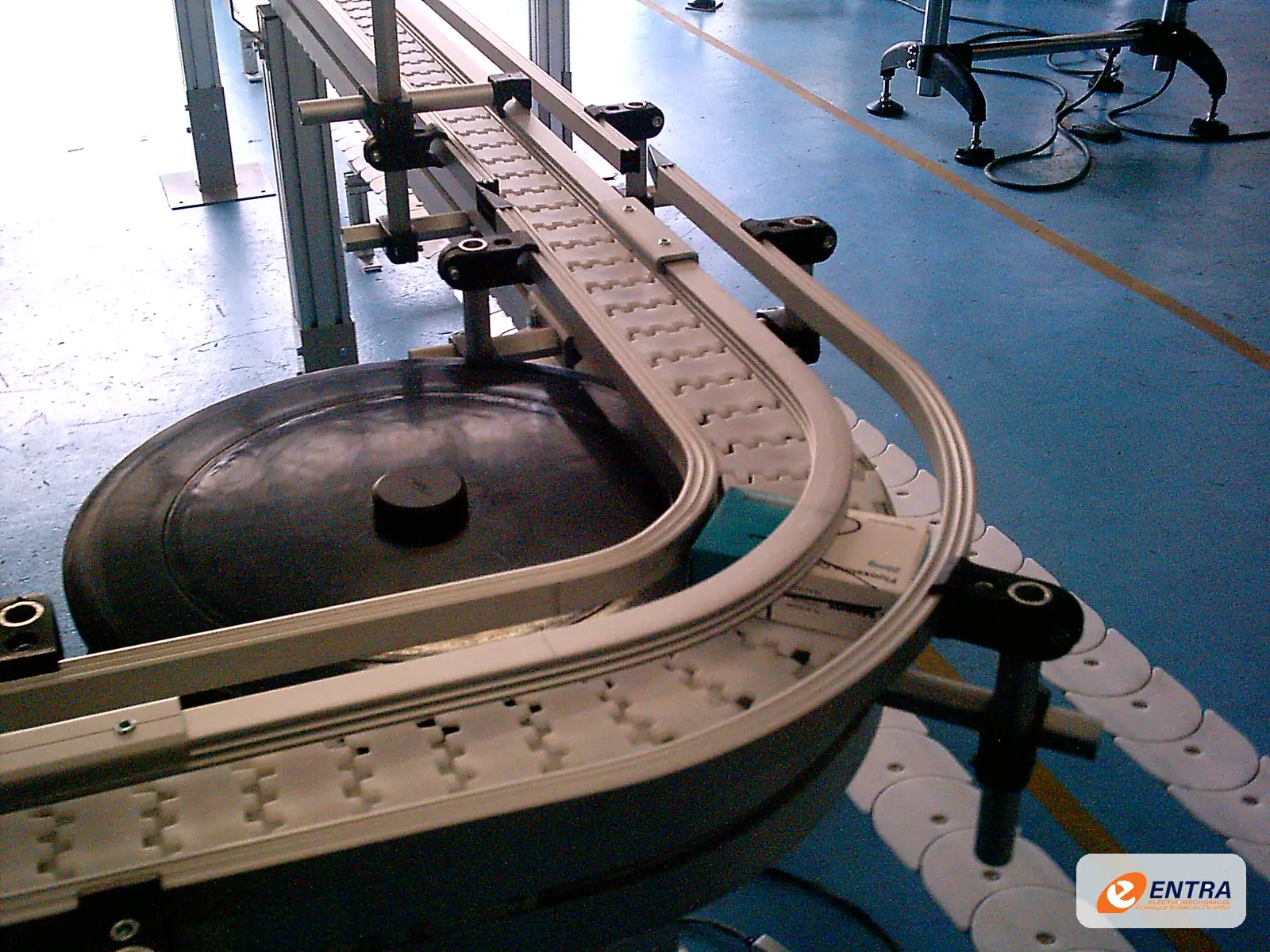
Pharmaceutical plants, fast-moving consumer goods (FMCG) factories and distribution centres all move large volumes of packaged products on conveyors. The equipment families overlap: plastic-chain and belt conveyors on packaging lines, roller conveyors for cases and totes, pallet conveyors at the end of the line. What differs is what matters most:
- Pharmaceuticals: product quality, cleanliness, traceability and documented control, under good manufacturing practice (GMP).
- FMCG (food, beverages, personal care, home care): speed, efficiency, frequent format changes and gentle handling of light, branded packs.
- Distribution: flexibility, order accuracy, peak capacity and integration with warehouse software.
Pharmaceutical conveyors
What GMP asks of equipment
The EU GMP guidelines state that premises and equipment must be located, designed, constructed, adapted and maintained to suit the operations carried out, with layout and design aimed at minimising the risk of errors and permitting effective cleaning and maintenance to avoid cross-contamination [1]. Production equipment should not present any hazard to the products, and equipment should be installed so as to prevent any risk of error or contamination [1]. For conveyors this translates into:
- Smooth, cleanable, corrosion-resistant surfaces, typically stainless steel frames and food- or pharma-compatible plastics.
- Designs that avoid recesses and ledges where dust or product collects, and that can be cleaned according to written procedures.
- Lubricants and wear materials that cannot contaminate the product, or are kept away from it.
- Clear separation of products and lines to prevent mix-ups, with line clearance between batches.
Qualification
Equipment that can affect product quality is normally qualified within the manufacturer’s validation programme. EU GMP Annex 15 describes qualification stages, including design qualification (DQ), installation qualification (IQ), operational qualification (OQ) and performance qualification (PQ) [2]. The conveyor supplier supports this with documentation: specifications, drawings, material certificates, test records, and protocols for factory and site acceptance tests, agreed with the client’s quality team.
Traceability and inspection
Pharmaceutical packaging lines often include checkweighers, vision inspection, serialisation and aggregation stations, and reject systems with confirmation. Conveyors must present each pack accurately and at constant spacing to these stations, and reject paths must be secure so rejected packs cannot re-enter the line.
FMCG conveyors
FMCG lines run fast, change formats often and handle light, sometimes unstable containers with labels and printing that must not be scuffed. Typical needs:
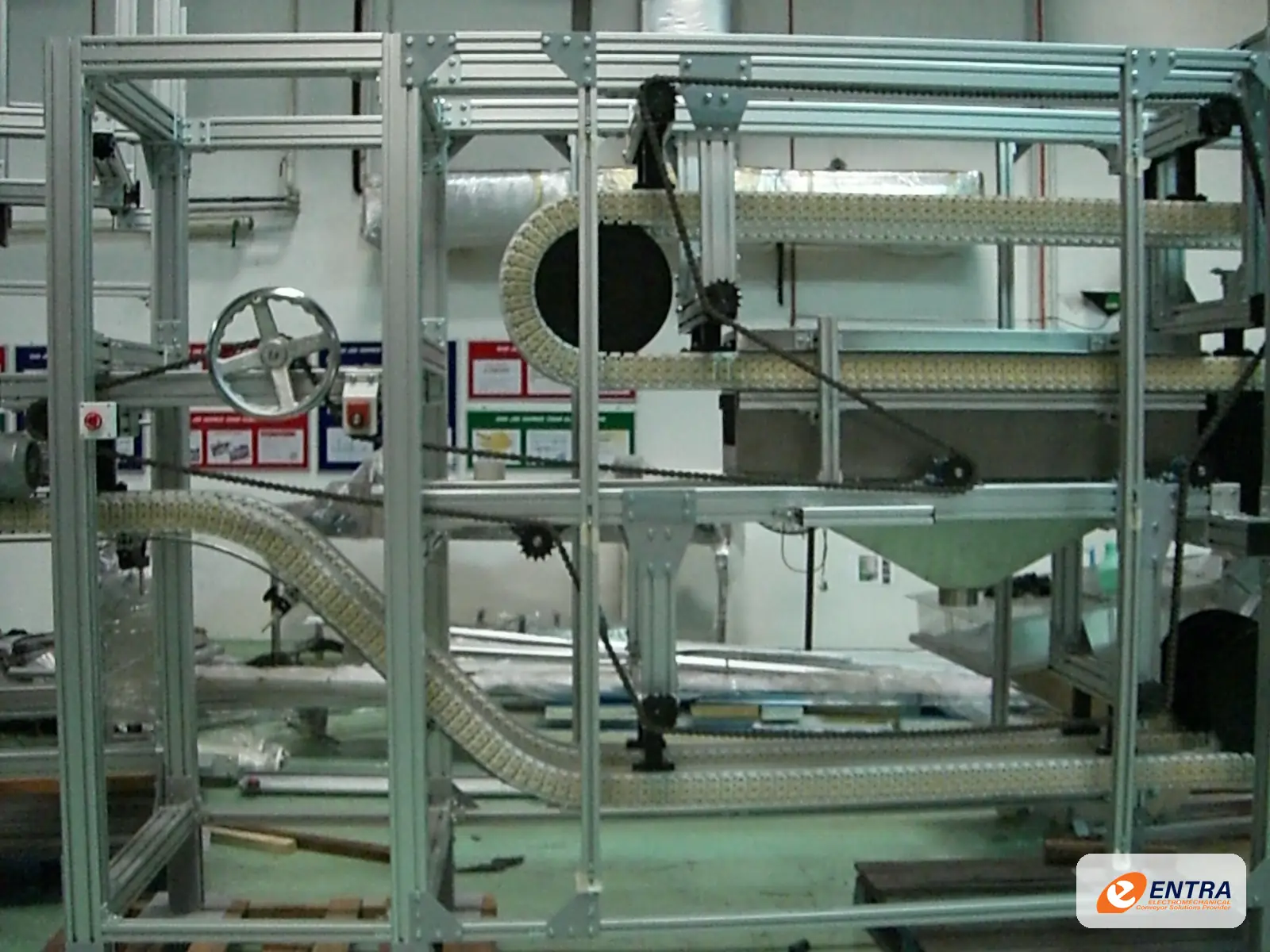
- Gentle, stable handling: plastic-chain conveyors with low-friction surfaces, well-designed transfers and guide rails; side-gripper conveyors for vertical transport or inverting.
- Accumulation between machines so that short stops do not stop the line; see accumulation conveyor systems.
- Fast changeovers: tool-free or motorised guide adjustment, format parts that are clearly marked.
- Cleanability appropriate to the product: food and beverages need hygienic design; personal and home care need resistance to spilled liquids and easy cleaning.
- End-of-line efficiency: case conveyors, palletiser infeeds and pallet conveyors; see pallet conveyor systems.
ENTRA’s client list covers food, personal care and heavy industry [4], and its case studies describe work in FMCG plants in Egypt.
Distribution conveyors
Distribution centres move cases and totes from receiving to storage, picking, packing and dispatch. Conveyors are chosen for flexibility and peak capacity:
- Zone-controlled motor-driven roller conveyors that accumulate without pressure and run only where products are present.
- Belt conveyors for inclines, declines and parcels.
- Transfers, diverters and sorters that route each item to its destination using barcode or other identification.
- Extendable conveyors at loading docks.
Integration with the warehouse management system is as important as the mechanics. See warehouse conveyor systems for planning steps.
Priorities compared
| Requirement | Pharmaceutical | FMCG | Distribution |
|---|---|---|---|
| Cleanability | Very high; documented cleaning | High for food; moderate for others | Standard |
| Documentation and qualification | Extensive (DQ/IQ/OQ/PQ support) | Moderate | Standard |
| Speed | Moderate to high | High | Variable, with peaks |
| Format changes | Batch-based, with line clearance | Frequent | Mixed items continuously |
| Traceability | Item-level, serialisation | Batch-level | Order-level |
| Typical conveyors | Stainless and plastic-chain conveyors, inspection and reject systems | Plastic-chain, side-gripper, accumulation, case and pallet conveyors | MDR roller, belt, sorters, extendable conveyors |
Safety and standards
Across all three sectors, conveyor safety is based on the risk assessment process of ISO 12100 and the related guard, interlock and control standards [3]. Multinational pharmaceutical and FMCG companies operating in Egypt and the Gulf usually apply their group engineering standards, which often reference these international standards; the conveyor design and documentation should be aligned with them from the start.
Pharmaceutical conveyor specification points
- Materials of construction for product-contact and non-contact parts, with certificates.
- Surface finish requirements and cleaning procedure compatibility.
- Lubricants and their compatibility with the product and cleaning agents.
- Layout that supports line clearance and avoids mix-ups between parallel lines.
- Reject systems with confirmation and locked reject bins where required.
- Documentation package: drawings, part lists, test records, FAT and SAT protocols supporting IQ and OQ.
- Change control for modifications after qualification.
FMCG changeovers: where the minutes go
On FMCG lines that run many formats, changeover time is often the largest single loss. Conveyors contribute through guide rails, transfer plates, starwheels and the settings of accumulation and speed. Measures that reduce changeover time include tool-free guide adjustment with scales or stops for each format, motorised guide rails with stored positions, colour-coded format parts, and recipes in the control system that set speeds and buffer levels for each product. Recording changeover times before and after such changes shows their value quickly.
Distribution: planning for peaks
Distribution volumes vary with seasons, promotions and month ends. A conveyor system designed for the average day will be overloaded at peaks; one designed for the absolute peak may be oversized most of the year. A common approach is to design the mechanical backbone (main lines, merges, sorter) for the expected peak with margin, and to add flexibility with manual stations, temporary shifts or modular additions that can be brought into use when needed.
Choosing a conveyor partner for these sectors
- Experience with your product types and line speeds.
- Ability to integrate with machines from several suppliers.
- Capability to deliver the documentation your quality and engineering teams require.
- Local installation, service and spare parts.
Our guide to choosing a conveyor supplier in Egypt and the Middle East gives a full checklist.
Frequently asked questions
What does GMP require from conveyor equipment?
EU GMP Chapter 3 requires that equipment is designed, located and maintained to suit its operations, minimises the risk of errors and contamination, and can be cleaned effectively. In practice this means cleanable materials and surfaces, documented cleaning, and qualification of equipment.
Do pharmaceutical conveyors need to be qualified?
Equipment that can affect product quality is normally qualified (design, installation and operational qualification) under the manufacturer’s validation programme. The conveyor supplier provides the documentation that supports it.
What matters most for FMCG packaging line conveyors?
Reliable product handling at speed, gentle transfers, accumulation between machines, quick changeovers between formats and easy cleaning.
Can the same conveyor handle several product sizes?
Yes, if guide rails, transfers and controls are designed for the full size range, ideally with quick or automatic format adjustment.
Sources and references
- European Commission, EudraLex Volume 4, EU GMP Guidelines Part I, Chapter 3: Premises and Equipment, 2014, in operation since 1 March 2015. Checked 28 Nov 2026.
- European Commission, EudraLex Volume 4, Annex 15: Qualification and Validation, 2015. Checked 28 Nov 2026.
- Pilz, Overview of generic machine-safety standards (EN ISO 12100, ISO 13849, ISO 14120, ISO 14119, IEC 60204). Checked 28 Nov 2026.
- ENTRA Electromechanical, About ENTRA (company history, scope and certifications as published by ENTRA). Checked 28 Nov 2026.
Sources are listed for technical accuracy. Names of standards bodies, regulators and manufacturers appear only to credit the source; ENTRA does not claim their products or specifications as its own.

Mechanical, electrical and controls engineers at ENTRA Electromechanical, Cairo. Since 2007 the team has designed, supplied, installed and maintained conveyor and material-handling systems for plants in Egypt and the Arab region. About ENTRA
Researched and drafted with AI assistance from the sources listed above, checked by recalculating every worked example, and published by the ENTRA Engineering Team.
Copyright © 2026 ENTRA. All Rights Reserved. Text, calculations and original graphics on this page may not be reproduced without permission.
Related articles
 Industrial Solutions & Business
Conveyor systems for food processing and packaging industries
Hygienic design, food-contact materials, washdown and conveyor types for food processing and packaging lines, with the rules to check.
 Material Handling & Automation
Warehouse conveyor systems: improving logistics, distribution and order fulfilment
Where conveyors fit in receiving, picking, packing, sorting and dispatch, and how to plan a warehouse conveyor system step by step.
 Material Handling & Automation
Accumulation conveyor systems: improving production flow and reducing bottlenecks
How accumulation conveyors buffer products between machines, zero-pressure vs low-pressure accumulation, and how to size a buffer.
