
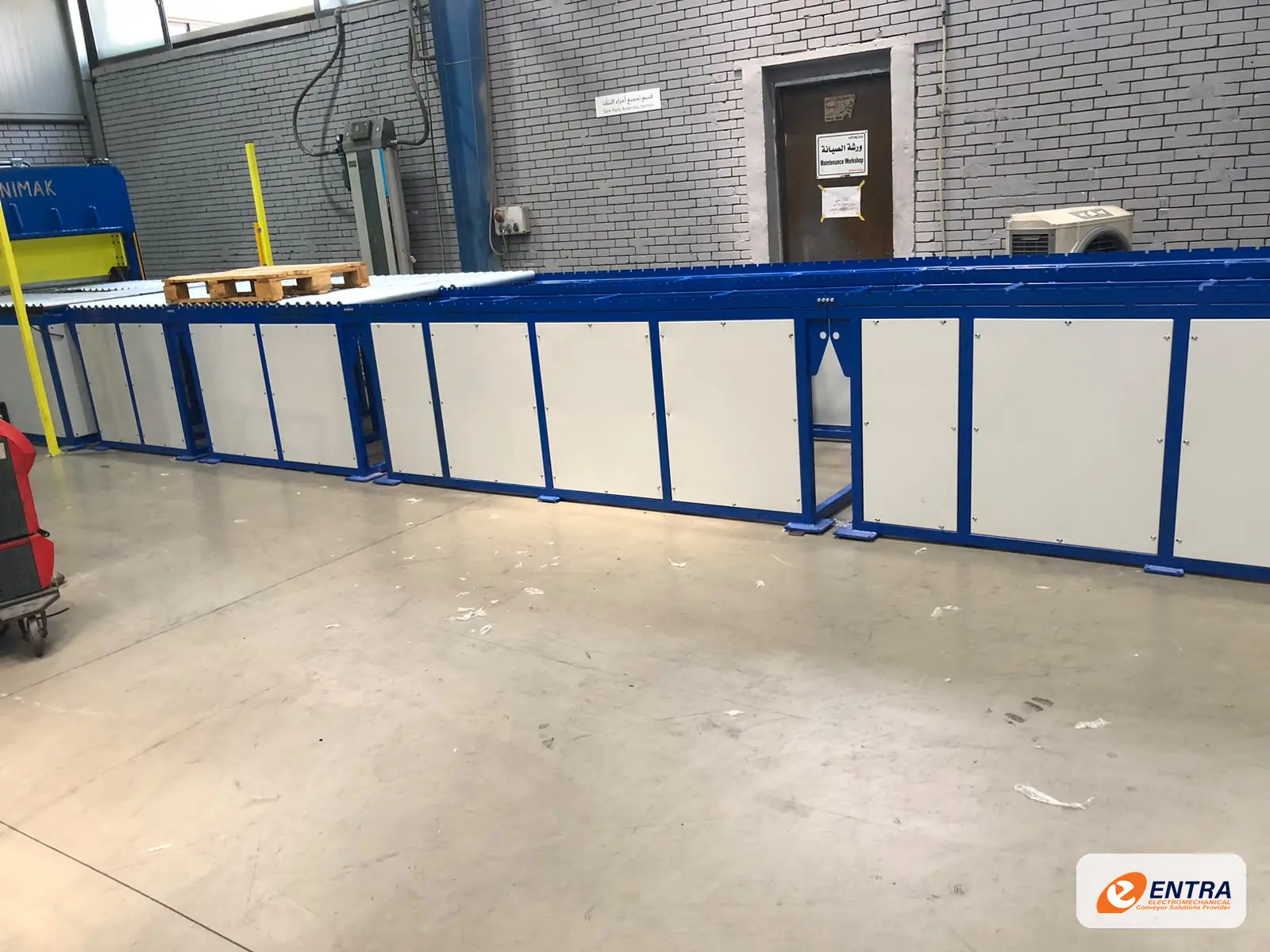
What conveyors do in a warehouse
In a warehouse or distribution centre, most labour is spent walking and carrying: taking cartons from trucks to storage, from storage to picking, from picking to packing and from packing to the dock. Conveyors replace a large share of that walking with a controlled, continuous flow. They also make the flow visible and measurable, because every carton passes known points at known times.
Warehouse conveyors handle mainly cartons, cases, totes and parcels, and at the ends of the flow, pallets. The equipment families are the same as in factories (powered and gravity roller conveyors, belt conveyors, transfers, vertical conveyors and sorters) but the design priorities are different: variable product mixes, peaks in order volume, frequent layout changes and integration with warehouse software.
Conveyors process by process
Receiving
Extendable belt or roller conveyors reach into the truck so that cartons are unloaded at waist height and carried directly into the building. A scanning point after the dock identifies each carton and routes it to storage, cross-docking or quality control.
Put-away and replenishment
Conveyors carry cartons or totes to storage zones, mezzanine levels or automated storage. Vertical conveyors and spiral conveyors move loads between levels in a small footprint.
Picking
In “person-to-goods” picking, a conveyor runs along the pick aisles and carries order totes or cartons from zone to zone, while pickers fill them from shelving or carton flow racks; the totes skip zones that have nothing to pick. In “goods-to-person” systems, conveyors or automated storage bring the stock to a fixed picking station, so pickers no longer walk.
Packing
Gravity or powered roller conveyors bring orders to packing benches at a comfortable height and take packed cartons away. Weighing, labelling and inspection points can be built into the line.
Sorting and dispatch
Sorters split the outgoing flow by route, customer or truck. Sorters are one of the unit-load handling equipment types covered by EN 619, alongside the conveyors and transfer devices that feed them [1] [2]. Simple diverters and right-angle transfers suit moderate volumes; dedicated high-speed sorters suit large parcel flows. At the dock, extendable conveyors load trucks directly.
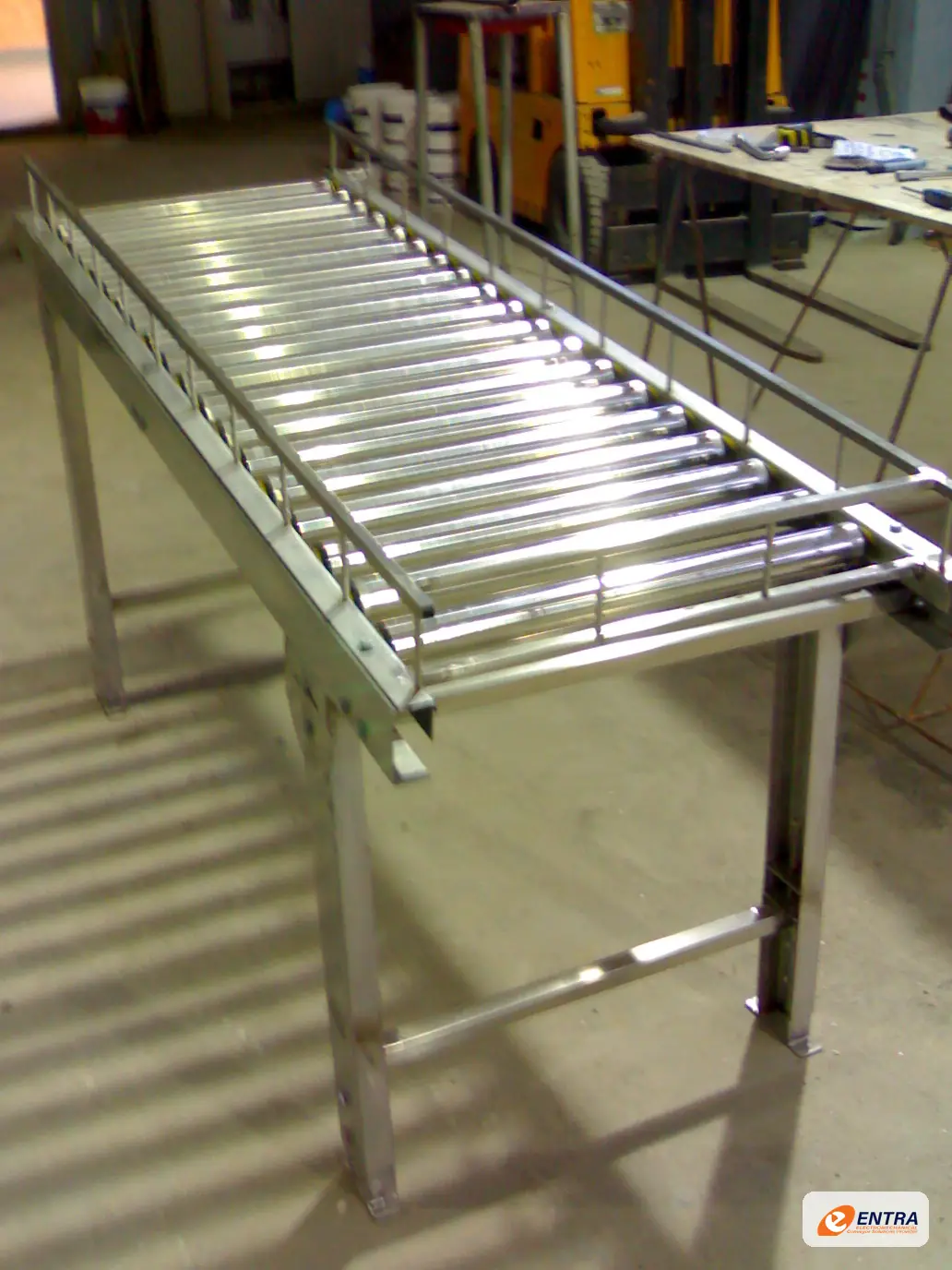
Conveyor types used in warehouses
| Type | Role | Notes |
|---|---|---|
| Motor-driven roller (24 V) | Main transport and accumulation of cartons and totes | Zero-pressure zones, quiet, runs only where products are present [3] |
| Belt-driven live roller | Transport with low-pressure accumulation | Simple, economical for steady flows |
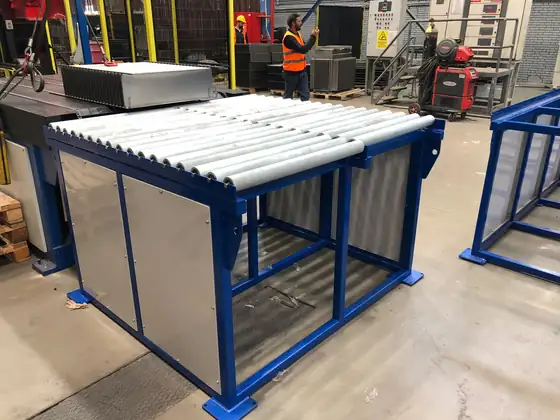
| Gravity roller and carton flow | Packing stations, buffers, pick faces, truck loading | No power; speed and end stops need care |
| Belt conveyor | Inclines, declines, small or unstable items, parcels | Belt surface chosen for incline angle |
| Curves and spurs | Changes of direction, merges | Tapered rollers keep cartons aligned |
| Transfers and diverters | Routing to zones and lanes | Must handle the full carton size range |
| Vertical and spiral conveyors | Level changes | Small footprint; spirals also buffer |
| Extendable conveyors | Truck loading and unloading | Reduces carrying inside containers |
| Pallet conveyors | Inbound and outbound pallets | See pallet conveyor systems |
How to plan a warehouse conveyor system
- Profile the orders. Orders and order lines per day and per peak hour, units per line, carton and tote sizes and weights, share of conveyable and non-conveyable items.
- Define the process. Which steps the conveyor will serve: receiving, picking, packing, sorting, dispatch. Where people work, and where loads are stored.
- Calculate rates. Cartons or totes per hour at each point, including peaks. From rate and carton spacing come conveyor speeds and the number of sorter outlets; see speed and throughput calculations.
- Lay out the routes. Shortest practical paths, no crossings with forklift aisles where possible, crossovers or lift gates for pedestrians, space for future lines.
- Choose the conveyor types for each section from the table above.
- Design the controls and data. Scanners, routing logic and the interface with the warehouse management system.
- Plan safety and maintenance access from the first layout.
- Plan for growth. Reserve space and capacity in drives, panels and software for the next stage.
Benefits and what to measure
- Less walking and carrying: measure walking distance and carrying per order before and after.
- Ergonomics: cartons arrive at a working height instead of being lifted from the floor. Manual lifting limits are set by ISO 11228-1 [4].
- Throughput and peak capacity: orders per hour without adding staff at peaks.
- Accuracy: scanning and routing reduce mis-sorts.
- Visibility: each carton’s position is known, which supports tracking and planning.
Our article on reducing handling costs through conveyor automation explains how to turn these effects into a payback calculation.
Common pitfalls
- Designing for the average day. Peak seasons and end-of-month peaks decide the capacity.
- Non-conveyable items. Very small, very large, round or soft items need totes or a separate flow.
- No space for growth. A conveyor squeezed between columns and racking is hard to extend.
- Software as an afterthought. Routing logic and the interface with warehouse software must be designed with the mechanics.
- Curves and merges at full speed. Tapered-roller curves have speed limits and merges need gap control; see gravity vs powered roller conveyors.
Worked example: sizing a picking-to-packing conveyor
Illustrative example, not an ENTRA project
A warehouse ships 6,000 order cartons in an 8-hour shift on a normal day and plans for a peak of 9,000. Peak hourly rate, allowing for an uneven day with the busiest hour 1.3 times the average: 9,000 / 8 × 1.3 ≈ 1,460 cartons per hour, or about 24 per minute. Cartons are up to 600 mm long and the scanner needs a 300 mm gap, so the pitch is 0.9 m. Minimum conveyor speed: 24 × 0.9 ≈ 22 m/min. With a margin for gaps that are larger than ideal, the main line is designed for about 30 m/min, and merges are checked to ensure they can insert cartons into the gaps at that rate.
Controls and software integration
- Identification: each carton or tote carries a barcode or label that scanners read at decision points.
- Routing: the conveyor control asks the warehouse software where each item should go, or receives a routing table in advance.
- Confirmation: the conveyor confirms that the item arrived at its destination, so the software knows the order status.
- Exceptions: no-reads, overweight or unknown items go to a manual handling lane.
- Reporting: throughput per hour, stoppages and exception rates help supervisors manage the shift.
Agreeing these interfaces early is as important as designing the conveyors; see conveyor integration.
Start small, grow in stages
Warehouse automation does not have to start with a large investment. A conveyor from the picking area to packing, or an extendable conveyor at the busiest dock, often pays back quickly and proves the concept. A well-planned first stage, with space and control capacity reserved, can then be extended as volumes grow.
Frequently asked questions
What conveyors are used in warehouses?
Mainly powered roller conveyors and belt conveyors for cartons and totes, gravity roller conveyors at packing and loading points, inclines and declines between levels, curves and transfers, and sorters where orders are split by destination.
Is a conveyor system worth it for a small warehouse?
It depends on volumes, distances and labour cost. A simple conveyor line from picking to packing or to the loading dock can pay back where staff walk long distances or handle heavy cartons all day. Measure the current flow first.
Can warehouse conveyors be extended later?
Yes, if the layout, controls and power distribution are planned for it. Modular conveyor sections and zone-controlled roller conveyors make extension and re-layout easier.
What information is needed to design a warehouse conveyor?
The range of carton and tote sizes and weights, order and line volumes at peak, building drawings, process steps, the systems the conveyor must exchange data with, and the planned growth.
Sources and references
- BSI, Increasing the safety of continuous handling equipment and systems (EN 619:2022 explained). Checked 28 Nov 2026.
- EVS, EN 619:2022 Continuous handling equipment and systems — Safety requirements for equipment for mechanical handling of unit loads. Checked 28 Nov 2026.
- MH&L, 24-volt conveyor line conserves power (zone activation and zero-pressure accumulation). Checked 28 Nov 2026.
- ISO, ISO 11228-1:2021 Ergonomics — Manual handling — Part 1: Lifting, lowering and carrying. Checked 28 Nov 2026.
Sources are listed for technical accuracy. Names of standards bodies, regulators and manufacturers appear only to credit the source; ENTRA does not claim their products or specifications as its own.

Mechanical, electrical and controls engineers at ENTRA Electromechanical, Cairo. Since 2007 the team has designed, supplied, installed and maintained conveyor and material-handling systems for plants in Egypt and the Arab region. About ENTRA
Researched and drafted with AI assistance from the sources listed above, checked by recalculating every worked example, and published by the ENTRA Engineering Team.
Copyright © 2026 ENTRA. All Rights Reserved. Text, calculations and original graphics on this page may not be reproduced without permission.
Related articles
 Material Handling & Automation
Material handling systems: a complete guide to industrial material flow
How to map, measure and improve material flow in a factory or warehouse, and how conveyors, lifts and handling equipment form one system.
 Material Handling & Automation
Accumulation conveyor systems: improving production flow and reducing bottlenecks
How accumulation conveyors buffer products between machines, zero-pressure vs low-pressure accumulation, and how to size a buffer.
 Conveyor Engineering
Roller conveyor systems: gravity vs powered roller conveyors
Gravity and powered roller conveyors compared: how each works, the drive options and how to choose the right roller conveyor for cartons, totes and pallets.
