What an industrial conveyor system does
An industrial conveyor system moves products or materials along a fixed path, continuously or in a controlled sequence, between the points where they are made, processed, packed, stored or dispatched. European safety standards call this family “continuous handling equipment” and group it into equipment for bulk materials and equipment for unit loads [1]. The distinction is a useful starting point for any project:
- Unit loads are individual items: bottles, cans, cartons, cases, trays, totes, bags, pallets and machine parts. They are counted.
- Bulk materials are loose materials such as grain, powders, granules, sand, ore and chemicals. They are measured by volume or mass per hour.
A conveyor is rarely a stand-alone machine. In a production line it links fillers, cappers, labellers, cartoners and palletisers; in a warehouse it links receiving, storage, picking, packing and the loading dock. Choosing the right conveyor therefore starts with the product and the process, not with a catalogue.
The main types of industrial conveyor
The European standard for unit-load handling equipment lists belt conveyors, carrying chain conveyors, plate conveyors, overhead conveyors, gravity and driven roller conveyors, transfer cars, vertical and horizontal transfer devices and sorters among the equipment it covers [1]. In practice, most factory and warehouse projects use the following families.
Belt conveyors
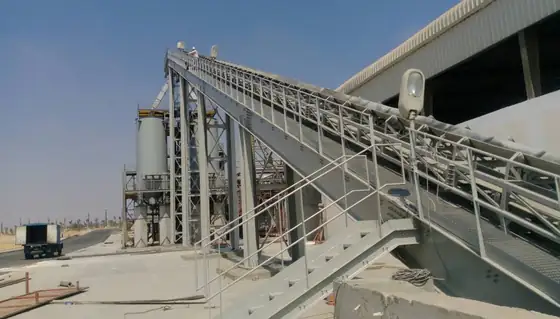
A continuous belt runs between a drive drum and a tail drum and is supported by a slider bed or by rollers. Belt conveyors handle small, soft, irregular or unstable products, bags and loose material, and they work well on inclines and declines. Light fabric belts with PVC or polyurethane covers are used for unit goods and processing [6]; heavier rubber belts on troughed idlers carry bulk materials. See our guide to belt conveyor design and components.
Roller conveyors
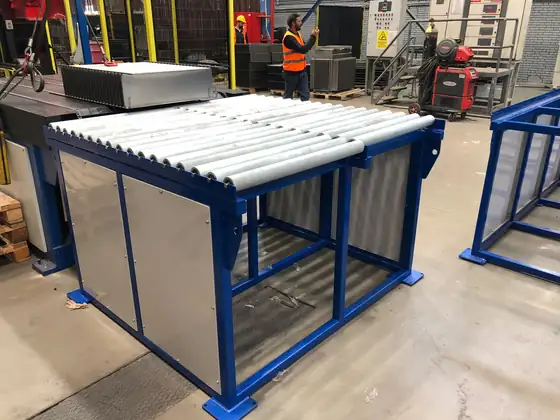
Products ride on a series of rollers, either free-turning (gravity) or driven by chains, belts or motor rollers. Roller conveyors are the standard choice for cartons, totes, trays and pallets with a firm, flat base. A product must be supported by at least three rollers at any time [5], so very small or soft items are usually better on a belt. Driven roller conveyors make accumulation, merging and diverting straightforward. Our article on gravity vs powered roller conveyors compares the options.
Chain and slat conveyors
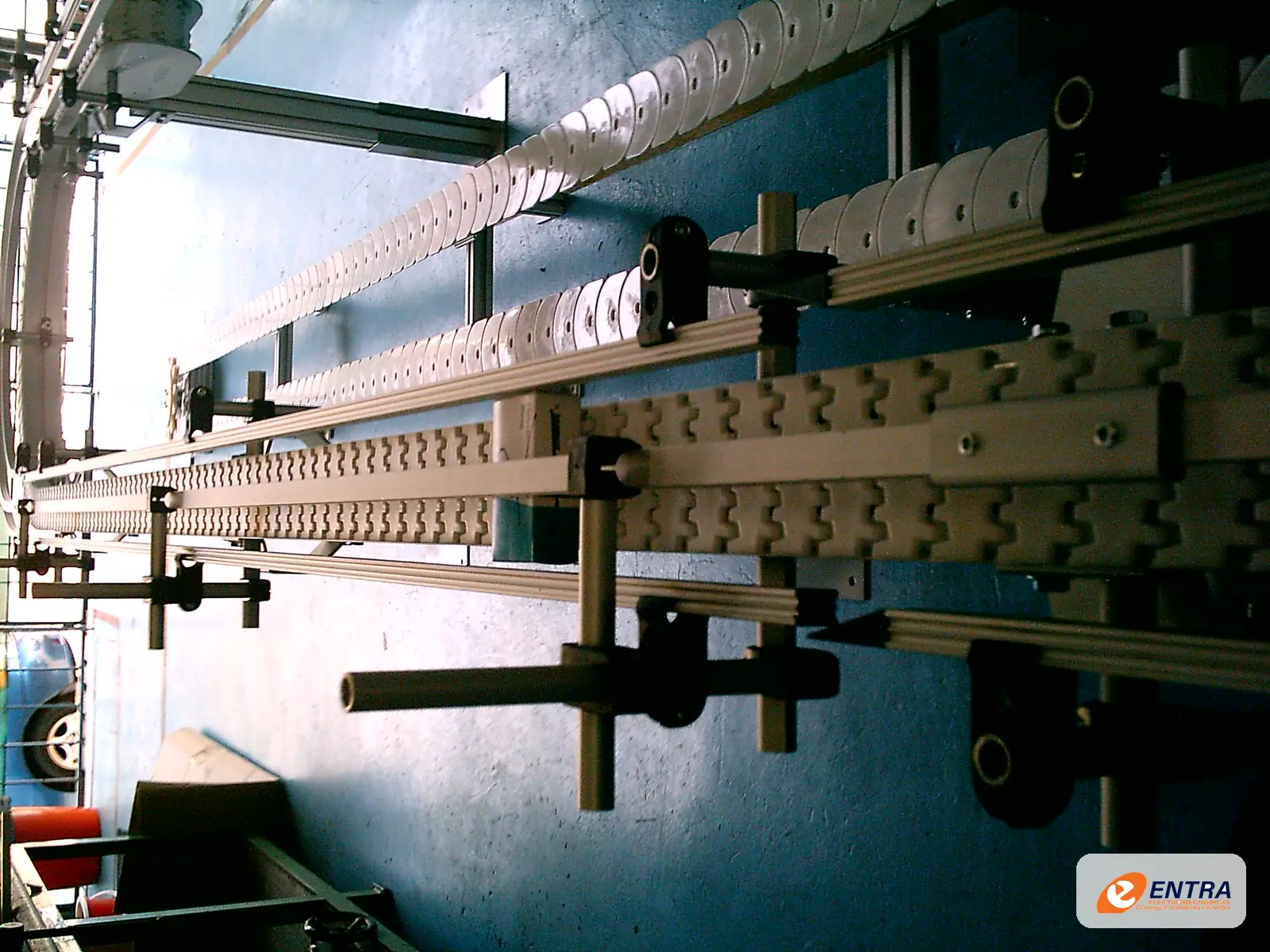
Products stand on a chain or on slats carried by a chain. Narrow table-top chains in steel or plastic are the backbone of bottling and packaging lines; heavy roller chains carry pallets and engine blocks; drag chains pull bulk material through a trough. Chain conveyors are positively driven, so they suit accumulation, curves and long, controlled transport. Read more in chain conveyor systems.
Modular plastic belt and plastic-chain conveyors
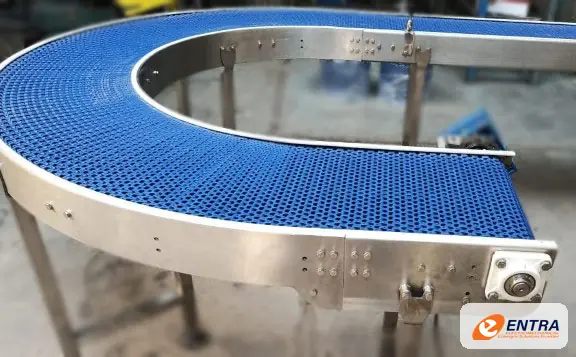
Belts built from interlocking moulded modules are driven by sprockets rather than by friction. They do not need tracking, they tolerate water and cleaning chemicals, and damaged modules can be replaced individually. Aluminium-frame plastic-chain systems can be reconfigured as a line changes. ENTRA has been the sole agent in Egypt for the MODU modular conveyor system since 2009. See modular belt conveyors.
Vertical, spiral, screw and special conveyors
- Vertical conveyors and elevators move unit loads between floors or mezzanines in a small footprint.
- Spiral conveyors change level gradually, and also act as a buffer, in a compact footprint.
- Side-gripper conveyors grip products between two belts to move them vertically or upside down, for example to rinse containers.
- Screw conveyors move powders and granules through an enclosed tube or trough and can also meter, mix or seal against dust.
- Overhead conveyors carry parts on hooks or carriers above the floor, freeing floor space in paint shops and assembly.
Quick comparison of conveyor types
| Type | Typical products | Strengths | Watch out for |
|---|---|---|---|
| Flat belt | Cartons, bags, small or irregular items, food | Continuous surface, inclines, quiet | Tracking, belt tension, slip on wet drums |
| Gravity roller | Cartons, totes with firm bases | No power, simple, low cost | Speed control, product spacing, slope |
| Driven roller | Cartons, totes, pallets | Accumulation, merges, diverts, zones | Product base, roller pitch, drive design |
| Table-top / slat chain | Bottles, cans, jars, packs | Positive drive, curves, accumulation | Lubrication, wear strips, chain elongation |
| Modular plastic belt | Food, wet or heavy products, wide flows | No tracking, washdown, repairable | Material choice, catenary, sprocket wear |
| Screw | Powders, granules, flakes | Enclosed, dust-tight, metering | Abrasion, material build-up, filling level |
| Vertical / spiral | Cartons, totes, packs | Level change in small footprint, buffering | Access, product stability, safety |
How to choose the right conveyor: seven questions
- What exactly is conveyed? Shape, base, dimensions, mass, stability, fragility, temperature, and the full range from the smallest to the largest product. The smallest product often decides the roller pitch or belt surface; the heaviest decides the structure and drive.
- How many, how fast? The required rate at normal and peak production, in products per minute, units per hour or tonnes per hour. From the rate and the product spacing you get the conveyor speed; see our speed, capacity and throughput calculations.
- What path must it follow? Distances, level changes, curves, merges, diverts, crossings with walkways and forklift routes, and the space available.
- What happens when something stops? Whether products must queue without touching (zero-pressure accumulation), whether a buffer is needed between machines, and how the line restarts.
- What is the environment? Food contact, washdown, dust, heat, cold, corrosive chemicals or explosive atmospheres decide materials, drives and electrical protection.
- How does it connect to people and machines? Manual loading heights and reach, machine infeed and outfeed heights, signals between conveyor and machine, and access for operators and maintenance.
- What does the future look like? New formats, higher rates and line extensions are much cheaper to accommodate if they are known at design stage.
Safety is part of the selection
Conveyors create nip points at drums, rollers and sprockets, shear points at transfers, and risks from falling or runaway loads. Machine safety follows a risk assessment and risk reduction process under ISO 12100, with guards designed to ISO 14120 and safety-related controls to ISO 13849 [4]. For bulk belt conveyors, EN 620 sets specific safety requirements covering design, setting, operation, maintenance and cleaning [2]; EN 619 does the same for unit-load handling equipment [3]. Even where these European standards are not mandatory, they are a sound basis for safe design in Egypt and the Middle East and are widely referenced by multinational clients.
Common selection mistakes
- Designing for the average product only. The smallest, lightest, tallest or wettest product is usually the one that causes jams.
- Ignoring the transfers. Most product damage and stoppages happen where one conveyor hands over to another, not along straight runs.
- No buffer between machines. Without accumulation, a short stop at one machine stops the whole line. See accumulation conveyor systems.
- Under-sized drives and structures. Start-up under full load, accumulation pressure and future rate increases must be included.
- Forgetting maintenance access. A conveyor that cannot be reached cannot be cleaned, adjusted or repaired safely.
Controls: from a start button to a connected line
The same mechanical conveyor can be controlled in very different ways, and the control level often decides how useful it is in practice.
- Simple start/stop: a motor starter, a local control station and an emergency stop. Enough for an isolated transport conveyor.
- Sensor-based logic: photo-eyes detect products and stop or start sections, so products do not pile up at the end of the conveyor.
- Variable speed: variable-frequency drives match the conveyor to machines, start smoothly and save energy at low load.
- Zone control: each zone runs only when the next one is free, giving zero-pressure accumulation on roller conveyors.
- Line integration: a PLC coordinates conveyors and machines, handles buffers, faults and restarts, and reports data to plant systems.
Choose the control level with the same care as the mechanics; see industrial automation and conveyor integration.
Typical conveyor mixes by industry
| Industry | Typical conveyor mix |
|---|---|
| Beverages and bottling | Plastic or stainless table-top chains, accumulation tables, side-gripper and vertical conveyors, case and pallet conveyors |
| Food processing | Hygienic belt and modular belt conveyors, stainless frames, spiral conveyors, screw conveyors for ingredients |
| Personal and home care | Plastic-chain conveyors between fillers, cappers and labellers, case conveyors, palletiser infeeds |
| Chemicals and fertiliser | Bulk belt conveyors on steel structures, screw conveyors, bag conveyors |
| Warehousing and distribution | Motor-driven roller conveyors, belt inclines, sorters, extendable conveyors |
| Engineering and assembly | Pallet-carrier systems, roller and chain conveyors, overhead conveyors |
Think about the whole life of the conveyor
The purchase price of a conveyor is only part of its cost. Over its life, energy, maintenance, spare parts, cleaning time and, above all, downtime of the line it serves usually cost more. When comparing options, ask how many drives, bearings and wear parts each design has, how long a belt or chain change takes, how easily it can be cleaned, and how efficient the drives are. A design with fewer transfers, efficient gearmotors and standard components often costs a little more to buy and much less to own.
How ENTRA approaches conveyor selection
ENTRA has worked as a turnkey conveyor provider in Egypt since 2007. Our mechanical, electrical and controls engineers start by studying the current line and the product, then propose a solution that shortens the material path and removes handling losses, and finally supply, install and support it. Most lines combine several of the conveyor types above; the right mix depends on your product, your rate and your building. Our step-by-step guide to designing a conveyor system for a manufacturing facility explains the full process.
Frequently asked questions
What are the main types of industrial conveyor?
The most common are belt conveyors, roller conveyors (gravity and powered), slat and plastic-chain conveyors, modular plastic belt conveyors, screw conveyors for bulk powders and granules, bucket elevators, vertical and spiral conveyors, and overhead conveyors. Each is suited to a different product shape, weight, rate and environment.
How do I choose between a belt conveyor and a roller conveyor?
Roller conveyors suit products with a firm, flat base such as cartons, totes and pallets, and make accumulation and transfers easy. Belt conveyors suit small, soft, irregular or loose products, inclines and declines, and products that would fall between rollers.
What information does a conveyor supplier need for a quotation?
Product type, dimensions and weight (smallest and largest), the required rate, the layout with distances and heights, the environment (temperature, washdown, dust, food contact), how the conveyor connects to machines, and the power supply available.
Can one conveyor line combine several conveyor types?
Yes. Most production and packaging lines combine types: for example plastic-chain conveyors at a filler, a belt incline to a mezzanine, roller accumulation before palletising and a pallet conveyor at the end of the line.
Sources and references
- BSI, Increasing the safety of continuous handling equipment and systems (EN 619:2022 explained). Checked 28 Nov 2026.
- BSI, BS EN 620:2021 Continuous handling equipment and systems — Safety requirements for fixed belt conveyors for bulk materials. Checked 28 Nov 2026.
- EVS, EN 619:2022 Continuous handling equipment and systems — Safety requirements for equipment for mechanical handling of unit loads. Checked 28 Nov 2026.
- Pilz, Overview of generic machine-safety standards (EN ISO 12100, ISO 13849, ISO 14120, ISO 14119, IEC 60204). Checked 28 Nov 2026.
- Interroll, Conveyor rollers – General technical information / planning basics, Catalogue pages 184–203, edition 01. Checked 28 Nov 2026.
- ISO, ISO 21183-1:2005 Light conveyor belts — Part 1: Principal characteristics and applications. Checked 28 Nov 2026.
- ENTRA Electromechanical, About ENTRA (company history, scope and certifications as published by ENTRA). Checked 28 Nov 2026.
Sources are listed for technical accuracy. Names of standards bodies, regulators and manufacturers appear only to credit the source; ENTRA does not claim their products or specifications as its own.
Mechanical, electrical and controls engineers at ENTRA Electromechanical, Cairo. Since 2007 the team has designed, supplied, installed and maintained conveyor and material-handling systems for plants in Egypt and the Arab region. About ENTRA
Researched and drafted with AI assistance from the sources listed above, checked by recalculating every worked example, and published by the ENTRA Engineering Team.
Copyright © 2026 ENTRA. All Rights Reserved. Text, calculations and original graphics on this page may not be reproduced without permission.
Related articles
 Conveyor Engineering
Belt conveyor systems: design, components, working principles and applications
How a belt conveyor works, what each component does, the design choices that matter, and where belt conveyors fit in food, packaging and bulk plants.
 Conveyor Engineering
Roller conveyor systems: gravity vs powered roller conveyors
Gravity and powered roller conveyors compared: how each works, the drive options and how to choose the right roller conveyor for cartons, totes and pallets.
 Industrial Solutions & Business
How to design an efficient conveyor system for a manufacturing facility
A step-by-step conveyor design process for factories: data, rates, layout, conveyor choice, controls, safety, installation and acceptance.
